Missouri governor issues executive order for Flock, other cameras. See new rules
Published in News & Features
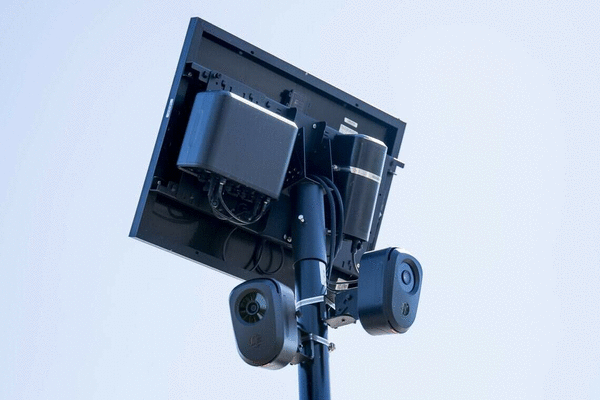
KANSAS CITY, Mo. — Not long after Parkville suspended its automated license plate reader cameras, Missouri Gov. Mike Kehoe has created new policies regarding how the cameras are used statewide.
Kehoe issued an executive order Wednesday regarding the use of Flock and similar ALPR cameras in Missouri, establishing safeguards to “prevent the misuse of the personal location data of Missourians while preserving legitimate law enforcement uses of the technology,” according to a news release.
Executive Order 26-18 directs the Missouri Department of Public Safety to establish statewide safeguards for state agencies and state-funded local law enforcement using ALPR technology. The release said that until the General Assembly establishes a permanent statutory framework, the executive order requires the following minimum standards:
— Requiring most license plate and vehicle data to be permanently deleted within 30 days
— Prohibiting vendors from selling, sharing or commercializing Missouri-generated data
— Limiting the use of ALPR technology to legitimate criminal justice and lifesaving purposes
— Requiring accountability measures to prevent and penalize misuse
— Prohibiting the integration of artificial intelligence facial recognition technology with ALPR systems.
Kehoe said in the release that protecting citizens also means protecting their constitutional rights, and the “unchecked collection and indefinite storage of location data belonging to law-abiding citizens raises substantial, valid constitutional and privacy concerns.”
The news release stated that Kehoe is the first governor in the U.S. to “take action that protects the privacy of citizens while preserving the legitimate law enforcement uses of the technology.”
“The government should not be building a permanent record of where law-abiding Missourians go, who they visit or how they live their daily lives,” Kehoe said. “This executive order is the first step in creating safeguards against abuse of this data, while still understanding the benefits of these vital public safety tools for law enforcement.”
Any misuse of Flock and other ALPR technology will be reported to the director of the Missouri DPS for immediate disciplinary proceedings.
There are currently more than 1,500 Flock and other ALPR cameras in the Kansas City area. Fifty-four of these are in Lee’s Summit, according to the city’s Flock web portal.
Kehoe’s order comes as national pushback grows regarding the use of Flock and other ALPR cameras from law enforcement and other organizations.
“Automatic license plate readers have the potential to create permanent records of virtually everywhere any of us has driven, radically transforming the consequences of leaving home to pursue private life, and opening up many opportunities for abuse,” the American Civil Liberties Union previously said in a statement.
What do Flock cameras track?
Flock cameras can record the following data when a car passes by:
—License plate number
—Vehicle make, model, color and body type
—Date, time and general location of detection.
Recent cameras also have additional technology to detect gunshots and crashes, along with sending drones that respond to 911 calls within 90 seconds.
“License plate recognition technology is important because in many cases, a license plate number is a crucial piece of evidence law enforcement can use to pursue an investigation,” Flock said on its website. “A license plate is objective, actionable and discrete.”
Flock said the cameras are used by public safety agencies, neighborhood homeowners associations, business managers and college campuses across cities in the United States. Any information is automatically deleted after 30 days unless local law requires something different, according to Flock.
Authorized users can search for vehicles using license plate numbers or the vehicle’s attributes noted in the data, Flock said. They can also receive alerts when a specific vehicle of interest is detected, such as a stolen vehicle.
Missouri Department of Public Safety Director Mark James said in a statement that these cameras have proven to be a valuable tool for law enforcement agencies to use in their efforts to catch violent criminals, recover stolen vehicles and find missing or endangered people.
“With this executive order, Governor Kehoe is making it clear that the state must establish a clear, accountable legal framework that equips law enforcement personnel with modern technology while also safeguarding the fundamental privacy rights and civil liberties of Missouri citizens,” James said in a statement.
“Our department looks forward to collaborating with state and local law enforcement agencies, as well as the members of the Missouri General Assembly, to put this executive order into action.”
_____
©2026 The Kansas City Star. Visit kansascity.com. Distributed by Tribune Content Agency, LLC.





Comments