NYC student screen-time restrictions don't go far enough, City Council members say
Published in News & Features
NEW YORK — Amid a reckoning on digital devices in the classroom, the New York City Council called for further reforms to reduce screen time in public schools during a hearing Tuesday.
Earlier this month, Mayor Zohran Mamdani unveiled a sweeping education technology policy, including a one-year ban on artificial intelligence until high school and devices like Chromebooks for each student through second grade. Local officials also recommended daily screen-time limits of 30 minutes for grades 3 to 5, and 45 minutes in middle schools.
It was the second major tech reform to hit local classrooms since the COVID-19 pandemic supercharged children’s reliance on technology: Gov. Kathy Hochul’s school cell phone ban took effect statewide last school year.
“We thought we were sending our kids back (after the pandemic), and the laptops were going to close,” said Danielle Giunta, the first deputy chancellor of the public schools. She said the current moment — the national debate, emerging research and public feedback — has led school leaders to take a closer look at the rapid expansion of education technology.
“This is a seismic shift,” said Giunta, acknowledging that schools are “so entangled” in the use of digital devices.
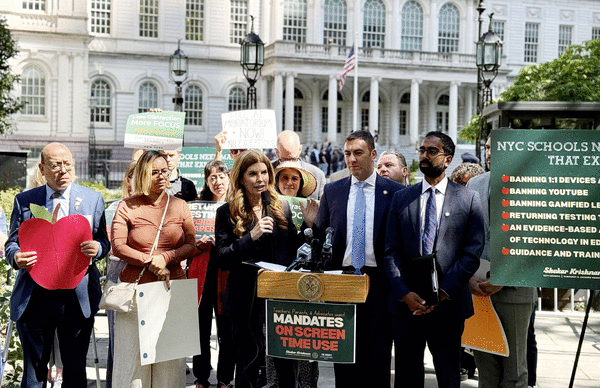
Ahead of the hearing, local lawmakers and advocates previewed their ideas for improving the policy during a rally at City Hall Park.
“Part of the problem is, it’s baked into the system,” Council Speaker Julie Menin, D-Manhattan, said at the rally. “Our students are taking standardized tests online, and so they have to prepare for them that way, as well. And even for homework, students use digital platforms to submit it.”
“Now, look, we know that a limited dose of digital tools can be helpful,” Menin added. “But too much screen time comes with severe consequences.”
Council members, led by Shekar Krishnan, D-Queens, and Eric Dinowitz, D-Bronx, said the ban on individual screen time should be extended through fifth grade and prohibit elementary students from taking home the school-issued device. (Group screen time, such as the use of a smart board by a teacher, is not covered by the policy.)
The lawmakers also called on the public schools to return digital tests to pencil and paper, and help them push the New York State Education Department to ditch computer-based exams, too. (Digital assessments are exempt from the restrictions.) The use of educational video games and YouTube should be restricted, as well, the two councilmen said.
As for YouTube, restrictions that prevent students from logging into the video-sharing platform took effect last Wednesday before the first day of school, school officials revealed during the hearing.
“We couldn’t agree more, actually,” Giunta said. “We have, in fact, turned off the access to the unfettered version of YouTube and kept sacred just a very limited educational purpose.” (There is an exception for educational videos embedded into Google Classroom for a lesson.)
Council members also questioned the school system’s move to ban screen time through second grade, but only issue recommendations in the third through eighth grades. Decisions around high school screen time were left up to individual principals.
“My concern is different school districts, different schools will implement these recommendations in different ways,” Krishnan said. “They’re not all on a level playing field.”
The Council’s push comes after a majority of members joined a call in June for an AI moratorium, which would have been two years and extended through high school.
Instead, the Mamdani administration opted for limited AI use in ninth through 12th grade. Those include career programs and five high school AI pilots, which are expected to launch in November, officials estimated during the hearing. Students in the older grades are also required to complete a short module or longer course in AI literacy, depending on how much of the new technology a given high school plans to use.
A working group will meet over the next school year to issue a report that will shape the policy going forward.
“I think it’s clear that both there have been changes to policy made, that you’re listening — but that there’s also a lot more to do,” Dinowitz said.
_____
©2026 New York Daily News. Visit nydailynews.com. Distributed by Tribune Content Agency, LLC.






Comments