The Iran war is costing taxpayers up to $3 billion per month as Democrats make it a campaign issue
Published in News & Features
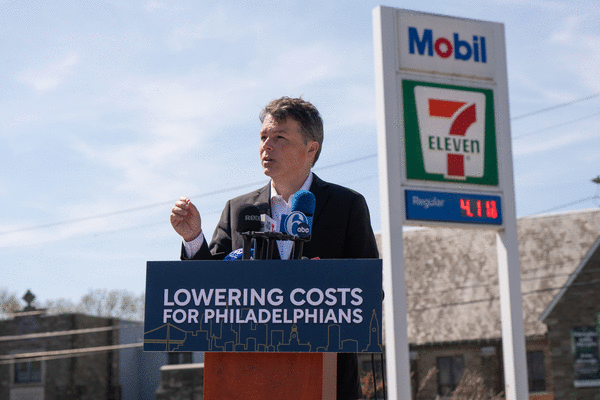
The war in Iran is costing the United States up to $3 billion per month and has tallied more than $38 billion in direct costs to the government since it began more than six months ago and became a flashpoint in voters’ frustrations over rising prices, according to a new and nonpartisan analysis requested by U.S. Rep. Brendan Boyle (D., Phila.).
The estimate, released Tuesday by the Congressional Budget Office, mostly represents munitions expenses as of Aug. 1. It does not include some other direct and indirect costs — such as the spike in gas prices felt by consumers — that likely make the total price tag for Americans far higher.
But with the war on the minds of voters during the midterm elections this fall, the latest tally is the one of the clearest signs yet of the conflict’s impact on taxpayers.
“It is now concrete evidence that when the administration was pretending like there wasn’t going to be a real cost to this war, they were wrong,” Boyle said in an interview Tuesday. “We have now paid $40 billion, and climbing, on the most reckless decision to go to war of at least my lifetime. So as the people go to the polls this November, they need to recognize that if they are voting for the president’s party, they’re voting for more of this.”
The top Democrat on the House Budget Committee, Boyle requested the analysis in the first days of the conflict — when President Donald Trump said the campaign would last for four or five weeks. The president and his allies said the goals were to root out Iran’s regime and dismantle its capacity to build a nuclear weapon.
Democrats and other critics warned of a reckless and potentially yearslong conflict.
Trying to win control of the House and Senate in the final two years of Trump’s term, they have largely framed their opposition to the war around the economic consequences — marrying an affordability message around rising healthcare and grocery costs with one about gas prices, which are they say are even more directly connected to Trump’s actions.
Polls and interviews show that message could have an impact in the midterm elections this fall. In Pennsylvania, voters in four key battleground districts will decide whether to keep their Republican members of Congress, each of whom has supported the war to varying degrees.
“This mess must stop,” Uber driver Miguel Vazquez, 60, of Allentown, said last week while filling up his 2021 Mitsubishi Outlander with $4.53-per-gallon fuel.
The price of gas has remained elevated and also increased in recent weeks as fighting continues in the oil-rich region. On Tuesday, the average cost of a gallon of gas was $4.50 in Pennsylvania and $4.33 nationally.
The war in Iran and tariffs have made daily living and working “a nightmare” that can be fixed only by “regime change,” said Vazquez. He said he plans to vote for Democrat Bob Brooks, a challenger to freshman Republican U.S. Rep. Ryan Mackenzie, who represents a swing district that covers the Lehigh Valley and Poconos.
“The [Republican] Party listens to Trump, who put us in Iran and set tariffs — making gas, food and everything else expensive,” Vazquez said. “They have to go.”
The cost of war
The report from the Congressional Budget Office, where nonpartisan staffers analyze federal policy for lawmakers on both sides of the aisle, largely aligns with other estimates of the war’s costs so far.
The nearly $38.1 billion in direct costs that it notes as of Aug. 1 is slightly more than the $37.5 billion figure that Defense Secretary Pete Hegseth noted during congressional testimony in late July.
The CBO’s estimate includes $21.7 billion to replace expended munitions, $10.4 billion for additional flying hours — which refers to the cost of the military’s deployment of aircraft in the region — and $2.7 billion due to higher fuel prices. The agency was unable to determine other costs like the damage to U.S. facilities in the region or expenses related to diplomatic operations and foreign aid.
The overall price tag also does not include indirect costs that affect the U.S., such as inflation and interest rates — though it notes that both are impacted by the war. For instance, year-over-year inflation is expected to be 0.5 percentage points higher in the first quarter of 2027 because of the war.
Independent analysts have noted those indirect costs are significant.
An “Iran War energy cost tracker” from Brown University’s Watson School of International and Public Affairs shows the consumers have felt the brunt of nearly $107 billion in additional gasoline and diesel costs since the start of the war.
Mark Zandi, the chief economist at Moody’s Analytics and based in Chester County, in June pegged the cost at $1,000 for a typical American household. The war has also fueled inflation and led to expectations that the Federal Reserve will raise interest rates this year instead of cut them, he’s said.
“The net effect of the Iranian conflict on U.S. economic output is unclear at this time,” the CBO report states. “Higher prices erode the purchasing power of U.S. households and businesses, dampening consumption and investment growth. Conversely, supply disruptions increase demand for U.S. energy exports, spurring additional domestic energy production.”
The CBO report states that while the ongoing costs of the war are difficult to estimate, the U.S. military action is costing between $2 billion and $3 billion per month, depending on the level of hostilities.
Fighting in recent weeks has included the U.S. Central Command destroying five Iranian crude oil carriers after the Islamic Revolutionary Guard Corps targeted a U.S. Navy ship with ballistic missiles, the Central Command announced last week. Eighteen U.S. service members have died in the war and several hundred more have been wounded.
©2026 The Philadelphia Inquirer, LLC. Visit at inquirer.com. Distributed by Tribune Content Agency, LLC.





Comments