Ex-Colorado Bureau of Investigation analyst Missy Woods sentenced to 10 years in prison in DNA testing scandal
Published in News & Features
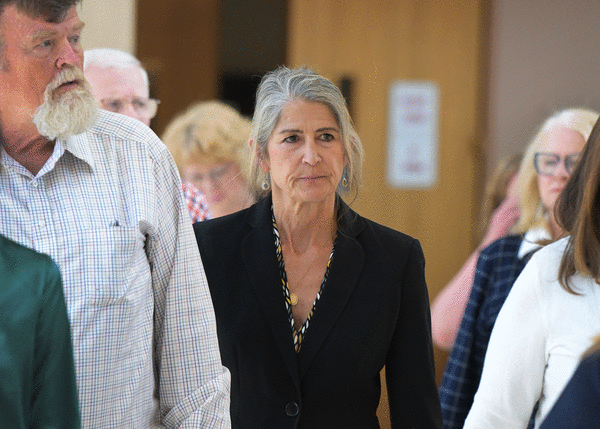
GOLDEN, Colo. — A Jefferson County judge sentenced former Colorado Bureau of Investigation scientist Yvonne “Missy” Woods to 10 years in prison Tuesday for her role in a years-long DNA testing scandal that shook confidence in the state’s criminal justice system.
“At its core, this case is about trust,” District Judge Andrew Poland said as he imposed the sentence. “The extraordinary trust placed in Ms. Woods, and her breach of that trust.”
Woods mishandled at least 1,045 criminal cases during her 29-year career as a DNA analyst at the CBI. She deleted, omitted and manipulated data to speed up the DNA testing process and boost her productivity, creating unreliable DNA testing results in hundreds of criminal cases.
“I know an apology cannot undo the harm or restore the trust that was lost,” Woods said in court. “For many years I was entrusted with evidence that could have profound consequences for defendants, victims, families and the courts. I failed that responsibility. I am deeply sorry for that failure.”
Woods’ defense attorney, Tom Ward, sought the minimum eight-year prison sentence for Woods, arguing that she took responsibility for her crimes and cooperated with investigators. He said Woods’ misconduct was clustered in a few years later in her career during which her caseload had doubled.
“The things she did in this case are serious and they merit punishment,” he said, “…but they do not erase all of the good things she did.”
In dozens of sexual assault cases, Woods falsely said she found no male DNA in her testing when she had in fact found male DNA, depriving investigators of information key to their cases and ultimately denying justice to victims, Chief Deputy District Attorney Darren Kafka said during Tuesday’s sentencing in Jefferson County District Court.
Kafka outlined 10 individual cases in which Woods lied about her DNA findings, including in the alleged sexual assault of a 4-year-old Pueblo girl, a woman who claimed she was raped in Rocky Mountain National Park, and an 88-year-old Denver woman who said she was sexually assaulted. In each case, Woods found male DNA but said she did not, and then covered her tracks by authoring false lab reports and making false changes to data, Kafka said.
“All of this created a mire of uncertainty and confusion that CBI and the state of Colorado as a whole will struggle to untangle, I suspect, for long after Ms. Woods’ sentence is discharged,” he said.
Ward said Woods discarded findings in cases that she believed “were going nowhere,” in an attempt to speed up CBI’s ability to test cases as the agency worked through backlogged sexual assault kit testing.
“It wasn’t her call to make, and she made it anyway, and that is why she is being sentenced today,” Ward said.
The 66-year-old former analyst pleaded guilty to four felonies in June, and as part of a plea agreement agreed to a prison sentence of between eight and 16 years. Woods pleaded guilty to committing a cybercrime, perjury, attempting to influence a public servant and forgery. At least 100 other counts against her were dismissed as part of the agreement.
The CBI’s investigation into Woods found she altered data from an evidence item in 156 cases, altered quality control samples in 520 instances, failed to document her work in 233 cases, failed to follow policy in 106 cases, and reported results that conflicted with her notes in 30 cases, Ward said. He noted that one act by Woods often impacted multiple cases, and said CBI found she acted intentionally to change data 227 times.
Kafka asked the judge to impose a sentence that would start to restore trust in Colorado’s criminal justice system by strongly condemning Woods’ crimes.
“Can we trust our criminal justice system?” he asked. “Or even to some, can we trust science? Sowing this doubt will be Ms. Woods’ legacy.”
The CBI’s internal investigation found that Woods took advantage of the state lab’s focus on results and productivity — as well as professional trust between colleagues — to hide her widespread manipulation of DNA data for years.
Several of Woods’ colleagues raised repeated ethical concerns about her work years before the scandal broke open — in 2014 and again in 2018 — but the CBI failed to stop her misconduct until an intern discovered a pattern of missing DNA data in Woods’ work in 2023, a failure of oversight that a Colorado judge in August found to be “outrageous government conduct.”
Woods resigned from the CBI in 2023 instead of being fired, and the agency spent 2024 sorting through her flawed work. Lawmakers passed a new law in 2025 that put additional guardrails on forensic testing in Colorado and opened up a specific legal path for people impacted by flawed testing to seek post-conviction relief in court.
Woods’ misconduct led to at least one overturned murder conviction — in the 1994 killing of Marty Grisham in Boulder — and has raised questions about the validity of hundreds of other convictions, with many post-conviction challenges underway in courts across the state.
-------------
©2026 MediaNews Group, Inc. Visit at denverpost.com. Distributed by Tribune Content Agency, LLC.





Comments