Brent oil surges near $100 as attacks halt Saudi energy sites
Published in News & Features
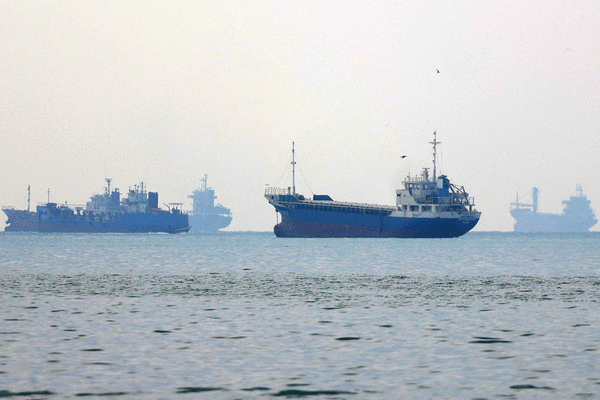
Brent oil approached $100 a barrel, before paring some of its gains, after Saudi Arabia said operations at several energy facilities in the kingdom’s south were halted by attacks.
The global benchmark was near $99, after rallying last week on a flare-up in Middle East hostilities and a pick-up in buying by China, the world’s largest importer.
The state-run Saudi Press Agency said the strikes took place Tuesday and wounded a number of people. Iran-backed Houthi militants said they again targeted the kingdom’s 400,000 barrel-a-day Jazan refinery and facilities that serve the domestic market. The Houthis are blockading Saudi Arabia’s oil flows in response to Riydah’s siege of the Yemeni capital, Sana’a, and have made repeated strikes in recent weeks.
The campaign against the largest producer in the Organization of the Petroleum Exporting Countries adds to concerns that oil supplies will continue to face disruption as a result of both Houthi attacks and the Iran war. Global inventories have been declining at a rapid pace, and prices for refined fuels like diesel are soaring around the world.
Brent oil is up more than 60% so far this year, while Europe’s diesel benchmark is closing in on $200 a barrel. That’s reinforcing concerns that central banks will have to raise interest rates to contain inflation.
Prices gave up some of its earlier gains after Iranian Foreign Minister Abbas Araghchi said “significant progress” has been made in talks with Oman over a temporary transit route through the Strait of Hormuz, during a call with his Japanese counterpart, according to a statement.
Iran had said earlier that an accord is imminent with Oman that will include a safe passage route, raising questions about how the U.S. would respond after striking Iranian tankers over the weekend. Tehran also warned that ships face the risk of attack near Oman on a route that the U.S. has been using to help vessels cross the waterway.
“Markets are increasingly pricing a prolonged Mideast conflict,” Goldman Sachs Group Inc. analysts including Daan Struyven said in a note, modestly raising the bank’s oil-price estimates on the assumption that shipping disruptions will persist into 2027. “Risks to our price forecast remain significantly tilted to the upside.”
As well as tensions in the Middle East, oil traders are increasingly honed on the outlook for refined fuels.
Russell Hardy, the boss of leading trader Vitol Group, said at a conference in Singapore on Tuesday that those markets are increasingly flashing signs of tightness. That’s in part because of the loss of about 2 million barrels a day of exports from the Middle East, and a further 2 million from Russia as a result of Ukraine’s drone attacks, he said.
Hardy estimated that oil flows through Hormuz are about 10 million barrels a day, about half of pre-war levels, but added that an exact figure is hard to quantify and volumes aren’t guaranteed to leave every day.
Meanwhile, Chinese crude imports strengthened in August, as cargoes from the Persian Gulf crept higher and refiners increased purchases from other sources, according to customs data on Tuesday. Higher purchases have allowed the nation to export more oil products, offering some relief to global markets.
Following the recent flare-up in hostilities, Iranian official Mohsen Rezaee said the “operational posture toward U.S. warships and bases has been fundamentally recalibrated.” The U.S. has been given “clear warning” about Iran’s missiles in recent days, the senior security official said in a post on X.
“We’ve seen so many twists and turns since late February, and every time we thought we were going to get somewhere, it has been ripped apart,” said Chris Weston, head of research at Pepperstone Group Ltd. “We’re back to almost square one.”
—With assistance from Bingyan Wang.
©2026 Bloomberg L.P. Visit bloomberg.com. Distributed by Tribune Content Agency, LLC.






Comments