Boston Mayor Michelle Wu sticking with center bus lane for Blue Hill Avenue over opposition: 'Not safe'
Published in News & Features
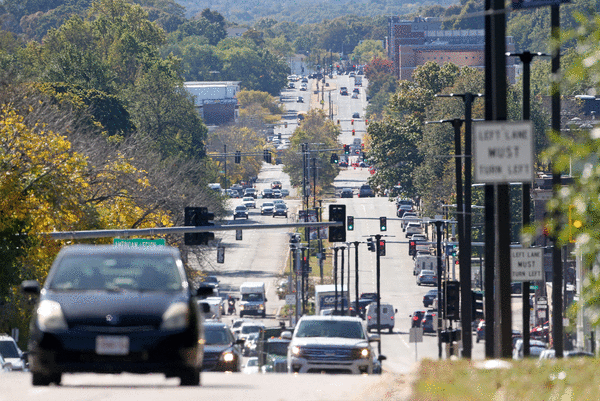
BOSTON — Boston Mayor Michelle Wu’s latest positive spin on the city’s $163 million redesign of Blue Hill Avenue didn’t do much to tamp down the community’s fierce opposition to a center-running bus lane that highlights the project.
Wu held an invite-only virtual press conference last week, which the Herald was not invited to attend and included an updated look at the city’s contentious redesign for Blue Hill Avenue. The major 4-mile street serves as Boston’s central spine, stretching through Roxbury and Dorchester and ending at Mattapan Square.
While Wu released a statement to the rest of the media several days later that said “community input has been critical to shaping a design that responds to the needs of the neighborhoods along Blue Hill Avenue,” critics of the plan say that’s not the case and the project has been rammed through over neighborhood opposition.
“The MBTA and the city has told us that they’ve been involved in meaningful engagement with the community, but from day one, only one option has been presented: the center-running bus lane,” Boston City Councilor Miniard Culpepper, who represents Roxbury, said last Thursday in a video posted to Facebook.
Culpepper said the planned center-running bus lane would create a “dangerous” situation for passengers who have to walk across the street to get on board.
“This is the only option that we have been given,” Culpepper said. “Our community deserves to be at the table, and not on the table when it comes to decisions that affect our daily lives, our livelihoods and our neighborhoods in the long-term. No center-running bus lane down Blue Hill Avenue. It’s just not safe.”
Reggie Stewart, a community organizer and former Roxbury-centric Council staffer, said the mayor’s community engagement process has been about giving residents a chance to help design a project the city has already decided to implement, rather than giving the community a chance to “reject the central policy choice.”
“This entire Blue Hill Avenue ‘community engagement’ process is a masterclass in political gaslighting,” Stewart posted to Facebook last Friday. “The central question has never simply been about where to put parking spaces, trees, loading zones or bus stops.
“The central disagreement is over the center-running busway itself. Yet that decision remains off the table while residents are invited to debate the details around it,” Stewart said.
He added that the Wu administration’s way of rolling out the information in a series of back-to-back meetings in affected communities over the next two weeks, beginning on Thursday, is “racist governance.”
Stewart said the rollout is designed to “distract, disperse, exhaust and overwhelm a coalition that is beginning to coalesce over shared concerns” about projects impacting Black communities: Blue Hill Avenue, White Stadium and Parcel P3.
“This is racist governance,” Stewart said. “And we need to get comfortable applying that word to what the Michelle Wu administration is choosing to do.”
A social media flyer is being distributed ahead of Thursday’s community meeting at Mattapan Town Hall that states a standout is being organized at the location with attendees encouraged to say “Hell no to center bus lane on Blue Hill Avenue.”
The flyer states that the project will worsen congestion by removing vehicular traffic lanes to allow for the center-running bus lane, hurt local businesses, make the area dangerous for all road users, and waste public funds.
Wu’s office distributed a press release Saturday that defends the center-running bus lane as a way to improve travel times for the 40,000 daily bus riders who travel on Blue Hill Avenue and ease congestion for all road users.
Her office said the design also includes a two-way, sidewalk-level bike path on the west side of Blue Hill Avenue, separated from traffic, to provide neighborhood cyclist connections to Franklin Park.
The latest updated design revealed last week to the city’s preferred media outlets “incorporates significant changes based on community feedback” from what was originally presented by the city two years ago, per Wu’s office.
Those changes include maintaining at least two general travel lanes in the majority of the corridor, a net increase in parking, including local parking solutions for high-demand areas like Morning Star Baptist Church. It also reflects additional investment in Blue Hill Avenue’s streetscape, with six miles of new sidewalks, 200 new accessible curb ramps, new street lighting, and 200 new street trees.
“This is a true once-in-a-generation opportunity to deliver on improvements that will enhance the quality of life and economic opportunity for our residents, small businesses, and community,” Wu said in a statement.
Roughly $124 million in local, state and federal funds have been secured for the project. Construction is set to begin in 2028.
-------------
©2026 MediaNews Group, Inc. Visit at bostonherald.com. Distributed by Tribune Content Agency, LLC.






Comments