Minnesota district leaders, federal officials wrangle over lawsuit concerning ICE activity near schools
Published in News & Features
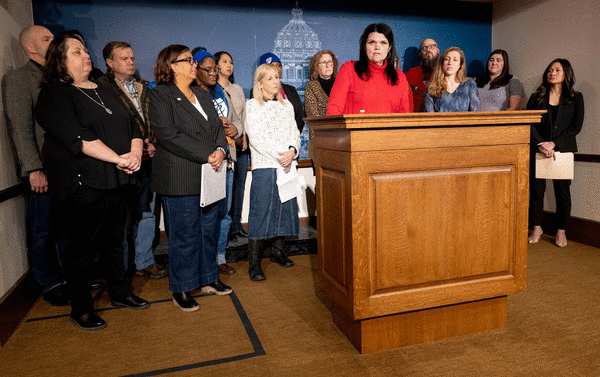
Weeks after the drawdown of federal immigration agents from Minnesota, schools are still seeing lower student attendance due to lingering fears — and that may not be resolved unless a judge reinstates a federal policy preventing agents from being near schools.
That was the argument school leaders made in court Wednesday, April 8, while attorneys for the federal government argued that such a change wouldn’t make a “meaningful impact on the immigration enforcement activity that the plaintiffs are complaining about.”
The proceeding was mostly back-and-forth legal wrangling in a case brought in February — at the height of Operation Metro Surge — by Fridley and Duluth schools, along with the state teachers union, against former Homeland Security Secretary Kristi Noem and top officials at Immigration and Customs Enforcement (ICE) and Customs and Border Protection.
The education groups are asking U.S. District Judge Laura Provinzino to effectively reinstate the federal government’s decades-old “protected areas” policy, which limited enforcement in sensitive locations including schools. That policy was rescinded in 2025.
The lawsuit alleges that lifting the policy caused attendance declines and disrupted schools’ ability to educate students, as leaders could no longer assure families that their children would be safe from immigration enforcement, with agents staging on school property and patrolling near bus stops and schools. Education Minnesota, the state’s teachers union, also had to divert resources to address educators’ fears, according to the lawsuit.
Provinzino repeatedly referenced a similar case brought by Denver Public Schools last year that was later dismissed. The judge said that the Minnesota case was “clearly different” in that it cited specific incidents where agents were on school property.
Federal officials have said that immigration agents do not target schools or children. In a February statement, then-Homeland Security Assistant Secretary Tricia McLaughlin said the Trump administration trusts agents to “use common sense” and make an arrest “if a dangerous illegal alien felon were to flee into a school, or a child sex offender is working as an employee,” the statement read. That situation, the statement said, “has not happened.”
When Jessica Lundberg, a Justice Department attorney representing Noem and the other ICE officials, told the judge that returning to the old “protected areas” policy “will not have a meaningful impact,” the education groups pushed back. They said parents’ and students’ fear — and the resulting attendance declines — could be linked to lifting the “protected” designation for schools.
“Operation Metro Surge was the megaphone that publicized the change in policy,” said Amanda Cialkowski, the attorney representing the plaintiffs. “But it was the change in the policy that causes the harm.”
Duluth Superintendent John Magas said the change created a “situation of chaos, fear and panic” in schools across the state, not just in the Twin Cities. And though the fear has lessened since the drawdown of federal agents in the metro area, educators and families are still worried it’s a “temporary calm.”
“There’s certainly not a sense that all is well,” Magas said, adding that a ruling reinstating the protected spaces policy could help ease some of the lingering fear.
Fridley Public Schools Superintendent Brenda Lewis said ICE agents have not been on school property in eight weeks, but the “impact is longstanding.” More than 70 students have not returned to class, Lewis said. Some enrolled into other districts or moved to other states they felt were safer, while others are in detention centers or chose to self-deport.
Because school funding is distributed per pupil and school meal funding is based on meals served at school, a decline in in-person learning hurts district’s budgets.
Cialkowski said Wednesday that she was pleased by the judge’s preparation and understanding of the case.
“We’re hoping to bring some relief to these guys,” she said, gesturing at the group of Minnesota school leaders attending the hearing.
_____
©2026 The Minnesota Star Tribune. Visit startribune.com. Distributed by Tribune Content Agency, LLC





Comments