Iran shoots down US fighter jet and hits energy sites in Arab Gulf states
Published in News & Features
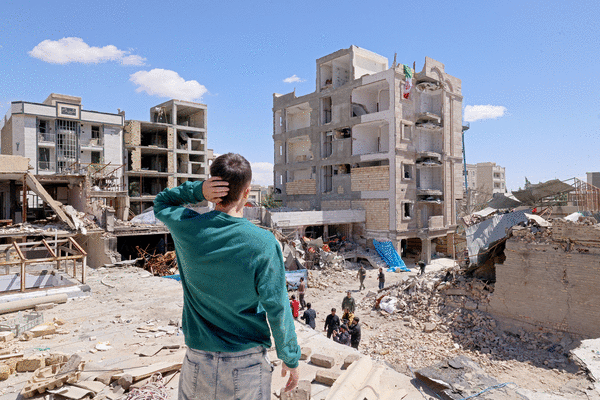
Iran shot down a U.S. fighter jet for the first time in the war and targeted more sites, including energy facilities, in Arab Gulf states overnight and into Friday.
The United States has rescued one of the crew members of the F-15E fighter jet, according to a U.S. official, who asked not to be identified discussing sensitive information. A search-and-rescue operation is underway for the second crew member, the official said.
President Donald Trump was briefed on the incident, the White House said.
U.S. Central Command didn’t respond to a request for comment.
The first known combat loss of a U.S. or Israeli fighter jet would mark a significant blow to the alliance after a war of almost five weeks that has triggered a global energy crisis.
Iran’s semi-official Tasnim news agency reported Friday that the country had shot down a “highly advanced American fighter jet.” Other Iranian media published photos showing what they said was wreckage of a downed jet.
The Iranian government is yet to comment on the incident.
Iran kept up attacks across the region after Trump renewed threats against Iranian infrastructure.
The United Arab Emirates’ largest natural gas processing facility, Habshan, suspended operations after debris from a projectile interception sparked a fire. Hours earlier, a drone attack set ablaze Kuwait’s Mina Al Ahmadi oil refinery, with a capacity of 346,000 barrels a day.
Kuwait also reported damage to a power and water desalination plant after an attack early Friday, and Saudi Arabia said it intercepted several drones in the early morning.
On Thursday, Trump posted a video of a destroyed bridge and said there would be “much more to follow” if Iran didn’t agree to a deal to end the almost five-week-old conflict, which has caused a global energy crisis.
Iran remained defiant, with Foreign Minister Abbas Araghchi saying strikes on civilian structures “will not compel Iranians to surrender.” The country has shown little sign of accepting Trump’s demands for peace and has laid out its own conditions — most of them unacceptable to the U.S. and Israel.
CNN reported that about half of Iran’s missile launchers are still intact — despite more than 12,000 U.S. and Israeli strikes since they began the war in late February — and that thousands of one-way attack drones remain in Iran’s arsenal. The assessment may include launchers that are currently inaccessible even if they are not destroyed, CNN said, citing sources familiar with the matter.
Trump signaled this week he may be willing to pull U.S. forces out of the conflict in two to three weeks, even if the vital Strait of Hormuz is still effectively shut. But he has vacillated in his messaging since then.
“With a little more time, we can easily OPEN THE HORMUZ STRAIT, TAKE THE OIL, & MAKE A FORTUNE,” Trump said early Friday in a post on Truth Social.
U.S. allies in Europe, the Middle East and Asia are stepping up efforts to ensure that the waterway — through which one fifth of the world’s oil and liquefied natural gas supplies normally flow — is reopened soon.
More than 40 of them met virtually Thursday to discuss plans, in a signal to Trump of their concern about the crisis triggered by the closure, with prices of energy and other commodities soaring in the past month.
The group was clear any ceasefire talks with Iran needed to include a solution for Hormuz, people familiar with the discussions said. Still, the meeting showed the coalition of countries deem it necessary to begin preparations for having to reopen the strait without the United States. Nations such as France and the United Kingdom have said military options are unlikely to work and a ceasefire is needed.
Bahrain, supported by Jordan and Arab Gulf states, is proposing a United Nations Security Council resolution aimed at helping reopen Hormuz, according to the UAE. It would provide “a clear legal basis for all states to mobilize and support safe passage,” the UAE said in a post on X.
Russia, an Iranian ally, pushed back on the initiative, with Foreign Minister Sergei Lavrov saying Friday the measure would “legitimize aggression against Iran.” The comments signal Moscow may use its veto power, as one of five permanent members of the U.N. Security Council.
Hormuz remains all but shut. Iran appeared to tighten its grip on Thursday when its media reported that the government is drafting a protocol with Oman to monitor traffic. That would require shippers to pay tolls to Iran, according to the country’s deputy foreign minister.
Oman, which sits on the other side of the strait from Iran, is yet to comment on the reports.
The passage is officially in international waters and any attempt by Iran to assert control over traffic will be strongly opposed by Western powers and Gulf Arab states.
A trickle of ships is managing to pass through. A container ship signaling French ownership recently exited the Persian Gulf, in what appears to be the first known transit by a vessel linked to Western Europe since the war began, Bloomberg reported.
In another unusual move, an LNG tanker made the passage hugging the Omani coastline instead of taking the northerly route at Tehran’s behest.
Trump has swung between casting diplomatic efforts as productive, and threatening further destruction — including on civilian and energy infrastructure. Earlier this week, he threatened to target Iran’s energy facilities and water desalination plants if the strait stays shut — a move that could constitute a war crime under the Geneva Conventions.
He previously said Iran has until April 6 to reopen Hormuz or have its power plants destroyed. It’s unclear if that Monday deadline is still in place.
The president is under increasing pressure from Americans to ease the energy shock, which has seen gasoline pump prices in the country surge to more than $4 a gallon on average — the highest in almost four years.
Trump has insisted prices will drop quickly once the war is over. He says the conflict was necessary to prevent Iran getting a nuclear bomb — something Tehran has always denied it wants — and to destroy its stockpile of missiles.
A prolonged conflict carries political risks for Trump and his Republican Party as the November midterm elections approach. Polls show a significant numbers of Americans disapprove of military operations against Iran and a rising number are concerned about the economic impact of the war.
More than 5,000 people have been killed in the conflict so far, almost three-quarters of them in Iran, according to government organizations and the U.S.-based Human Rights Activists News Agency. Just over 1,300 people have been killed in Lebanon, where Israel is fighting a parallel war against Iran-allied Hezbollah.
©2026 Bloomberg L.P. Visit bloomberg.com. Distributed by Tribune Content Agency, LLC.





Comments