West Bank farmers pay heavy price for Israel's failure to stamp out settler violence
Published in News & Features
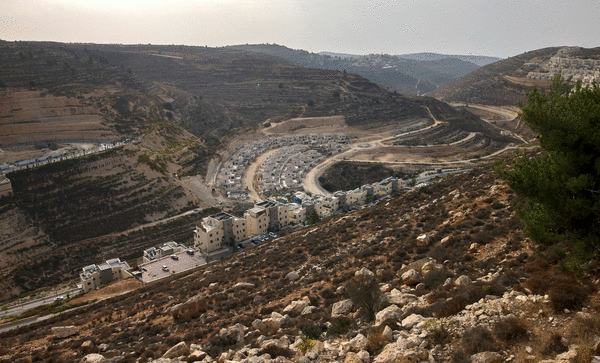
Amir and Khaled Shanaran went out to their fields in the southern Hebron Hills at around 3:30 pm on a recent Saturday.
An Israeli settler was grazing sheep on their land, and they asked him to leave. Within minutes, two more settlers arrived on tractors. One of them pulled out a gun and shot Amir in the neck, killing him instantly. Khaled was shot in the stomach, and is hospitalized with wounds that left him paralyzed, according to their uncle, Ehsan Shanaran, human rights groups and local authorities.
The brothers are among 10 Palestinians killed and 260 injured this year in escalating attacks in the West Bank by extremist Israeli settlers.
“Things have gotten worse,” said Ehsan, who witnessed the March 7 shootings. “The situation is catastrophic.”
Palestinian authorities blame the Hilltop Youth, a loosely organized group that has become bolder since emerging in the late 1990s after Ariel Sharon urged settler youths to grab the hilltops and create facts on the ground in the West Bank — the larger of the two Palestinian Territories, and long considered by advocates as the core of any future Palestinian state.
“They aren’t armed with sticks, they are armed with pistols, with M60 rifles with Molotov cocktails,” Varsen Shahin Minister of Foreign Affairs and Expatriates for the Palestinian Authority, which runs parts of the West Bank, told reporters in Ramallah on Thursday. “All of it is used to terrorize our lives day in and day out.”
Shahin said there were 1,067 assaults in 62 Palestinian population centers so far this year, with an average of 11 per day in recent weeks.
The U.S. Office of Foreign Assets Control, an agency within the Treasury Department, designated the Hilltop Youth in 2024 as a violent extremist group operating in the West Bank, home to some 3 million Palestinians and around 500,000 Israeli settlers. Shahin said that more countries should take such steps and that violent settlers should be disarmed.
In another incident this month, a 29-year-old shepherd named Suhaib Abualkebash said attackers stripped him naked, beat him and zip-tied his genitalia. Family members and a rights activist said they were also beaten in the village of Khirbet Humsa. The New York Times first reported the details on March 18.
Palestinian property has been damaged, with vehicles set on fire, olive trees uprooted, livestock killed, wells destroyed, and hateful graffiti sprayed on walls, according to Shahin. Holy sites have been desecrated, she said.
Two attacks by Palestinians have been recorded in the West Bank against Israelis this year. An 18-year-old settler man was killed in a traffic collision earlier this month that Israeli officials ruled an act of terror; another was wounded in an incident in January, according to the U.N.’s Office for the Coordination of Humanitarian Affairs.
Prime Minister Benjamin Netanyahu has publicly framed the settler violence over the years as the work of a “handful of kids” who “take the law into their own hands.”
Former officials have taken a much harder line more recently.
Ex-foreign minister Tzipi Livni suggested that by allowing a religious system of law and justice to operate parallel to state laws, “the government of Israel is dismantling the state of Israel,” in a social media post on Thursday. Last week, ex-premier Naftali Bennett said he condemned “any manifestation of nationalist violence by Jewish extremists,” Israeli media reported. A staunch supporter of West Bank settlements, Bennett is widely seen as Netanyahu’s main rival for the premiership in elections set to be held later this year.
Current military leadership has also issued sharp condemnations, highlighting ethical and security implications for Israel.
“It cannot be that during a multi-front war, the IDF is forced to contend with a threatening minority from within,” Chief of Staff Lt.-Gen. Eyal Zamir said in a statement earlier this month. He added that the attackers don’t represent the settlement movement and described their actions as “morally unacceptable.”
The Israeli defense ministry intends to set up a unit tasked with formulating strategies to tackle extremism, and steer settler youths “toward value-driven and socially constructive activities,” according to a March 24 statement. A detailed plan, budgeted at tens of millions of shekels annually, will be submitted for government approval in the near future, it said.
While the Israel Defense Forces is the main security authority in much of the West Bank, it’s the Israeli police — currently under far right Minister of National Security Itamar Ben Gvir — that’s responsible for investigating crimes in the territory. Palestinians say its officers turn a blind eye to this kind of crime and they rarely get justice because such cases are handled in Israel’s civilian court system, while the cases against them are usually tried in Israeli military courts.
Of 1,701 investigations into what were deemed to be ideologically driven settler attacks from 2005-2024, only 3% ended with a partial or full conviction, according to Israeli human rights group Yesh Din.
“Who are we supposed to complain to? What will they tell us — that they’ll convict the settler?” Ehsan said of his nephews’ attackers. “We have a lawyer, but we haven’t even started the legal procedures yet.”
When they heard the shooting, young men from the village of Susiya rushed to try to help the Shanaran brothers. The settlers turned their guns on them, too, according to Ehsan. More settlers appeared and beat them.
“We called the Palestinian police and the ambulance, but they took too long to come,” said Ehsan, who is 47 and has two children. “So, we put them in our own cars and drove them to Yatta hospital.”
The villagers lived for generations in ancient underground chambers carved into the soft limestone of the South Hebron Hills. Around 30 years ago, after the discovery of the ruins of a synagogue above, Israeli authorities declared the area an archaeological site and expelled some 1,300 people.
Most of them moved away, a few hundred stayed close and set up Susiya, naming it after the place they had been forced to leave. An Israeli settlement began expanding nearby.
Over the years, tensions between the two communities have ebbed and flowed. And many structures in new Susiya have been razed by Israeli authorities after being erected without permits, which Palestinians say Israel rarely grants them in the area. As a result, their homes, animal enclosures, schools and wells have been continuously rebuilt and demolished.
Under international law, the West Bank is considered occupied territory, and an occupying power is prohibited from establishing civilian settlements or forcibly displacing the local population, though Israel counters this, saying the territory is disputed not occupied.
Matters worsened after Oct. 7, 2023, when Hamas — designated a terrorist organization by the U.S. and Israel — attacked southern Israel, killing about 1,200 people, prompting Israel’s war in Gaza, the smaller of the two Palestinian Territories, which has left at least 72,000 dead, according to local health officials.
In the West Bank — around 80 kilometers (49 miles) away where Fatah, a rival to Hamas, dominates the Palestinian Authority — Israeli restrictions widened, military operations expanded and settlement activity accelerated, further fragmenting Palestinian life. Israel says it’s trying to keep its citizens safe, so that an assault like October 7 is never repeated.
For many West Bank Palestinians, the escalating settler violence is seen as intimidation.
“All of this is just to scare people, to terrorize, to seize the land,” Ehsan said. “Only God can fix things.”
———
(Dan Williams contributed.)
©2026 Bloomberg L.P. Visit bloomberg.com. Distributed by Tribune Content Agency, LLC.






Comments