Gulf countries' frustration with the US grows as war wears on
Published in News & Features
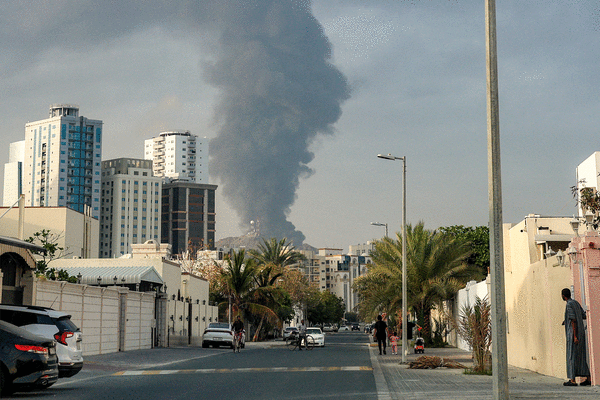
Gulf countries are increasingly frustrated with the U.S. over the Iran war, privately questioning American security guarantees and expressing concern about the Trump administration’s apparent lack of strategy, according to people familiar with the matter.
One month into the U.S.-Israeli conflict with Iran that they spent a year lobbying against, Gulf states continue to come under Iranian attack, with Saudi Arabia on Friday intercepting half a dozen drones and two Kuwaiti ports being struck. That’s as the Strait of Hormuz — a vital shipping corridor that’s an economic lifeline for the region — remains nearly shuttered, causing billions of dollars of losses in oil revenue.
Many officials are questioning U.S. President Donald Trump’s rationale, commitment and aims for the war, and the value of hosting American bases that have made their countries targets, said the people, who requested anonymity to discuss sensitive matters.
Still, wary of angering Trump, none have voiced those concerns publicly, and there’s little prospect of them asking the U.S. military to abandon its bases.
Some of them, particularly the United Arab Emirates and Saudi Arabia, have been hardening their position against Tehran and are considering joining in on attacks against the Islamic Republic if more of their own vital infrastructure is hit, Bloomberg reported on Wednesday. One key goal of Abu Dhabi is to pull together a coalition of nations including the U.S. to end Iran’s stranglehold over the Strait of Hormuz, according to people familiar with the thinking of Gulf allies.
“It is inconceivable that this aggression should turn into a permanent state of threat,” Anwar Gargash, a senior diplomatic adviser to the UAE’s president, said earlier this week, adding that any ceasefire must curb Iran’s “nuclear threat, missiles, drones, and the bullying of the straits.”
Many Gulf officials fear Trump will cut a deal with Tehran that doesn’t curb its production of ballistic missiles or support for proxy militant groups such as Hezbollah and Hamas, the people said. They believe that outcome is possible so that Trump can declare victory and pull out of a war that’s unpopular in the U.S. and has driven up energy prices around the world.
In such a scenario, the Gulf states fear they would be left to deal with an embittered Iran that maintains some kind of control over the Hormuz strait, the people said.
The Trump administration is now signaling to allies that it has no immediate plans for a ground invasion of Iran, even as it deploys thousands of troops to the Middle East, people familiar with the matter said.
The Gulf states were heartened by Trump’s remarks in an interview with Fox News this week. He said the U.S. would continue to protect Gulf allies even “if we don’t stay” in Iran. “They’d probably like us to stay,” he said. “If we don’t stay, we’re going to be protecting them. We know, you know, they’ve been very good.”
Those comments followed senior UAE officials, including State Minister Lana Nusseibeh and Sultan Al Jaber, who heads the country’s main energy producer, meeting U.S. politicians such as Vice President JD Vance in Washington.
“The White House understands the economic implications of keeping the strait closed,” Nusseibeh said in an interview in the U.S. city this week. “That’s pretty clear across the administration. The ‘what comes next?’ is clearly what people are working on right now.”
Asked about the possible use of military force, she said “all options would be on the table to keep the Straits of Hormuz open.”
Trump’s first scheduled international visit after taking office last year was to Saudi Arabia, the UAE and Qatar. They collectively pledged trillions of dollars in investment in the U.S., including in artificial intelligence and data centers. The UAE last week said the country’s $1.4 trillion investment and economic framework with the U.S. was on track.
Still, many in the region are wondering what the pledges have bought them, the people said.
One key frustration, said some of the people, is that their concern about Iran’s retaliation in the event of war was shrugged off by the U.S. Washington, they said, gave more weight to Israel’s arguments. Israeli Prime Minister Benjamin Netanyahu, who has a very close relationship with Trump, had long argued that Iran wanted a nuclear weapon — something Tehran’s leaders have denied — and that military action against it was necessary.
In addition, Gulf officials were upset over a U.S. decision to temporarily suspend sanctions on a trove of Iranian oil — potentially worth more than $10 billion — on the seas in tankers. That move was to help lower surging crude prices but came with Gulf Arab states unable to get most of their own petroleum exported because of Iran’s threats against vessels sailing through Hormuz.
A few Gulf states are quietly urging the U.S. to continue attacking Iran and even try to topple the Islamic Republic, said the people. They worry that anything less would allow Iran to continue to hold the strait, and their economies, hostage and embolden it further.
That’s even with the goal of regime change appearing out of reach for now. While the U.S. and Israel spoke of it in the early days of the war, they do so less now. Iran’s military and the government have remained unified, despite several senior individuals being assassinated and the bombardment battering Iran’s armed forces.
Now, as thousands of drones and missiles fly over Gulf Arab cities that are meant to be havens for tourists and financial investors in a volatile region, some governments are talking about doing more to diversify their geopolitical relationships beyond the U.S. and forging even stronger ties with China, the people said.
Beijing wouldn’t provide a security guarantee, but neither has the U.S., and its pitch over the past year as the more predictable superpower is gaining traction, the people said.
(Ben Bartenstein and Nick Wadhams contributed to this report.)
©2026 Bloomberg L.P. Visit bloomberg.com. Distributed by Tribune Content Agency, LLC.






Comments