Trump extends energy-attack ceasefire, claiming Iran request
Published in News & Features
WASHINGTON — President Donald Trump again pushed back his deadline for Iran to strike a deal with the U.S. or face more attacks, saying talks with the country were going “very well.”
Trump said he would extend, by 10 days, his pledge to refrain from attacks on Iranian energy sites, offering a brief calm to global energy markets jolted by conflicting signals on the prospect of a halt to the nearly month-long war.
The move represented the second extension since Saturday’s threat to eviscerate Iran’s power plants, in absence of a deal.
“As per Iranian Government request, please let this statement serve to represent that I am pausing the period of Energy Plant destruction by 10 Days to Monday, April 6, 2026, at 8 P.M., Eastern Time,” Trump said in a social media post on Thursday. “Talks are ongoing and, despite erroneous statements to the contrary by the Fake News Media, and others, they are going very well.”
Emerging-market currencies and U.S. Treasuries pared losses and the dollar pared gains against major peers after his latest post.
Oil prices climbed on Thursday, with Brent crude settling near $108 a barrel, as shifting signals from the White House on Iran talks left traders unconvinced of a quick resolution. Prices briefly pared gains in post-settlement trading after Trump announced the deadline extension.
It’s still unclear who the U.S. is negotiating with since several top Iranian government and military officials have been killed.
During a Cabinet meeting Thursday morning, Trump said special envoys Steve Witkoff and Jared Kushner, as well as Vice President JD Vance “will tell me whether or not they think it’s going along.” He added that “we have a lot of time” before the deadline, issued Monday morning in Washington, expires.
“It’s a day. In Trump time, a day, you know what it is? That’s an eternity,” he added.
Iran confirmed on Thursday, through the Tasnim news agency, that it’s waiting for a response after rejecting a U.S. 15-point plan to end the war and offering its own conditions. Those include a guarantee that the U.S. and Israel won’t resume their attacks, the payment of reparations for war damages and recognition of Iran’s authority over the Strait of Hormuz.
Iran is also calling for an end to the war on all fronts, Tasnim reported, a likely reference to Israel’s parallel war against the Tehran-backed Hezbollah militant group in Lebanon.
Witkoff confirmed during the Cabinet meeting that the 15-point proposal had been delivered to Iran through Pakistani mediators, without giving details, and offered a more optimistic tone. He said it had led to “strong and positive messaging and talks.”
The U.S. has compiled a list of a dozen demands alongside three points Iran would get in return, according to people familiar with the matter.
Trump is under pressure to persuade Tehran to reopen the critical waterway for oil and gas flows, a step needed to arrest a global supply shock.
He said during Thursday’s Cabinet meeting that Iran had allowed 10 boats of oil to sail through the Strait of Hormuz as a goodwill gesture, and Treasury Secretary Scott Bessent said a U.S. insurance program meant to boost shipping through the waterway will begin soon.
Trump’s extended deadline for talks also allows more time for the U.S. to amass additional troops in the region, with some already set to arrive before week’s end. On Thursday, Trump repeated an earlier timeline of four- to six-weeks for military operations and said the U.S. war effort is “ahead of schedule.”
Trump has faced questions on the duration of the war effort, including from his own party’s lawmakers ahead of November midterm elections.
U.S. Senator Lisa Murkowski, an Alaska Republican, said the administration isn’t providing answers on the scope and purpose of military operations in Iran in closed-door briefings. She’s working on legislation to authorize operations in order to set an end goal for the war.
“I don’t know what else to do,” she said. “I’m worried we get out of town and the president goes in with ground troops aiming for a full takeover.”
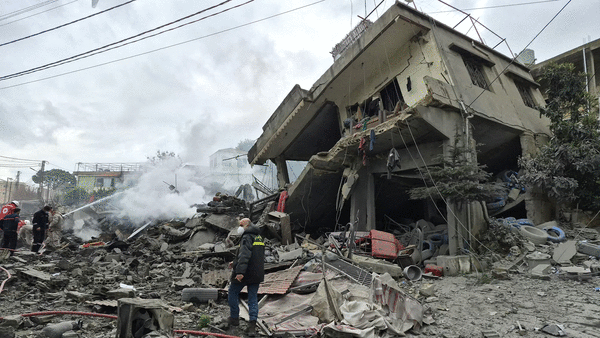
Both sides kept up their air attacks on Thursday. The Israel Defense Forces completed a wave of strikes in the central Iranian city of Isfahan, while Iran’s state TV said the country had begun another wave of missile strikes against Israel. Two people were killed after debris from an intercepted missile fell in Abu Dhabi.
Iran is looking to formalize a transit fee for the Strait of Hormuz, with lawmakers working on a draft bill to impose a toll in exchange for providing security to ships, according to the Fars news agency. The strait is a conduit for about a fifth of the world’s oil and liquefied natural gas.
The Islamic Republic is still able to export its own crude from the strait, likely earning hundreds of millions of dollars of extra income.
The conflict has led to surging fuel and fertilizer prices, and sparked fears of an inflation crisis and worldwide food shortages.
The OECD on Thursday sharply increased its inflation forecasts for major economies and now sees the average rate for the Group of 20 this year jumping to 4% — with an even higher pace in the U.S. — rather than the 2.8% it predicted in December.
Trump has publicly signaled any peace agreement would have to include a prohibition on Iran ever obtaining a nuclear weapon or enriching radioactive material for civilian purposes.
The U.S. plan also stipulates that the Islamic Republic use a reduced missile arsenal in self-defense only, according to people familiar with the matter. Iran would receive certain concessions in return, including sanctions relief.
Israeli officials have shown no inclination to end the fighting.
“At this stage we are still at war, and when it might end, no one knows,” Israeli Energy Minister Eli Cohen told radio station Galey Israel.
Gulf states such as Saudi Arabia and the United Arab Emirates are considering joining the war against Tehran, several people with knowledge of the situation said this week.
“We can’t let Iran hold the U.S., the United Arab Emirates and the global economy hostage,” UAE Ambassador to the U.S. Yousef Al Otaiba wrote in a Wall Street Journal op-ed. “A simple cease-fire isn’t enough. We need a conclusive outcome that addresses Iran’s full range of threats.”
More than 4,500 people have been killed in the conflict, according to governments and non-government agencies. Around three-quarters of the fatalities have been in Iran, while almost 1,100 people have died in Lebanon, where Israel is fighting a parallel war against Iran-backed Hezbollah militants and has displaced more than a million people. Dozens have been killed in Israel and Arab Gulf states.
_____
(With assistance from John Bowker, Mia Gindis, Iain Marlow and Erik Wasson.)
©2026 Bloomberg L.P. Visit bloomberg.com. Distributed by Tribune Content Agency, LLC.




Comments