Bags of shredded documents at NY jail after Epstein's death, officer tells FBI
Published in News & Features
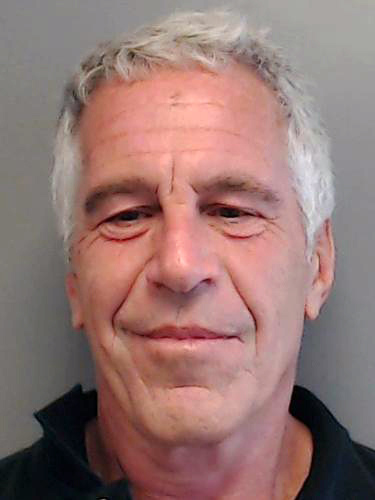
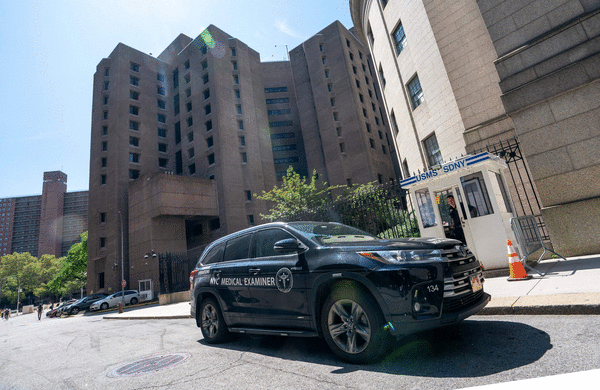



MIAMI — Less than a week after Jeffrey Epstein was found dead inside his cell at the Metropolitan Correctional Center in Manhattan, something was afoot inside an office where the Federal Bureau of Prisons’ After Action Team had set up a probe into what had happened to their most high-profile inmate.
The FBI was told that there were people shredding documents. Bags of them.
An inmate at the jail was ordered to take the bags of shredded material to MCC’s rear gate and throw them in a dumpster on Thursday, Aug. 15, and again on Friday, Aug. 16, days after Epstein’s Aug. 10 death, records show. The sheer volume of material seemed unusual, the inmate noted.
“They are shredding everything,” the inmate told one of the guards, adding that he was asked to give the officials, whom he did not recognize, a hand with the shredding.
“Make sure you get that box too,” one of the men allegedly told him.
The inmate wasn’t the only one who found it out of the ordinary. A corrections officer at the detention facility called the FBI’s National Threat Operations Center that same night, a Friday, at 6:28 p.m. to report that he had “never seen this amount of bags of shredded documents coming out to be put in the dumpster at the rear gate of MCC.”
A back gate corrections officer was also troubled by what he witnessed as the inmate brought down “bales” of shredded paper, according to a memo he wrote to investigators three days later, on Monday, Aug. 19.
“I believe that this conduct may be inappropriate for [an] investigative team to be shredding paperwork related to the investigation and you may want to investigate why BOP employees are destroying records,” the correctional officer wrote on Aug. 19 around 11 a.m.
“Can we take a look at the Dumpster ASAP to see if the paper is still there? Possible they didn’t dump it yet,” replied one of the federal agents whose name is redacted in the memo.
But it was already too late. The trash was picked up that very morning.
By that time, federal prosecutors had also found something else amiss: “We learned today that all institutional count slips for dates prior to August 10, 2019, which we requested on August 12, 2019, are apparently ‘missing.’”
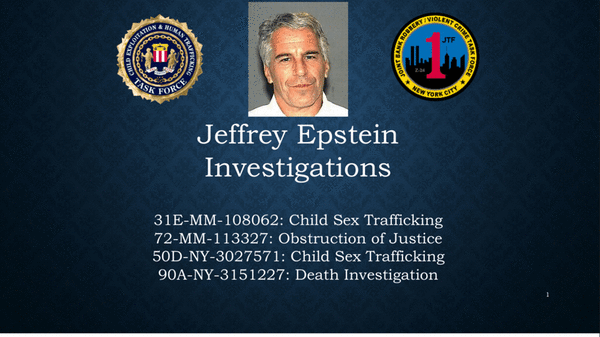
The discovery was only one of many suspicious events that unfolded in the days and weeks both before — and after — Epstein’s death, the Miami Herald has found from an analysis of thousands of pages of documents released by the Justice Department. In fact, there were so many irregularities discovered at the Manhattan jail that the U.S. Attorney’s Office for the Southern District of New York (SDNY) opened three separate probes into the case, with different case numbers, records and emails show.
First, there was the probe into Epstein’s death, which the medical examiner concluded was a suicide by hanging. Despite the ruling, a forensic pathologist hired by Epstein’s estate disputes the finding by Dr. Barbara Sampson, who was then the chief medical examiner of the City of New York.
Dr. Michael Baden, also a former New York City chief medical examiner, argued that the injuries found in Epstein’s neck and the ruptured capillaries in his eyes were more consistent with strangulation than suicide by hanging.
Baden served for decades as a member of the New York State Correction Medical Review Board, an entity responsible for reviewing deaths of inmates in custody. Baden has conducted more than 20,000 autopsies including reviewing those of former President John F. Kennedy, and civil rights leaders the Rev. Martin Luther King Jr. and Medgar Evers.
But there were also two corruption probes associated with Epstein’s death: one, an obstruction-of-justice case involving the shredding of documents and possible charges of dereliction of duty and other misconduct by correctional officers; and second, a blackmail-for-sex scheme involving a correctional officer that the DOJ labeled a “Color of Law” probe.
That investigation grew out of inmate and correctional officer interviews in the aftermath of Epstein’s death. It’s not clear why it was attached to Epstein’s case. The Herald could find no connection.
What stands out, however, is that at some point early on, the cases seem to have changed hands from being an FBI criminal case — to matters that were handled by the Justice Department’s Office of the Inspector General (OIG), which has no criminal prosecution powers. The OIG is an independent agency that investigates allegations of fraud, waste or misconduct, but it must refer its findings to the DOJ for potential prosecution.
The reason for the OIG taking over the probes isn’t entirely clear. From the outset, on the day Epstein’s body was found, then-Attorney General William Barr immediately announced that Epstein died of an “apparent suicide.” And then, six days later, on Aug. 16, Sampson confirmed the suicide ruling.
With the cause and manner of death already determined, and no foul play suspected, the only aspects of the case left unresolved — at least in the eyes of the Justice Department — was whether the actions of any of the officers contributed to Epstein’s suicide.
This seemed to color the investigation almost from the beginning, since Epstein’s death was never treated as suspicious. As a result, his cell was never considered a possible crime scene that would, under normal circumstances, be examined by experienced criminal and forensic experts who would take fingerprints, blood samples and other evidence. One thing that got lost as a result of the cell not being examined was that the piece of fabric that Epstein allegedly used to hang himself was never identified.
It also should have been looked at carefully because on July 23 — just 18 days before he died — Epstein was found unconscious on the floor of his cell. He initially told prison officials that his cellmate, Nick Tartaglione, had tried to kill him and that Tartaglione, a quadruple killer, had been threatening and extorting him. Tartagione denied he tried to harm Epstein, and Epstein later said he couldn’t recall what happened.
Prison officials concluded it was an attempted suicide. Still, the fact that Epstein had reported being threatened by inmates should have been enough for the DOJ to treat his death as suspicious.
Many, if not most, of the entities and investigators contained in the Epstein file documents reviewed by the Herald are redacted. This means that it’s impossible to fully understand which agents or agencies were communicating with each other about the various aspects of the Epstein investigations.
The Herald pieced some of the correspondence together in order to draw as complete a picture as possible of the various cases.
Separately, the Herald also found that the federal Bureau of Prisons wrote an “After Action Review” of Epstein’s suicide on Aug. 10, 2019. This 18-page report was conducted by an “After Action Review Team,” whose names are redacted from the report. This is likely the team that was in the prison in the days following Epstein’s death. The report refers to a review of “written documentation, electronic databases and limited staff conversations.”
The BOP said in a statement that the team is standard following prison suicides.
“These teams review such things as various background information for the inmate, health care and personality information, antecedent circumstances, and various other details surrounding the suicide. This team then draws conclusions and makes recommendations to the facility,” the BOP said.
First call about documents being shredded
The first mention of document shredding was a call to the FBI’s Threat Operations Center from a corrections officer at 6:28 p.m. on Aug. 16, six days after his death. An FBI 302 form containing an interview with the officer noted that “Caller found it suspicious that an after-action team charged with investigating would be shredding huge amounts of paperwork” with all the officials from the FBI, BOP and OIG in the building.
The caller advised that if “anyone cares about what was shredded,” they needed to check the dumpster before it was collected at 8 a.m. on Monday. But that doesn’t appear to have happened.
Instead, about 11 a.m. Monday, a corrections officer wrote an email to the OIG reporting the shredding said that it appeared to be an unusually large number of trash bags at MCC’s back gate. It’s not clear whether the officer was the same one who had called on Friday.
Later that day, at about 7:30 p.m., an assistant federal prosecutor requested permission to interview the inmate who was identified as dumping the material. In the email, the prosecutor notes, “We are also investigating any efforts, following Epstein’s death, to obstruct justice by destroying relevant records at MCC. In particular, we learned today that all institutional count slips prior to August 10, 2019, which we requested on August 12, 2019, are apparently “missing.”
Two correctional officers on duty the night Epstein died, Tova Noel and Michael Thomas, were both interviewed in 2021 by the OIG. Both were questioned about whether they knew anything about Epstein’s “missing” MCC file.
“Did you ever remove or destroy any of Epstein’s paperwork?” the OIG agent asked Noel and Thomas in each of their interviews. Both replied, “no.”
The inmate who was identified as removing the shredded documents was interviewed by OIG agents on Aug. 20. One report indicated that a prison lieutenant whose name is redacted may have been present during the time the inmate was questioned. It was clear from the transcribed interview, however, that the inmate was concerned about whether he would face retaliation for talking about what he saw.
The inmate’s interview was not transcribed until four months later, on Dec. 19, 2019, and the original handwritten notes are not included in the report. The interview was 15 minutes.
The inmate, Steven Lopez, did not explain what he saw, and the agents didn’t ask.
Instead, they gave Lopez questions that he could respond with either yes or no answers.
“Do you have any information about shredding documents?”
Lopez: “No.”
“Did you overhear anyone talk about shredding documents?”
Lopez: “No.”
“Do you know what, if any documents were shredded?”
Lopez: “No idea what if anything was shredded, just did usual trash bin runs.”
The report ended with the statement: “Lopez had no other information relating to Epstein or the tip and informed that he is just trying to stay out of trouble, keep his head down and do his work. Lopez informed that he enjoyed the position he has and doesn’t want to screw it up in any way.”
Eight days later, the corrections officer who sent the email to the FBI was interviewed. While his name is redacted in the interview, an email sent days later identifies the complainant as officer Michael Kearins, and a subpoena for Kearins by OIG agents is included in the files. He said he had been working for BOP for almost 30 years. He admitted he sent the email and provided a first-hand account of what he heard and saw, records show.
According to the report, Kearins said that about 10:30 a.m on Aug. 15, Lopez approached the post at the rear gate at MCC with approximately three bags of shredded paper. Kearins recalled that Lopez said “they are shredding everything back there.”
According to Kearins, Lopez described one of the men involved in the shredding as white, with a Southern accent. Kearins said he didn’t know anyone at the prison who fit that description, so he surmised that he must have been part of the BOP’s After Action team related to Epstein’s death.
Lopez told him that the man ordered him to “make sure you get that box over there too.” Kearins said that another inmate (whose name is redacted) was also asked to help shred the documents. Kearins admitted he did not know what documents were being shredded or where they originated.
The Miami Herald was unsuccessful in reaching Lopez. Kearins, who was reached by phone, declined to comment.
The case closing memo, issued on Aug. 29, noted that the corrections officer had a reputation for filing unfounded complaints.
“Inmate Lopez was previously interviewed on 08/21/2019. Due to no evidence to support the complaint, FBI NY will be closing this matter,” the memo said.
That was not the end, however.
Anonymous letter
A corrections officer wrote an anonymous letter to a federal judge sometime later. The date stamp on the envelope is illegible, but it appears to have been sent after the FBI interviewed Kearins and Lopez. The writer implies that the “government” is covering up the destruction of the records.
“I do not feel comfortable reporting this to OIG because OIG knows about this and may be covering it all up,” the writer said.
There is no indication from the Epstein files whether the FBI, the federal prosecutors or the OIG took further action on the shredding. There is also no indication they looked at video from outside the prison or whether any members of BOP’s After Action Team was interviewed.
The two officers on duty the night Epstein died, Noel and Thomas, were ultimately criminally indicted for falsifying their inmate counts and failing to make the required 30-minute checks during their overnight shift.
But it would be two years before the officers were formally interviewed by OIG investigators. Those lengthy interviews showed that their memories had faded, and that at times, they couldn’t recall or provided conflicting statements about the sequence of events that night. Their answers didn’t seem to raise any flags with OIG investigators.
But their charges were quietly nolle prosed, or dropped, in December 2021 with little explanation, other than it was part of a deferred prosecution in which both guards complied with community service and other terms that were not publicly specified.
Both guards never returned to work and were fired.
Cash deposits suspicious, bank says
Banking records for three corrections officers were subpoenaed by federal investigators for Thomas, Noel and an operations lieutenant, Glenda Anderson-Layne. The Herald could not find Thomas’ or Anderson-Layne’s bank records in the files. DOJ’s Epstein library did contain Noel’s bank and credit union statements and Anderson-Layne’s credit card statements.
The Herald was unsuccessful in reaching lawyers who represent each of the corrections officers.
It’s not clear what, if anything, investigators concluded by reviewing their financial statements. Noel’s bank statements show thousands of dollars in cash deposits, some of which her bank, JP Morgan Chase, flagged as suspicious. She also leased a new 2019 LandRover, valued at $63,000 in January 2019.
Her salary, according to the loan application, was listed as $130,000 a year. She also had numerous anonymous or redacted Zelle and other cash app deposits to her checking account, sometimes thousands of dollars at a time.
Many of the deposits preceded Epstein’s incarceration at MCC. But the bulk of the deposits, including a $5,000 cash deposit on July 30, were made during the time Epstein was housed at the prison.
Investigators probing Epstein’s death discovered that one of the corrections officers on duty the night Epstein died, Robert C. Adams, had been harassing the female visitors to the prison. In early July, Adams found that a female visitor had smuggled drugs into the prison. Adams allegedly told her that he wouldn’t report her if she had sex with him, court records show.
The investigation lasted several months — as federal authorities confirmed through cellphone records and surveillance video that the female visitor met Adams at a local pizza shop where he took her to the Hutchinson motel in Brooklyn and the two had sex, according to court records.
Adams was indicted on charges of bribery and blackmail, but was found not guilty following a trial by jury. He is no longer employed by the BOP, prison officials confirmed.
It’s not clear why the case — including the reams of evidence collected — was included in monthly updates with the Epstein death investigation.
Despite a pervasive culture of smuggling drugs, cellphones and other contraband into the prison previously reported by the Herald and other media and despite the bank flagging a guard’s deposits, neither Noel nor Thomas were asked about their financial records during the OIG interviews.
———
Note: This story was written with the help of the search database Sourcebase.ai.
———
©2026 Miami Herald. Visit miamiherald.com. Distributed by Tribune Content Agency, LLC.






Comments