Florida Gov. Ron DeSantis signs bill to bolster nature-based coastline protection
Published in News & Features

MIAMI — Building along the water’s edge comes with consequences as the sea rises, and for decades the first line of defense against flooding has been concrete seawalls.
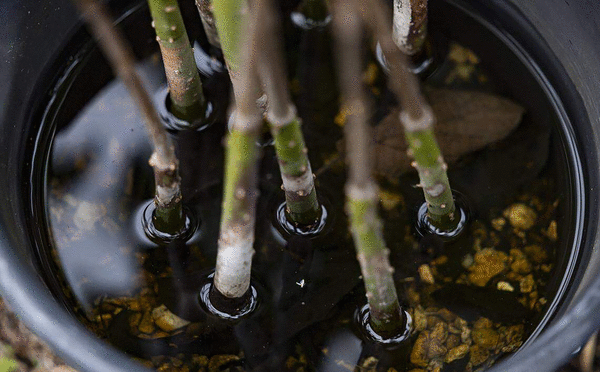
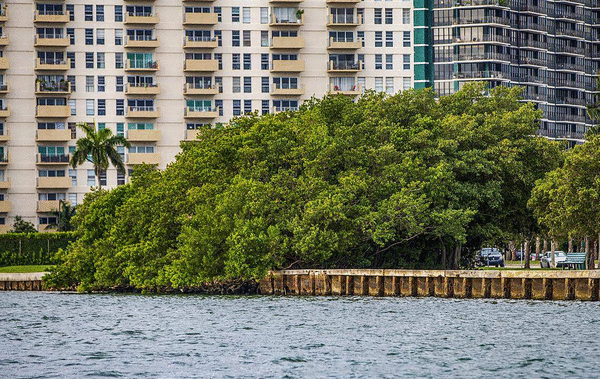
Now, the state is leaning into another approach: “living shorelines” such as mangrove forests, oyster reef restoration and hybrid options like 3D-printed walls.
Gov. DeSantis signed a bill into law Thursday that will make obtaining a permit for nature-based solutions easier as well as help fund them.
The law, which will take effect July 1, calls for the Florida Department of Environmental Protection (DEP) to create a permitting process for installing living shorelines that will have a faster application review.
The law also stipulates the DEP should incentivize new technology, like 3D-printed sea walls that are designed to mimic nature and give coral and algae surfaces to latch on to while creating a home for fish and crabs.
“These measures will not only lead to better environmental outcomes but also protect coastal communities from erosion and mitigate the effects of storm surges,” DeSantis said after signing the first bills of the recently completed legislative session.
Money available for projects
It may also get easier to fund the projects. The bill says that living shoreline projects qualify for “Resilient Florida” grant money. The more than $200M in funding will help bankroll projects like road raising, dune reconstruction and storm pumps. Now, living shoreline projects can tap those funds.
“The bill protects property and the coastal economy in Florida while providing local governments with science-based tools for responsible stewardship,” said Sen. Iliana Garcia, the Republican legislator from Miami who sponsored the Senate version of the bill.
Mariana Aziz, an environmental lawyer and policy specialist with the non-profit Miami Waterkeeper, said the new law speaks to how far the community has come from an Army Corps of Engineers’ proposal to erect a tall concrete wall through Biscayne Bay and waterfront neighborhoods — a plan Miami-Dade rejected in 2021.
“If we have a clear permitting process, if we have local governments that are on board with this and if we have funding, I think that’s a good recipe for nature-based solutions to move forward,” Aziz said.
Irela Bagué, whose work as chief bay officer for Miami-Dade County helped shape the legislation, championed the bill after several iterations over several years.
“One of the purposes of it is just to set up a structure to normalize it, so there’s some consistency,” Bagué said. “Ultimately, this is to improve the health of the watersheds, restore habitat and protect coastal properties. It’s a win, win.”
What made living shorelines harder to install?
Typically, permitting natural solutions has been more difficult and costly than simply repairing seawalls.
Agencies are more familiar with traditional concrete seawalls, so those projects typically move faster through approval while living shoreline projects are approved on a case-to-case basis and may require additional review or environmental studies.
After Hurricane Milton, a 2024 Category 4 hurricane, the DEP issued an emergency order in Tampa Bay for immediate repairs to its seawalls that crumbled during the storm.
Many of the permits for nature-based solution go through both the county and the state, Aziz said. She hopes the law will help streamline this process and figure out “who’s the responsible authority.”
Then, there are some existing rules designed for seawalls that can complicate living shoreline installation.
Anya Freeman, founder of KIND Designs, said current regulations cap seawall thickness at 18 inches. While intended to prevent encroachment into waterways, the limit poses challenges for her 3D-printed designs, which require deeper grooves to mimic mangrove root structures and deflect waves.
While those details weren’t directly addressed in the bill, Freeman said it’s a first step toward local governments and property owners who have been looking to use KIND Designs’ living seawalls.
“The bill provides a directive but not a specific direction on how it should be implemented,” Freeman said. “The real impact will depend on how DEP moves forward from here.”
©2026 Miami Herald. Visit at miamiherald.com. Distributed by Tribune Content Agency, LLC.






Comments