Will fuel reach Cuba? Russian oil tankers test US pressure on Havana as crisis deepens
Published in News & Features
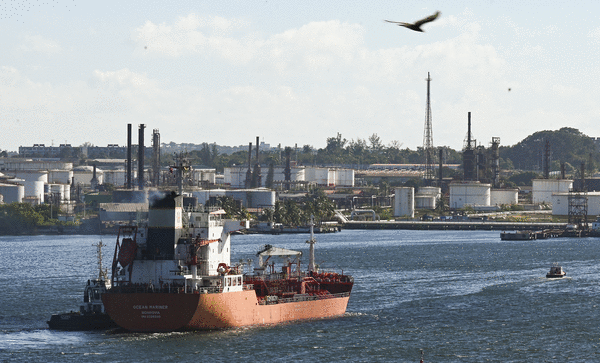
The fate of two oil tankers believed to be carrying desperately needed fuel to Cuba is emerging as a key test of Washington’s escalating pressure campaign — and of Havana’s ability to withstand it.
At the center of the uncertainty is the Sea Horse, a Hong Kong-flagged tanker whose unusual movements have raised questions about whether it already delivered fuel to the island in secret or is still attempting to do so under growing scrutiny.
The vessel, carrying an estimated 190,000 to 200,000 barrels of Russian diesel, spent nearly three weeks broadcasting that it was “not under command” while drifting in the Sargasso Sea, about 1,300 nautical miles from Cuba. Maritime tracking data, however, suggests the behavior may have been deceptive.
Analysts say the tanker likely engaged in “spoofing” — manipulating its tracking signal — and may have sailed to Cuba undetected earlier this month before reappearing far out at sea. It had previously switched off its transponder during a ship-to-ship transfer of Russian fuel near Cyprus, a tactic commonly linked to sanctions evasion.
“The Sea Horse is no longer drifting and is now moving under its own power at about 9.9 knots,” said Jorge Piñón, an energy expert at the University of Texas at Austin. “Our calculations show it could reach Cuba’s north coast in about five days.”
A second tanker, the Anatoly Kolodkin, which is under U.S. sanctions, is believed to be carrying about 700,000 barrels of Russian crude and is also heading toward the Caribbean.
Whether either vessel ultimately reaches Cuba remains unclear.
At least two U.S. Coast Guard cutters are positioned off Cuba’s northeastern coast, between Moa and Puerto Padre, according to Piñón, placing them in position to intercept ships if ordered. Their presence underscores what has effectively become a U.S. maritime blockade on fuel shipments to the island.
“The United States has issued a directive to prevent oil from entering Cuba,” Piñón said. “And those assets are there in case they need to act.”
But some analysts question whether the Sea Horse is even attempting to reach Cuba.
“The idea that a tanker could sneak into Cuba right now just doesn’t make sense,” said Evan Ellis, a professor at the U.S. Army War College. “That’s probably the most monitored patch of the Caribbean.”
Ellis pointed to the large scale of U.S. military deployment in the region — including surveillance aircraft, destroyers and Marine units tasked with intercepting sanctions-violating vessels — even after the aircraft carrier USS Gerald Ford and its accompanying warships, which had been sent to the Caribbean late last year, are now in the Middle East.
“You just can’t sneak a tanker into Cuba without somebody noticing,” he said.
Instead, Ellis said the vessel’s conduct may point to other explanations, including mechanical failure. Many ships involved in sanctions evasion are part of the so-called “shadow fleet,” and are often aging tankers operating with limited oversight.
“They’re usually way past their service life and only marginally seaworthy,” he said. “It’s entirely possible this is some kind of real emergency.”
The ship’s current position — still hundreds of miles from Cuba — further clouds assumptions about its destination.
“It doesn’t even necessarily suggest they’re heading for Cuba,” Ellis said. “It just sounds like something unusual is going on.”
The uncertainty is compounded by confusion over U.S. sanctions policy.
Piñón said the Trump administration recently eased certain restrictions on Russian oil shipments to countries such as India, China, Japan and South Korea amid disruptions caused by the closure of the Strait of Hormuz after the U.S. and Israel attacked Iran. But it remains unclear whether that flexibility extends to Cuba.
“We haven’t seen the directive — whether it’s an executive order or something else — that clarifies whether Cuba is included,” he said. “That’s the question we all have.”
At the same time, Ellis noted that U.S. officials have discussed allowing limited oil shipments from Venezuela under tightly controlled conditions — with cargoes delivered to private companies rather than the Cuban government — in an effort to ease humanitarian pressures without benefiting governments in Caracas or Havana.
The stakes for the island are high.
Diesel has become the most critical fuel in Cuba’s economy, powering transportation, electricity generation, agriculture and water systems.
“Diesel is essential,” Piñón said. “It moves food, runs generators, pumps water. Right now, there is aid sitting in ports that can’t be distributed because there’s no diesel for trucks.”
If the Sea Horse’s cargo arrives, it could be used almost immediately. Crude from the Anatoly Kolodkin, however, would take weeks to refine — and Cuba’s aging facilities produce limited amounts of diesel.
The developments come as Cuba faces one of its worst energy crises in decades.
A nationwide blackout on March 16 underscored the severity of the situation after fuel imports largely dried up. Venezuela — long the island’s main supplier — halted shipments following the Jan. 3 capture of Nicolás Maduro and the subsequent U.S. control over the Venezuelan oil company PDVSA. Mexico’s last delivery of oil to Cuba was also in early January.
In recent days, Cubans have taken to the streets for 11 consecutive nights, banging pots and pans in protests during blackouts.
Against that backdrop, the question of whether the tankers will reach Cuban shores remains unresolved — and increasingly complex.
For Washington, the decision carries significant risks. Blocking the shipments could escalate tensions with both Cuba and Russia. But allowing them through could weaken a strategy aimed at cutting off fuel supplies to force political change.
For ordinary Cubans, the stakes are more immediate: Whether the ships dock or turn away could determine how long the lights stay on.
_____
©2026 Miami Herald. Visit at miamiherald.com. Distributed by Tribune Content Agency, LLC.






Comments