On final weekend before Illinois primary, candidates try to keep it local despite flood of out-of-state money
Published in News & Features
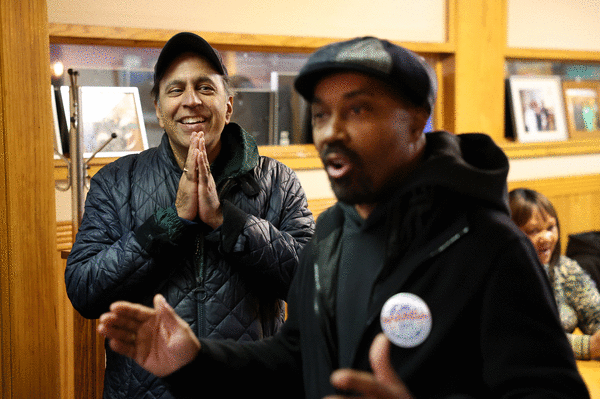
Candidates fanned out across the state to hit traditional campaign stops in the final weekend before Tuesday’s primary, wooing local audiences in an election increasingly overcome by national events and out-of-state money.
Some trooped through soupy rain along Western Avenue at the South Side Irish St. Patrick’s Day Parade. Others toured West and South Side churches with predominantly Black congregations. Still others held rallies in favored locales.
It was the late Speaker of the U.S. House Tip O’Neill who popularized the phrase “all politics is local.” But that was years before the U.S. Supreme Court issued its Citizens United ruling that allowed independent political expenditures by corporations, unions and other outside groups.
The effects of the Citizens United case, accelerating the nationalization of local politics, have rarely been more evident in Illinois than in this campaign season, with tens of millions of special-interest dollars being pumped into TV and online commercials and mailings aimed at influencing voters’ choices of candidates for U.S. Senate and in four intensely crowded races for open U.S. House seats.
Chief among the outside spenders are generically named political action committees launched by pro-Israel, pro-artificial intelligence development, pro-cryptocurrency and pro-cloud data center interests. The funding by the American Israel Public Affairs Committee comes as the U.S. and Israel are prosecuting a war on Iran that many Democrats have called illegal, leading to a surge in gas prices as they campaign against President Donald Trump on the issue of affordability under his leadership.
Senate is the marquee race
With the marquee race Tuesday coming down largely to three Democrats — U.S. Reps. Raja Krishnamoorthi of Schaumburg and Robin Kelly of Lynwood, and Lt. Gov. Juliana Stratton of Chicago — looking to win the nomination to succeed retiring U.S. Sen. Dick Durbin, money has been flowing freely.
At a campaign meet-and-greet at the Second Baptist Church in Elgin, where Stratton and her husband, Bryan Echols, were married, the state’s junior U.S. Sen. Tammy Duckworth lashed out at groups funded at least in part by Krishnamoorthi supporters. It’s resulted in a combined $11.6 million in spending, including $9.9 million from the pro-cryptocurrency super PAC Fairshake, attacking Stratton as she began to build momentum.
“Who do you think is going to answer the phone when crypto calls and wants to exploit working people? The guy that they just spent $10 million to support, or Juliana, who’s been an independent fighter for this state?” asked Duckworth. She defeated Krishnamoorthi in 2012 for a northwest suburban U.S. House seat, which he later won when Duckworth captured a U.S. Senate victory in 2016.
Given a chance to raise their concerns, members of the audience discussed the lack of affordable housing, cuts to federal programs such as Head Start, and the hollowing out of the Civil Rights Division at the U.S. Department of Justice. In many ways, those concerns have been overshadowed during the primary campaign by attacks and debates over who is funding whom.
Stratton, the state’s two-term lieutenant governor under Gov. JB Pritzker, has also benefited from roughly $12.2 million in outside spending, much of it funded by the billionaire governor and some of his relatives. That backing, channeled through the ostensibly independent Illinois Future PAC, helped Stratton remain competitive in a race where Krishnamoorthi’s campaign spent more than $25 million on TV ads beginning in July.
The late infusion of money from Krishnamoorthi’s backers sends a message, Stratton argued: “I don’t want somebody who’s going to be a fighter against Donald Trump.”
After stops at other churches, Stratton and Duckworth were set to appear at a veterans event in Chicago’s Hyde Park neighborhood with Ald. Gilbert Villegas, 36th.
South Side Irish Parade
Amid periodic rain and a lingering winter chill, politicians, some sporting green, worked the crowd along a lengthy stretch of Western Avenue at the South Side Irish Parade in Beverly.
Krishnamoorhi greeted prospective voters along the metal railings on Western, shaking hands with supporters along the route.
Shortly before marching, Krishnamoorthi downplayed the role of outside money in the race, saying he has raised substantial funds on his own and that “nobody’s bankrolling my campaign.”
“At some point, we’re going to fix this campaign finance system so we don’t have super PACs dominating things,” Krishnamoorthi said. “But right now, that’s the situation in a lot of races.”
As for Pritzker’s heavy influence on Stratton’s campaign and what it means for the race, Krishnamoorthi said, “It is what it is.”
“All that being said, I think the people want to decide,” he said. “They want to make the decision ultimately about who their next U.S. senator is going to be. And so that’s why I’m here. I am appealing to every single person for their vote.”
Money was also top of mind for Kelly as she rallied supporters Sunday afternoon at Replay Lakeview, an arcade bar in Chicago’s Northalsted neighborhood, formerly known as Boystown.
“I need everyone to talk to everyone they know because I cannot buy this race,” Kelly told a packed roomful of volunteers and staffers, many clad in green “I’m with Robin Kelly” T-shirts, before they headed out to talk to voters in the neighborhood. “I cannot buy it. I have to go person by person by person by person, and I will tell you, I feel great on the ground. So many people from all kinds of neighborhoods have been coming up to me and saying, ‘We got you, we got you, we got you.'”
Kelly, whose only outside financial backing has come from Krishnamoorthi supporters seeking to sway Black voters away from Stratton, expressed frustration with the lieutenant governor’s surrogates casting her as a spoiler. That includes Duckworth, who praised Kelly’s work ethic during her Sunday morning appearance with Stratton but added, “Where we are right now with my dear friend Robin Kelly is that it’s her siphoning votes away from Juliana.”
If “people are concerned about splitting the vote, they should vote for the most qualified person,” Kelly said. “Happens to be this Black woman.”
Also seeking the Democratic U.S. Senate nomination are Kevin Ryan, Steve Botsford Jr., Bryan Maxwell, Jonathan Dean, Sean Brown, Awisi Bustos and Christopher Swann.
The Republican race
On the Republican side in the Senate race, former Illinois GOP Chair Don Tracy spent the day knocking on doors in his hometown of Springfield alongside his 10-year-old grandson Charles, urging dispirited conservative voters to turn out Tuesday.
“I’m worried about apathy, complacency, and ‘Mr. and Mrs. Undecided,’” said Tracy, a lawyer and a member of the family that owns Dot Foods, the nation’s largest food redistributor.
Tracy, who lost a 2002 bid for a state Senate seat as a Democrat and finished third in a six-way Republican lieutenant governor primary in 2010, argued his political experience and business background make him the strongest GOP candidate to take the Senate seat in November.
Echoing a frequent campaign theme, Tracy said the Senate general election is “no place for a rookie Republican candidate.”
Also running for the GOP Senate nomination are attorney Jeannie Evans, a first-time candidate, Casey Chlebek, who unsuccessfully sought the GOP U.S. Senate nomination in 2020 and 2022; Pamela Denise Long; Jimmy Lee Tillman II; and R. Cary Capparelli.
Another major statewide contest Tuesday is the Republican race to challenge Pritzker’s bid for a third term as governor in November. Pritzker is unopposed for the Democratic nomination.
The four-way GOP race features downstate former state lawmaker Darren Bailey, who lost to Pritzker by nearly 13 percentage points four years ago; Ted Dabrowski, the former head of the Wirepoints conservative activist organization; real estate developer and video gambling firm owner Rick Heidner; and DuPage County Sheriff James Mendrick.
The race has been notable not only for a dearth of out-of-state money but for a general lack of overall spending, a stark contrast to the tens of millions of dollars that poured into the 2022 GOP primary.
With little TV advertising, turnout among Republicans — who tend to vote on Election Day rather than use early voting or vote by mail, following Trump’s directives — could be dampened further by the weather. The forecast calls for a rapid shift to snow and blustery winds on Monday, leading to a frosty Election Day.
“Look, you know, there’s not a whole lot of money this time around in the Republican primary. So I think, you know, turnout will be low, but, you know, it is what it is,” Dabrowski said before stepping off at the South Side parade.
“What we’ve been doing is just traveling (to) southern Illinois. We’ve traveled (to) Rock Island last night. I was in Madison County three or four days ago. Now, you know, here in Chicago, doing these parades and just having a great time, and the people, the people who vote will vote, and hopefully they’re all going to move our way.”
Dabrowski said he believed Bailey’s campaign focus on his native downstate territory has “opened up the door for us.”
Bailey was campaigning Sunday night at a get-out-the-vote rally in downstate Quincy before scheduling a six-city fly-around of the state on Monday, including a final stop in suburban Palatine.
____
©2026 Chicago Tribune. Visit at chicagotribune.com. Distributed by Tribune Content Agency, LLC.



Comments