Key US senator investigates FDA over rare-disease drug denials
Published in News & Features
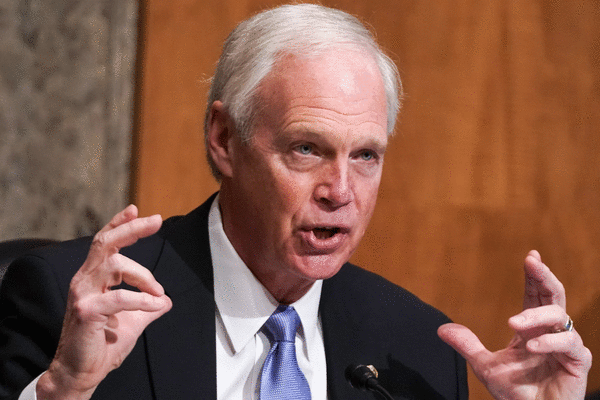
WASHINGTON — A key U.S. Republican senator said he’s launched an investigation into the Food and Drug Administration’s recent denials of treatments for rare diseases, adding political pressure on an agency that’s already in turmoil.
Wisconsin Sen. Ron Johnson said he’s seeking the FDA’s written denials to drugmakers, known as complete response letters. He plans to write letters to the agency asking why it denied certain drugs. He said he’s also considering having top FDA officials, including Commissioner Marty Makary, testify before the Senate’s Permanent Subcommittee on Investigations that he chairs.
“The stories are so outrageous,” Johnson said in an interview Monday with Bloomberg News. “It just appears that they’re looking for excuses to say no.”
Johnson’s comments came after the FDA has refused to approve treatments for several rare diseases, and demanded additional studies before it would consider approving others, sparking an outcry from patient advocates and investors.
He called the agency’s recent request for a new trial of UniQure NV’s experimental gene therapy for Huntington’s disease “bureaucratic idiocy.”
“You’re expecting people to go through sham surgeries where they get holes drilled in their heads?” Johnson said. “That’s just unbelievable.” The FDA has denied that the surgery would require people in the control group to get holes drilled in their heads.
The agency has said it’s largely following the recommendations of staff scientists and that approvals in general have not gone down.
A spokesman for the Department of Health and Human Services, which oversees the FDA, said the number of drug approvals and rejections under this Trump administration is “consistent with historical data over the last decade.”
“The FDA stands by the scientists evaluating these applications and each rationale is explained in detail through CRLs, which for the first time, are made available to the public,” the spokesman, Andrew Nixon, said in a statement.
Tumultuous Tenure
On Friday, the FDA announced that Vinay Prasad, the head of the division of vaccines and gene and cell therapies, will be leaving the agency. The division has overseen several of the drug denials under his tumultuous tenure.
During Prasad’s watch, the agency has announced multiple new initiatives to speed rare-disease medicines, including one that would allow some drugs for ultra-rare diseases be approved without traditional trials. But biotech companies and agency critics have said that behind the scenes, the goalposts are shifting as the agency has taken a harder line on some new therapies.
Johnson has long been an advocate for giving unproven drugs to dying patients and believes that the FDA often is too risk averse. He once sponsored the Right to Try Act, a 2018 law designed to make it easier for dying patients to get access to experimental medicines.
Last year, Johnson got personally involved in helping restore patient access to a gene therapy for a rare muscle disease. The FDA had requested the company, Sarepta Therapeutics Inc., pull its drug from the market after the deaths of two teenagers who got the treatment. Johnson told Bloomberg last year that he spoke with Makary about how to go about getting Elevidys back on the market and texted Trump about the situation.
Among other denials Johnson is upset about is a drug for spinocerebellar ataxia from Biohaven Ltd. that was rejected by the agency in November. In the interview, he says he couldn’t comprehend why agency officials aren’t listening to top disease specialists who say it has helped their patients.
©2026 Bloomberg L.P. Visit bloomberg.com. Distributed by Tribune Content Agency, LLC.






Comments