From Maduro's fixer to expendable pawn: Alex Saab faces second extradition to the US
Published in News & Features
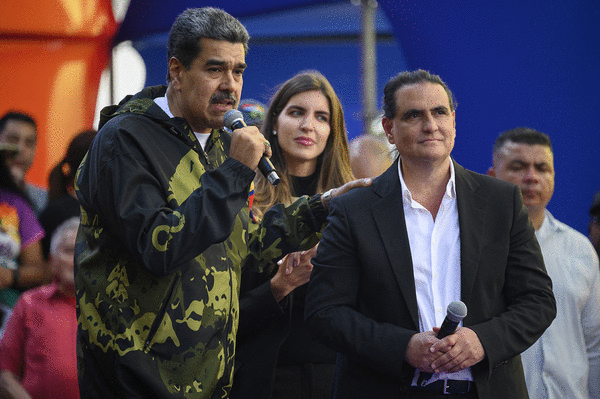
Alex Saab, a once-powerful financial fixer for former Venezuelan strongman Nicolás Maduro who vanished from public view last month, is likely to be extradited soon to the United States following intense negotiations between U.S. officials and Venezuela’s interim government led by Delcy Rodríguez, sources familiar with the discussions told the Miami Herald.
Saab’s extradition —which would be the second extradition of the Colombian businessman to the United States— has become a central piece of a broader set of talks between Washington and Caracas that could shape the future of Venezuela’s fragile political transition and influence the prosecution of Maduro and his wife, Cilia Flores, who are facing criminal charges in New York.
According to sources who spoke on condition of anonymity because they were not authorized to discuss the negotiations publicly, the discussions have covered a wide range of political and legal issues. But enough progress appears to have been made to make Saab’s extradition increasingly likely.
Saab disappeared from view in early February amid reports in Venezuelan media that he had been detained shortly after Rodríguez removed him from his post as minister of industry and national production.
Saab, widely described by investigators as a close Maduro associate and financial operator, had previously spent more than two years in U.S. custody after being extradited from Cape Verde to Miami in 2021. U.S. prosecutors had accused him of orchestrating a $350 million money-laundering scheme tied to contracts with Venezuela’s government.
That case ended in December 2023 when President Joe Biden granted Saab a pardon as part of a prisoner exchange agreement with the Maduro regime.
But U.S. officials have continued to pursue other investigations involving Saab, particularly allegations tied to Venezuela’s food subsidy program known as CLAP. Prosecutors have long accused Saab of building a vast network of shell companies and intermediaries that overcharged the Venezuelan government for imported food while generating enormous profits for regime insiders.
Sources familiar with the current negotiations say Saab’s value to U.S. authorities goes beyond bringing him back to face charges.
“The U.S. needs Saab because he has crucial information about Maduro’s financial operations and can provide evidence for narcoterrorism charges,” one source told the Herald. “He managed the money. If investigators want to show how funds moved through the system and how those funds may have supported criminal activities, Saab is a key witness.”
According to the sources, U.S. officials believe Saab could provide detailed information about financial networks used by Maduro’s inner circle, including accounts, intermediaries and international business arrangements that helped move billions of dollars through global banking systems.
His potential testimony could become particularly significant as prosecutors prepare their case against Maduro and Flores, who are accused by U.S. authorities of participating in a long-running narcoterrorism conspiracy involving Venezuela’s military and political leadership.
Rodríguez emerged as Venezuela’s interim leader after a dramatic turn of events on Jan. 3, when a U.S. military operation resulted in the capture of Maduro and his removal from power. The operation — described by Washington as the culmination of a years-long criminal investigation into alleged narcoterrorism activities by the Venezuelan leadership — abruptly ended more than a decade of Maduro’s rule and triggered a scramble among senior regime figures to stabilize the country’s governing structure.
In the aftermath of Maduro’s capture, senior officials within the ruling coalition and the National Assembly moved quickly to install Rodríguez as interim president, presenting the arrangement as a temporary measure intended to maintain institutional continuity while negotiations with the United States and international partners unfolded. Her government has since been navigating a delicate transition, balancing pressure from Washington for cooperation on corruption and criminal cases with the demands of powerful figures within Venezuela’s military and security apparatus who remain wary of the rapidly shifting political landscape.
The discussions over Saab’s fate are part of a larger negotiation between Washington and the interim government that emerged after Maduro’s capture.
Sources say the United States has presented a series of demands to give the government in Caracas an opportunity to demonstrate it is willing to cooperate with international justice efforts and dismantle elements of the old regime’s criminal networks.
Among the most sensitive issues is the future of powerful security officials still serving in the Venezuelan government.
Interior Minister Diosdado Cabello and Defense Minister Vladimir Padrino López both face U.S. indictments and multimillion-dollar rewards for information leading to their arrest. U.S. prosecutors accuse them of helping lead the so-called Cartel de los Soles, an alleged drug trafficking organization that prosecutors say operated with the protection of the Venezuelan state.
Sources say Washington has not demanded that Rodríguez immediately hand over Cabello or Padrino López for prosecution in the United States.
Instead, the Trump administration has so far pushed for their removal from positions of power, a step seen as necessary to restructure Venezuela’s military and security apparatus during the transition.
That demand has triggered delicate internal maneuvering within the government as officials attempt to identify potential replacements who could be acceptable both to Washington and to influential factions within Venezuela’s armed forces.
Within that context, Saab’s extradition has emerged as a potential bargaining chip.
“The regime made it known that they would be willing to hand over Saab if the United States granted certain concessions,” one source said.
Another figure sought by U.S. authorities, Venezuelan media magnate Raúl Gorrín, has also surfaced in the talks.
Gorrín, the owner of Caracas-based television network Globovisión, has been indicted in the United States for allegedly participating in a massive scheme to siphon more than $1 billion from Venezuela’s state oil company and launder the proceeds through U.S. banks and luxury real estate purchases.
His extradition has reportedly faced resistance from powerful figures within the Venezuelan government, including Cabello, according to people familiar with the negotiations.
Sources say Cabello has attempted to leverage his influence within the security apparatus to shape the outcome of the talks, including pushing for a say over who would replace him in key positions and pressing for guarantees that opposition leader María Corina Machado would not be allowed to return to Venezuela.
The delicate negotiations have also unfolded against a backdrop of rising distrust between Washington and Rodríguez’s interim government.
Earlier this week, a Reuters report citing anonymous sources said the U.S. Justice Department had been quietly preparing a potential corruption indictment against Rodríguez tied to alleged financial dealings involving Venezuela’s state oil company, PDVSA.
U.S. officials quickly rejected the report, but sources familiar with the situation said the leak was widely interpreted within Venezuelan political circles as a warning to Rodriguez from Washington.
According to one source with direct knowledge of the discussions, U.S. intelligence agencies have been closely monitoring Rodríguez’s communications and believe she has sent conflicting messages to different government officials as she tries to navigate the complex transition.
“They know what she is saying and what she is thinking,” the source said. “The message was that the United States is aware of the double game.”
For now, however, the negotiations appear to be moving forward, with Saab’s potential extradition emerging as one of the most immediate and consequential outcomes.
If completed, his transfer to U.S. custody could provide prosecutors with one of the most important insider witnesses yet in their effort to unravel the financial networks that sustained Venezuela’s former regime.
©2026 Miami Herald. Visit miamiherald.com. Distributed by Tribune Content Agency, LLC.





Comments