Minnesota farms face labor shortage as workers fear federal immigration action
Published in News & Features
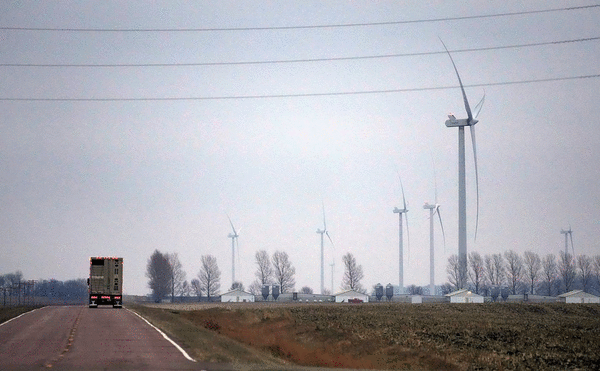
MINNEAPOLIS — Minnesota farmers are worried they won’t have enough hands to tend livestock and manage crops this year, a consequence of ongoing federal immigration enforcement in the state targeting undocumented workers from Latin America who keep U.S. agriculture churning.
While the thousands of Immigration and Customs Enforcement (ICE) agents who’ve descended on Minnesota have focused on the Twin Cities, rural communities are feeling their presence, too.
ICE has recently raided dairy farms, according to farmers and industry leaders, and crop growers are worried they won’t have enough temporary visa holders to work the fields come spring.
The immigration enforcement has created a climate of fear among both undocumented and documented workers, and made farmers unsure if they’ll survive the growing season.
Even before Operation Metro Surge began in December, ag leaders like Land O’Lakes CEO Beth Ford warned that President Donald Trump’s hard stance on immigration could stoke a farm labor crisis. Workers were already in short supply, and the industry was grappling with the fallout from federal trade and agriculture policies that have reduced incomes and raised costs.
It’s difficult to track exactly how many foreign-born workers work on Minnesota farms each year, particularly those who are undocumented. Nationally, the majority of a total of about 1 million hired farmworkers are noncitizen immigrants, according to a KFF analysis.
Foreign-born workers make up about 10% of Minnesota’s total employment in the U.S. Census category that includes agriculture, though that only counts year-round employment. Federal data on seasonal H-2A visa holders shows more than 4,000 people traveled to Minnesota to work temporary agriculture jobs in 2024, a number that has dropped since Trump took office.
If people employed on farms are afraid to come to work, or if ICE were to detain and deport many of them, it could spell catastrophe for Minnesota farms across the global food supply chain.
A group of 27 retired ag and government officials recently wrote a letter to members of Congress warning of a “widespread collapse” of the agriculture industry.
“Mass deportations, removal of protected status and failure to reform the H-2A visa program are wreaking havoc with dairy, fruit and produce and meat processing,” the bipartisan group wrote. “Those disruptions are causing food to go to waste and driving up food costs for consumers.”
Farmers are used to weathering unexpected challenges, said Josh Bryceson, a Wisconsin farmer and director of grower support at the Good Acre, a Falcon Heights-based nonprofit. But this one, he said, “could be insurmountable.”
“You may have seventh-generation farmers just having no other choice but to just sell off the farm,” Bryceson said, “because there’s no one there to do the work.”
It’s unclear how many farmworkers Minnesota might lose this year because of ramped-up immigration enforcement, but U.S. Department of Labor data shows the state had already experienced a loss.
In the first half of 2025, after Trump took office for the second time and his administration’s immigration policies took hold, the number of agricultural workers with H-2A visas in Minnesota fell about 12% compared with the same period in 2024, according to analysis by Fernando Quijano, an economist and University of Minnesota Extension educator.
Minnesota faces a growing worker shortage as its population ages and the state can’t afford to go without immigrant workers, he said.
“We’re losing population. Communities are shrinking. We need every precious body we can get,” Quijano said.
“This situation is the worst thing that could have happened to Minnesota in this particular moment, in terms of the demographics.”
John Rosenow owns a 700-cow dairy farm about 100 miles southeast of the Twin Cities just across the Mississippi River in Waumandee, Wis. He said 13 of his 18 employees are Mexican green card holders. He said ICE showed up once at his farm a decade ago, searching for an employee’s son. Unlike now, Rosenow said, the agents didn’t wear face coverings.
There hasn’t been much ICE activity in Wisconsin recently, he said, but if federal agents were to detain his employees, he would immediately reach for the cattle buyer’s phone number he keeps in a drawer.
“We would have to get out of here within a day,” Rosenow said, “because we would not be able to keep up with the work.”
Some Minnesota farmers are responding to stepped-up immigration enforcement by supporting local immigrant families who are in hiding and unable to work, said Lucy Richardson of Hispanic Outreach of Goodhue County. Others are simply angry.
“They thought that this administration was going to leave them alone,” she said. “And that’s just not true. Farmers definitely are very upset.”
State Rep. Andy Smith, a DFL co-vice chair on the House Agricultural Finance Committee, said lawmakers will try to address immediate economic issues by funding food purchasing programs around Minnesota. But he warned there isn’t much the state can do on its own to mitigate labor losses.
Like the central cities, Minnesota’s farm regions face an economic hit that is coming into focus. With immigrant workers afraid to leave home, farmers who depend on their labor and Main Street business owners who count them as customers are falling behind.
Crop growers planning for the coming season are wondering if the temporary visa holders they typically hire will show up this year. In the long term, farmers worry that the plants they depend on to process their hogs or corn at the end of the season won’t have enough employees to operate.
“What we’re hearing from the farmers is the workers are going to decide to go to another state,” said Minnesota Agriculture Commissioner Thom Petersen. “There’s jobs out there. You don’t have to come to Minnesota.”
One 36-year-old dairy farmworker came to Minnesota because it seemed safe, a place where he and eventually his family could escape the poverty and violence of their native Mexico.
But six years after arriving and a year after applying for a visa, he and his fellow workers now spend their few off hours hiding in the trailer they pay their employer to rent, fearful of ICE.
The man, who asked not to be identified because he is undocumented, said he and his fellow workers live in conditions more suitable for animals than humans.
For nearly three weeks this winter, he said, their trailer had no running water. They wash their clothes in the same area where they do laundry for the cows. They rely on community help for food and have started making their own tortillas because they can’t risk a visit to the grocery store.
What the man said he fears most is not deportation but maltreatment at the hands federal agents if they were to find him.
“They’re detaining citizens. They’re killing people with papers,” he said in Spanish. “Imagine what could happen to us.”
Just across the Minnesota-Wisconsin border, Rodrigo, who has owned and operated a 46-acre vegetable farm since 2008, relies mostly on family help but also hires some seasonal workers. Like many farmers, he’s unsure those workers will come.
Another source of anxiety: detention. The 52-year-old, who asked to withhold his last name because he is undocumented, is trying to do as much of his work indoors as he can, sticking to the house, the garage, the barns.
“I’m trying to be invisible,” he said in Spanish.
Theresa Schneider, executive director at the Good Acre, said the organization works with immigrant farmers who are afraid to transport their goods or sell at farmers markets, creating uncertainty for them and their buyers.
To alleviate some of that fear and uncertainty, she said, the Good Acre facilitates contracts that reduce financial risk for both farmers and customers. That also allows the organization, instead of the farmers, to manage distribution logistics.
“When farmers can’t plan with confidence for the season, the entire farm-to-market pathway becomes really fragile,” Schneider said. “It’s really hard to recover from those kinds of shocks.”
Ultimately, farmers’ ability to raise animals and harvest crops is about the most basic need: putting food on the table.
“We can go without everything. We can go without a phone. We can go without electricity,” Rodrigo said. “But we can’t go without food.”
©2026 The Minnesota Star Tribune. Visit at startribune.com. Distributed by Tribune Content Agency, LLC.





Comments