Maryland GOP urges Democrats to slow emergency bills ending ICE agreements
Published in News & Features
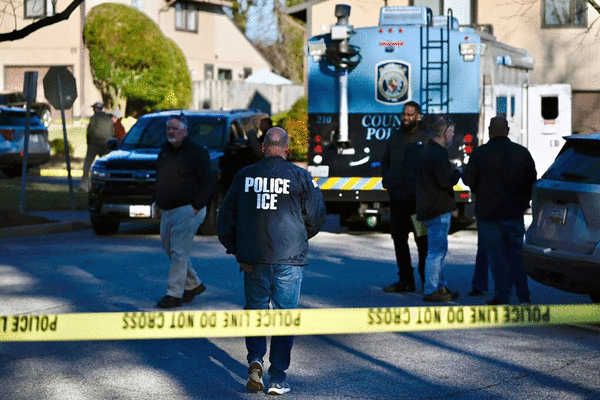
Maryland Republican lawmakers are urging Democratic leaders to slow down emergency legislation that would end local cooperation agreements with federal immigration authorities, arguing the General Assembly is moving too quickly amid shifting national conditions and legal uncertainty.
The identical bills — House Bill 488 and Senate Bill 245 — would immediately terminate all existing 287(g) agreements, which allow local law enforcement agencies to cooperate with U.S. Immigration and Customs Enforcement. Eight Maryland counties currently participate in 287(g) agreements: Allegany, Carroll, Cecil, Frederick, Garrett, Harford, St. Mary’s and Washington. The bills would also bar counties from entering into new agreements.
The measures are scheduled for a final vote on Thursday in both chambers. If approved, they would head to Gov. Wes Moore’s desk for a signature that would make them law.
On the Senate floor Tuesday, Senate Minority Whip Justin Ready of Carroll County asked whether the legislation still warrants emergency status and urged lawmakers to delay final passage.
“I really feel very strongly that waiting a week or two would not be a bad idea,” Ready said, citing what he described as reduced tensions and shifting cooperation between local and federal officials in Minnesota, where federal officers have killed two people this year, Alex Pretti and Renee Good. “Allow temperatures to cool down.”
Ready, who has strongly opposed the bill, also defended sheriffs currently participating in 287(g) programs, saying they have acted “in good faith” and without significant problems.
Still, Senate President Bill Ferguson, a Baltimore Democrat, pushed back on Ready’s claims, saying there has been no meaningful de-escalation of federal enforcement activity in Maryland or in other states. “What I hear from folks in my community every day is true and utter terror,” Ferguson told The Baltimore Sun Tuesday, citing concerns about increased ICE activity as the agency has expanded its physical presence across the state through detention facilities.
“We need to move this particular policy forward … We need to make sure that Marylanders have confidence and respect and trust in law enforcement, which ICE is undermining on a daily basis.”
In separate text messages following Ready’s remarks, Republican leaders in both chambers echoed his call for a brief pause, framing it as a matter of timing.
House Minority Leader Jason Buckel, who represents Allegany County, said delaying final passage would allow lawmakers to assess whether changes in federal tactics could reduce the need for aggressive ICE enforcement at the local level.
“I think [the additional time] would be prudent, given that Minnesota and other states are apparently willing to cooperate more with federal authorities,” Buckel told The Sun, adding that 287(g) agreements can limit street-level ICE enforcement. He said that he does not expect Democratic leadership to be persuaded, adding they view the issue “through a political rather than a public safety lens.”
Senate Minority Leader Steve Hershey, who represents parts of the Eastern Shore, shared a similar sentiment. “A short delay — just a week or two — isn’t about opposing enforcement or safety,” Hershey told The Sun. “It’s about ensuring that the policy responds to the most accurate, up-to-date conditions and includes meaningful input from the very law enforcement professionals who will be tasked with implementing it.”
Hershey warned that “rushing a policy in response to conditions that may be rapidly changing risks enacting law that is either redundant or misaligned with current realities.”
House Democratic leaders, however, dismissed those concerns, saying the legislature has been debating the issue for years and that sheriffs have long been aware a repeal would come.
“This issue has been before the General Assembly now for nearly a decade,” House Majority Leader David Moon of Montgomery County said. “It’s been thoughtfully undertaken.”
Moon said the decision to immediately repeal the agreements is rooted in public safety and community trust, particularly in immigrant communities. “In counties where police have decided to cooperate proactively with ICE, people are not going to be calling the police for help, even if they’re the victim of a crime,” he said.
Moore echoed Democratic leaders’ sense of urgency, saying the emergency designation reflects the scale of federal immigration enforcement and its impact on Maryland communities.
“The reason that they’re proposing emergency legislation is this is an emergency,” Moore told reporters Tuesday, criticizing ICE’s enforcement priorities and the sharp increase in federal funding for ICE. “I don’t think we’re moving too fast,” he said. “If anything, frankly, I think what we are seeing from this [President Donald] Trump, [Vice President JD] Vance, ICE — they’re the ones who need to be slowed down.”
House Speaker Joseline Peña-Melnyk told reporters Tuesday that she has privately spoken with Moore and expects him to sign the legislation. “He has stated that he will sign it,” she said. When asked directly just an hour earlier whether he would sign the bills if they reached his desk, Moore said his administration has been working with lawmakers and that he would “wait to see what the final bill looks like.”
________
©2026 The Baltimore Sun. Visit at baltimoresun.com. Distributed by Tribune Content Agency, LLC.






Comments