Chicago Mayor Brandon Johnson will not direct ICE misdeeds for charges, following prosecutor criticism
Published in News & Features
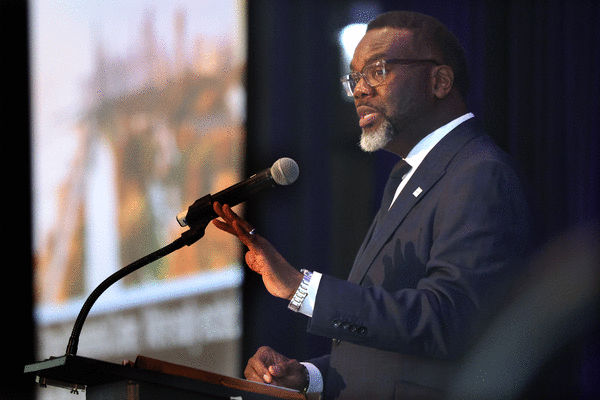
CHICAGO — Mayor Brandon Johnson on Tuesday said he will not refer alleged cases of misconduct by federal immigration agents to the Cook County state’s attorney’s office, following criticism by the top prosecutor that his “ICE on notice” executive order would politicize investigations.
Cook County State’s Attorney Eileen O’Neill Burke released a memo last week saying Johnson’s decree would jeopardize her office’s ability to secure convictions.
Johnson told reporters his order will nonetheless remain as-is, arguing the text “does not necessarily” involve his office in any potential charges against federal immigration agents despite saying “CPD Supervisors must … at the direction of the Mayor’s Office, make a referral of felony matters to the Cook County State’s Attorney.”
“The direction is to the Police Department, not to the state’s attorney,” Johnson said when asked how the “direction” language in the order should be interpreted. “I direct the Police Department all the time … The reason why that direction had to be codified is so that there is no ambiguity around how the Police Department can engage when they’re on site and if they’re witnessing abusive behavior.”
The state’s attorney’s office did not immediately respond to request for comment on Tuesday.
After the mayor’s City Hall news conference, Johnson spokesperson Cassio Mendoza clarified the mayor’s office would not be reviewing individual cases. Usually, law enforcement makes referrals to prosecutors asking them to approve felony charges, so involvement from the mayor’s office would not be typical.
Johnson told reporters “we are having conversations” in the wake of a memo disseminated by Burke’s team on Friday that was critical of his order. But he said work will continue on the 30-day “rule-making process” set out in the order to clarify how it will be implemented.
Johnson’s remarks were the latest volley in the public back-and-forth between the two officials who are at odds over how to respond to federal immigration raids.
And with their offices far from aligned on this issue, the prospects of federal agents facing criminal charges in Cook County Circuit Court for alleged on-duty abuses appear thin.
Johnson has positioned himself as a progressive bulwark against President Donald Trump while navigating a rocky first term. With most Chicago residents opposed to the federal immigration raids dubbed “Operation Midway Blitz” in the city last fall, the mayor has found a point of relative consensus locally by speaking out against the aggressive tactics endorsed by the White House.
Burke, elected in 2024 after running as the moderate candidate in the Democratic primary, has also condemned the mass deportation campaign. But she has cautioned that her office’s scope in bringing charges against on-duty agents would be narrow.
Johnson signed the executive order at the end of last month directing Chicago police to collect evidence, investigate and potentially refer for felony prosecution criminal charges against federal immigration agents accused of misconduct. The freshman mayor had touted it as a first-of-its-kind effort to rein in Trump’s administration that has zeroed in on Chicago and other Democratic-led cities for an aggressive deportation campaign.
But his announcement faced pushback from Burke that afternoon despite the mayor telling reporters she was in “complete support” of the measure. Since then, the temperature has only gone up as Burke wrote in the staff email memo Friday night that the order was “wholly inappropriate” and “jeopardizes our ability to effectively prosecute and secure convictions” against federal agents.
Burke’s email said she was worried that in cases where Johnson’s office was involved in referring a case for potential prosecution, the defense could point to the unusual approach as evidence that Chicago police officers called as witnesses were “directed” by a politically motivated mayor’s office.
The memo also warned that any Johnson staffers issuing directives to law enforcement for case referral could also be called to the witness stand, “creating serious litigation issues.”
If Johnson’s administration will not in fact oversee referring cases to Burke’s office, the most concrete changes from his decree appear to be requiring Chicago police to record federal immigration activity.
The order requires police to verify the names and badge numbers of immigration agents in leadership roles when responding to the scene of immigration enforcement actions. If federal agents do not comply, police should capture that denial with their body cameras, the order states.
It also directs police to preserve and document body-camera footage, notify supervisors if people on site allege immigration agents broke the law and complete more reports that Johnson’s team says would build a foundation for prosecution.
_____
©2026 Chicago Tribune. Visit chicagotribune.com. Distributed by Tribune Content Agency, LLC.




Comments