Cuba warns airlines it's out of jet fuel, announces drastic measures amid US oil blockade
Published in News & Features
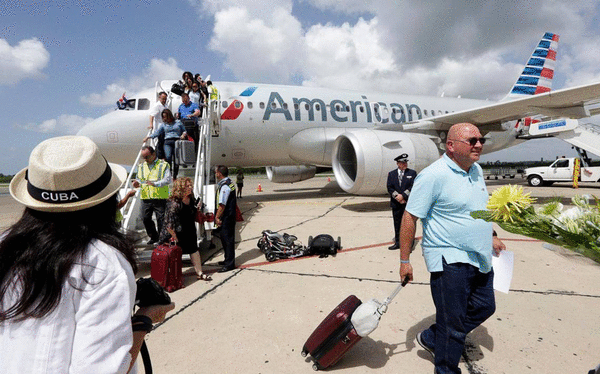
Cuban authorities have notified international airlines that they won’t be able to refuel at the island’s airports, as the country’s energy crisis deepens following President Donald Trump’s steps to cut the island’s oil supply in a push for negotiations.
The Federal Aviation Administration published notices Sunday alerting U.S. airlines that Jet A-1 fuel, commonly used for international flights, will not be available at Cuban international airports, including those in Havana, Santiago de Cuba and Varadero, starting Tuesday, and won’t be available again until March 11 at the earliest.
No flights to Cuba from Miami were canceled on Monday morning, but regular airlines and companies operating chartered flights were assessing the impact of the announcement.
“We are closely monitoring the situation,” American Airlines, which operates 11 daily flights to six destinations in Cuba, said. The airline did not say whether it was expecting cancellations.
Delta Air Lines said there was “no operational impact” on its flights to Havana at this time. Delta operates one daily roundtrip flight from Miami to Havana.
A representative of a charter flight company in Miami, who asked not be named to discuss the company’s internal deliberations, said the company was assessing whether to reduce passenger and baggage loads on flights, so the planes could return from Havana without refueling. The company was not yet considering suspending flights, the representative added.
Air Canada, a major carrier of Canadian tourists, said that effective Monday it is suspending its service to Cuba due to the ongoing shortage of aviation fuel. The airline said it would operate “empty flights southbound” to pick up approximately 3,000 Canadians that are currently on the island. Air Europa said it would add a stop on the Dominican Republic to refuel on its Madrid-Havana route.
Though Cuba has issued similar temporary warnings at other times of oil shortages, this time might be different.
Cuban leaders said they haven’t received oil since December, when a U.S. armada blocked oil shipments from Venezuela bound for the island. Trump also recently signed an executive order to impose tariffs on Cuba’s oil suppliers, in a move to pressure Mexico to stop sending oil to the island.
Consultancy data and analytics firm Kpler said that Cuba received 84,900 barrels this year from a single Mexican shipment on Jan. 9. Mexican President Claudia Sheinbaum confirmed last week that the national petroleum company, Pemex, has halted shipments, waiting to find a diplomatic solution with the U.S. to resume the supply. The firm said Cuba’s oil reserves would be depleted by the end of this month, the Financial Times reported.
The warning to airlines speaks to the critical situation on the island and may worsen the outlook for the tourism industry, one of Cuba’s main sources of foreign revenue that has been in decline as the country’s economic crisis deepened in recent years.
On Friday, Cuba’s vice prime minister, Oscar Pérez Oliva-Fraga, said the government is planning to “compact” tourists into a smaller number of hotels as part of an austerity plan that includes severe restrictions on public transportation – especially between provinces – a four-day work schedule for state workers, reduced school hours and the suspension of non-emergency surgeries.
The government also halted sales of gasoline in Cuban pesos and rationed sales in dollars, a move that will likely affect food deliveries by Miami-based online supermarkets and private businesses.
Oliva-Fraga reassured the population the country “would not collapse,” departing from the more alarming tone set by the country’s leader, Miguel Díaz-Canel, the day earlier.
Díaz-Canel had warned the population that the fuel crisis would impact food distribution by the state too.
“We are going to eat what is produced in each place,” he said. “If there is less fuel now, food will not be able to be transported from one municipality to another.”
He also proposed that the population use “solar ovens” to cook, which prompted derision among many Cubans, who took to social media to question his remarks and his call for greater sacrifice in the name of the 67-year-old revolution.
“It’s impossible to demand sacrifice (it’s high time we said it: sacrificing one’s life) when some people are poor while others are rich,” said Ulises Toirac, a comedian on the island. “When some people are in utter destitution while others live in such opulence that they become disconnected from the rest of society. When there’s no real understanding of what it means to say ‘difficult times are coming’ at the worst possible moment in people’s lives.”
Hugo Cancio, a Cuban American from Miami who supported President Barack Obama’s engagement policies and is the owner of Katapulk, an online supermarket that delivers food on the island, penned an openly critical editorial on his news site On Cuba criticizing Díaz-Canel’s speech.
“I would say it is no longer fair or reasonable to keep asking for sacrifices from people already living at the limit in order to sustain a dysfunctional system of government,” Cancio told the Miami Herald. “External pressures have undoubtedly had a real and negative impact, but regardless of circumstances, the fundamental responsibility of any government is to govern for the benefit of its people.
“When daily life becomes a struggle for the basics, asking for more effort without offering concrete solutions ceases to be leadership and becomes a profound disconnect from the reality people are living,” he added.
Despite calls for change from Cubans on the island and abroad, Cuban leaders have said they are ready to talk to the United States, but ruled out changes to its economic or political system.
Even at this difficult moment, Cuban authorities continued arresting those who criticize the government on social media.
The U.S. State Department called for the release of two influencers running social media accounts named El4tico who identify themselves as dissidents and have frequently referred to the Cuban government as a dictatorship.
“The illegitimate Cuban regime continues with its daily acts of repression and abuses. It detained #El4tico Kamil Zayas Pérez and Ernesto Ricardo Medina in Holguín simply for speaking out about the dictatorship’s economic mismanagement,” the State Department’s Bureau of Western Hemisphere Affairs posted on X.
Other young influencers on the island, including four wearing “Make Cuba Great Again” hats, have called for the release of the two influencers in videos circulating on social media.
“This time we are not going to stay silent, because we are all el4tico,” Ana Sofía Benítez, a 21-year-old influencer who has gained a following exposing the government’s double standards and the scarcities Cubans face, said on a video.
“You cannot silence us all.”
_____
El Nuevo Herald reporter Verónica Egui Brito and Miami Herald reported Vinod Sreeharsha contributed to this report.
_____
©2026 Miami Herald. Visit miamiherald.com. Distributed by Tribune Content Agency, LLC.






Comments