How the arrival of thousands of federal agents has shaken Minnesota
Published in News & Features
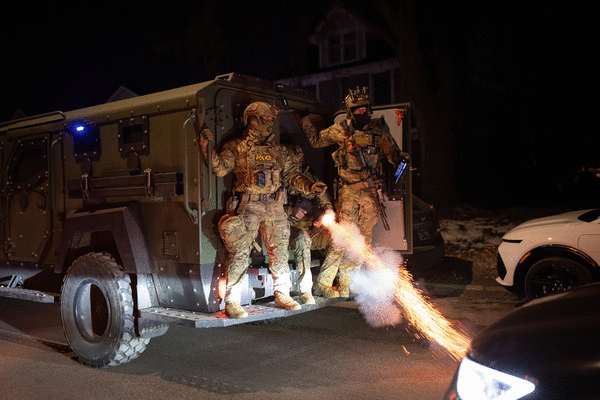
MINNEAPOLIS — Nine days after a U.S. Immigration and Customs Enforcement agent shot and killed 37-year-old Minneapolis resident Renee Good during a federal immigration operation, the city and state remain in upheaval.
Federal actions have intensified since the Jan. 7 shooting as observers and protesters continue to record and confront agents. Meanwhile, lawsuits challenging the federal surge have been filed, the president has threatened to invoke the Insurrection Act and a group of senior federal prosecutors in Minnesota have resigned.
In the midst of all of this, a second shooting involving a federal agent on Jan. 14 resulted in heightened anxieties and calls for calm.
While the Department of Homeland Security launched Operation Metro Surge in the Twin Cities on Dec. 1, enforcement activity picked up considerably in the last two weeks.
DHS Secretary Kristi Noem said Jan. 15 there are “no plans to pull out of Minnesota,” and U.S. Customs and Border Protection Cmdr. Gregory Bovino said in a recent television interview with WCCO that the operation has no end date, even as legal challenges and political pressure mount.
Here is a recap of the key developments.
Good was fatally shot on the morning of Jan. 7 near E. 34th Street and Portland Avenue during what federal officials described as an immigration enforcement operation.
Video captured by bystanders shows ICE agent Jonathan Ross and other federal agents approach Good’s vehicle, which was stopped in a perpendicular position, partially blocking the road. As she attempted to drive away, Ross fired multiple shots into the SUV. Good’s vehicle continued forward before crashing into a parked car.
Federal officials, including Homeland Security Secretary Kristi Noem, repeatedly have said Ross fired in self-defense after Good “weaponized” her vehicle and attempted to run over agents.
Minneapolis officials, witnesses, civil rights advocates and members of Good’s family dispute that account, saying video evidence does not support claims that agents were struck or faced an imminent threat.
Good was transported to the hospital and later pronounced dead. As of Friday, nine days since Good’s death, the Hennepin County Medical Examiner’s Office had not released the cause or manner of her death. The Minnesota Star Tribune has an official request pending for preliminary findings.
A Minneapolis Fire Department incident report said she was found with four gunshot wounds to the chest, arm and head.
Good’s body was returned to her family several days ago, though they also have not learned anything about the autopsy from the Medical Examiner’s Office.
Hennepin County Medical Examiner’s Office spokeswoman Carolyn Marinan said she had no further information about when autopsy findings might be released. In 2020, the same office released the cause and manner of George Floyd’s death seven days after he was killed.
No criminal charges have been filed against Ross.
Charging decisions in cases involving federal law enforcement typically require a completed investigative file and review by prosecutors.
Minnesota Attorney General Keith Ellison and Hennepin County Attorney Mary Moriarty have said their offices have jurisdiction to review the case but have emphasized that their ability to do so is constrained by limited access to evidence.
Federal officials have not said whether the U.S. Department of Justice is actively considering charges, nor have they provided a timeline for a prosecutorial decision.
In the hours after Good’s death, the Minnesota Bureau of Criminal Apprehension announced it would jointly investigate the shooting with the FBI. That agreement was later reversed by federal officials, and the BCA was removed from the case.
The FBI now controls the primary investigation and has declined to share key evidence, including Good’s vehicle, with state and local authorities. State officials also have said they do not have access to all video footage, forensic evidence or investigative interviews.
Ellison and Moriarty have said the lack of access undermines transparency and public trust. While both offices announced plans to pursue an independent state investigation, they acknowledged that without cooperation from federal authorities, their review would be limited.
Federal officials have not released a full investigative timeline or said when findings might be made public.
The shooting occurred amid Operation Metro Surge, a sweeping federal immigration crackdown that began in early December and dramatically expanded in the first weeks of January.
Federal officials say between 2,000 and 3,000 agents from ICE, U.S. Customs and Border Protection and other DHS agencies have been deployed to Minnesota, and that more than 2,500 people have been arrested.
In the days since the shooting, immigration agents have conducted arrests across Minneapolis, St. Paul and greater Minnesota, including at workplaces, restaurants, apartment complexes, hospitals and near schools.
Many U.S. citizens have been detained. Some have been detained briefly and released, while others were held for hours and later released. Teachers, parents and legal observers have reported being detained or confronted while documenting enforcement activity.
Attendance has dropped sharply in schools, and public transit ridership has declined as residents avoid buses and trains out of fear of ICE encounters.
Minneapolis Public Schools closed for two days following Good’s death, citing safety concerns. Starting Jan. 12, the district provided a remote option to students for the following month.
St. Paul’s school district also announced it would offer online learning starting on Jan. 22. The district previously closed on Jan. 14 and canceled in-person classes from Jan. 19 to Jan. 21 to prepare for the temporary virtual learning option.
Fridley closed schools and Columbia Heights shifted to online learning on Jan. 9 following Good’s killing. Both Fridley and Robbinsdale also offered e-learning after a Robbinsdale student’s parent was detained at a school bus stop.
The turmoil following Good’s killing has also triggered a rare shakeup inside Minnesota’s U.S. Attorney’s Office.
On Jan. 13, a majority of the office’s leadership team resigned, including Joe Thompson, the lead federal prosecutor who spearheaded major fraud cases in Minnesota and previously served as acting U.S. attorney. At least five other senior prosecutors also left.
According to sources familiar with the departures, the resignations stemmed directly from directives issued by top Justice Department officials after Good was killed. Those directives included blocking the BCA from participating in the shooting investigation and a request from federal officials to investigate Good’s widow for possible charges.
Thompson’s resignation also reflected broader frustration, a source told the Minnesota Star Tribune, that the Trump administration’s immigration enforcement surge in Minnesota had effectively eclipsed ongoing fraud investigations that Thompson had led.
The federal government has cited the fraud investigations to justify the surge of ICE agents in the state.
Gov. Tim Walz said the resignations were a result of President Donald Trump pushing out career professionals and replacing them with political loyalists. Minneapolis Police Chief Brian O’Hara called Thompson’s departure a significant blow to the justice system.
The resignations in Minnesota coincided with reports of a broader wave of departures from the Justice Department’s Civil Rights Division, which recently learned it would not pursue a civil rights investigation into Good’s killing.
On the evening of Jan. 14, a federal agent shot a man in the leg during an encounter in north Minneapolis.
According to the DHS, ICE was attempting a traffic stop when a man fled and a struggle ensued; two others reportedly attacked the agent with a snow shovel and broomstick, prompting the agent to fire in self-defense.
The man who was shot, identified as Venezuelan national Julio Cesar Sosa-Celis, and the agent were taken to a hospital. The incident drew crowds and sparked fresh protests near the scene.
Federal officials later announced two arrests related to vandalism and theft of government property during unrest that followed the non-fatal shooting.
In response to the protests, Trump on Jan. 15 publicly threatened to invoke the Insurrection Act, a rarely used law that would allow the deployment of federal troops domestically to suppress civil disorder.
Walz, Minneapolis Mayor Jacob Frey and St. Paul Mayor Kaohly Her have demanded that ICE leave Minnesota and end Operation Metro Surge, calling the operation reckless and unconstitutional. Ellison, along with Minneapolis and St. Paul, filed a lawsuit on Jan. 12 seeking to halt the federal surge.
A separate class action lawsuit filed Jan. 15 by the ACLU and ACLU of Minnesota on behalf of Somali and Latino residents alleges racial profiling, unlawful arrests and civil-rights violations during the surge.
The lawsuit alleges agents routinely detain people without warrants or probable cause, ignore proof of citizenship or lawful status and target individuals based on race or perceived ethnicity, in violation of the Fourth and Fifth Amendments. The DHS denied the claims, calling them false, and said enforcement actions are based on immigration status, not race.
In Washington, House Democrats, including Minnesota’s four Democrats in Congress, have introduced articles of impeachment against Noem over her handling of the Trump administration’s immigration crackdown. The articles include charges of obstruction of Congress, “violation of public trust” and “self-dealing.”
_____
Paul Walsh of the Minnesota Star Tribune contributed to this story.
_____
©2026 The Minnesota Star Tribune. Visit startribune.com. Distributed by Tribune Content Agency, LLC




Comments