Colorado Gov. Jared Polis highlights achievements on education, housing as he pitches final year's agenda
Published in News & Features
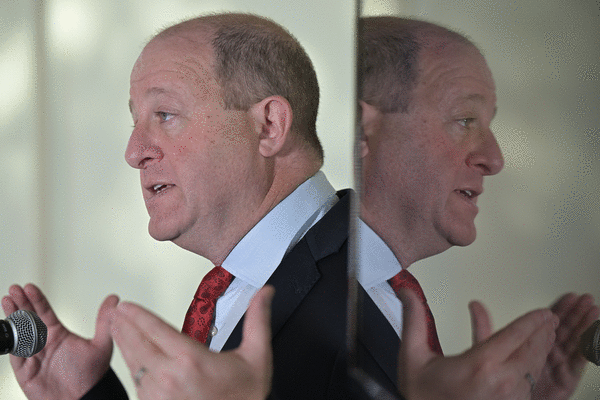
DENVER — Gov. Jared Polis used his final State of the State speech to highlight achievements made on housing, education and transportation over his tenure, work that he said would continue through his final year.
He delivered his speech to a joint session of the Colorado legislature on Thursday as lawmakers grapple with a major budget gap as well as divisions with both Polis and the federal government.
Polis is term-limited, making this his eighth and final State of the State address. He was first elected governor in 2018 and reelected in 2022. His rise in state politics coincided with the state’s distinctly blue shift. Along with Polis’ election, voters have delivered Democrats control of both chambers of the General Assembly during his time in office.
In his tenure, he oversaw the state’s response to the COVID-19 pandemic, delivered free full-day kindergarten and partial preschool. He also worked with lawmakers to erase the so-called budget stabilization factor, or the budget maneuver that allowed the state to fund education below the level mandated by the Colorado Constitution. Polis called that effort a “beast.”
Among the other achievements he highlighted in his speech: Colorado becoming the new home of the Sundance Film Festival, the development of renewable energy infrastructure, the cutting of income taxes, and then-President Joe Biden’s designation of Camp Hale as a national monument.
“When it comes to turning my bold agenda into a better daily life for Coloradans, we haven’t always succeeded on our first try,” Polis said, according to his prepared remarks. “But we’ve always stepped back up to the plate — because that’s what we do in Colorado.”
Polis, who recently had taken a less pointed stance toward the Trump administration than other Colorado Democrats, also ripped the Republicans who control Congress. Donald Trump’s tariffs are costing Coloradans money, Polis said, and federal actions are threatening $1 billion in cuts to state programs.
“Washington Republicans — once the self-proclaimed party of states’ rights and small government — today are too often the party of socialism, overreach and intrusion into people’s daily lives in ways that are wholly out of the scope of government,” Polis said. “Picking corporate winners and losers — whether it’s co-opting capitalism with cronyism, it often feels like big government is in our wallets, our doctor’s offices, in our homes, bullying businesses of all sizes.”
The federal administration’s recent assault on immigrants makes “words on the Statue of Liberty beckoning those who come to ‘breathe free’ ring hollow,” Polis said.
“In our Colorado for All, we welcome immigrants and refugees who seek to build a better life here, who strengthen our economy and enrich our communities under the shelter of our democracy,” Polis said. “In our Colorado for All, an attack on one of us is an attack on all of us.”
Polis delivered the lengthy speech — he spoke for more than an hour and 20 minutes — in a packed Colorado House of Representatives chamber in the state Capitol. He wore a bolo tie stylized with the emblem of a Colorado C. He drew applause from Republicans on calls to further cut income taxes, while most Democrats sat.
The applause flipped, with Democrats delivering a standing ovation, when Polis called out the Trump administration’s assault on immigrants.
Trifecta control of state government by his party hasn’t resulted in automatic smooth sailing for the governor. Most recently, he has tussled with his fellow Democrats on land-use measures and technology regulations.
In his speech, Polis said he hoped to continue to work on land-use issues. (He also made a joke about lawsuit threats the state often sees from Kevin Bommer, the head of the Colorado Municipal League, when he or his members see the state encroaching on local control.)
Polis said he would seek to give local governments more resources to build and improve bus and train stations, and unite them with more housing near transit hubs.
Regarding artificial intelligence, the subject of pending regulations that both Polis and lawmakers want to adjust, he called on state officials to “act thoughtfully to embrace innovation while empowering consumers.”
He highlighted a slew of achievements in public transit, such as the expansion of the state’s Bustang regional bus routes. But he also nodded at an upcoming fight over the Regional Transportation District, the agency that oversees public transit in metro Denver.
“Until we have a world-class metro area transit agency with RTD, we simply cannot meet our climate or affordability goals,” Polis said. “This begins with governance changes, increased accountability and transparency, and a stronger partnership between the cities it serves and the transit agency.”
The final legislative session of Polis’ tenure is guaranteed to have its share of speed bumps.
The state again faces a deep budget deficit as ballooning Medicaid costs eat up an ever-growing share of state spending. Polis has proposed a slew of Medicaid cuts to try to bend the program toward fiscal sustainability, which could set off a battle with Coloradans who rely on the service — especially those with severe intellectual and developmental disabilities.
“The reality is that health care expenses are rising far faster than the rest of our budget,” Polis said. “We must take action to bring Medicaid costs to a more sustainable level and protect access for the 1.2 million Coloradans who rely on Medicaid.”
He said Americans are “getting screwed on health care,” but the state can’t solve the problem alone. Universal health care, from the federal government, would cost less and provide better health outcomes, he said.
“We will continue fighting for Coloradans, but ultimately, we need Washington to step up and take real action on a real solution. Call it what you will — a social insurance model, multipayer universal health care, Medicare for All, a single-payer system with private insurance and care on top — no matter the jargon, the outcome is what matters: health care for everyone at lower costs,” Polis said.
Polis has also — again — sought to privatize Pinnacol Assurance, the state’s workers’ compensation insurer of last resort. That proposal appears dead on arrival in the legislature.
Polis nonetheless highlighted the effort in his State of the State speech.
Converting the Pinnacol would “shore up our workers’ compensation system to better protect workers,” while setting up the quasi-governmental agency for long-term success in a changing marketplace, Polis said. It would also give the state some budgetary relief. The governor tied the potential sale to keeping the senior homestead exemption for property taxes fully funded.
Polis concluded his speech with another acknowledgement that this would be his last — and that whoever addresses the General Assembly next year might not be as eager to sign some of the bills lawmakers are working on.
“I encourage all of you to take this year to lead on issues you know I will agree with you on perhaps more than the next governor, whether it’s school choice, eliminating puppy mills, technology innovation, supporting blockchain and crypto, or reducing the income tax — now’s your chance,” Polis said. “And on issues you know I disagree with you on, let’s work together to find agreement.”
-----------
©2026 MediaNews Group, Inc. Visit at denverpost.com. Distributed by Tribune Content Agency, LLC.






Comments