At least 3 Americans freed in Venezuela amid slow political-prisoner releases
Published in News & Features
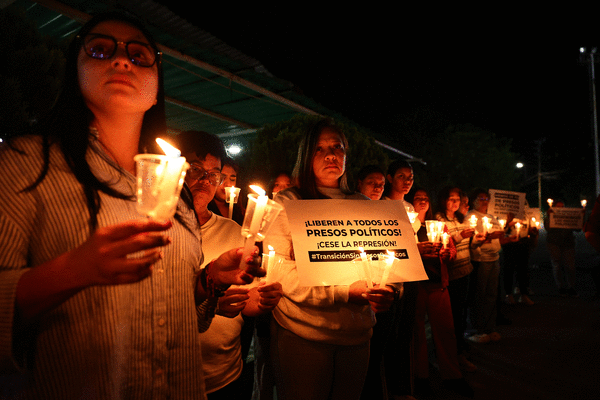
At least three Americans have been released from detention in Venezuela, the latest in a slow-moving and contested process to free political prisoners following the nighttime raid earlier this month that captured strongman Nicolás Maduro.
U.S. officials confirmed that a small number of Americans were freed, though they did not provide identities or details about the circumstances of their detention.
“We welcome the release of detained Americans in Venezuela,” the U.S. State Department said in a statement. “This is an important step in the right direction by the interim authorities.”
The Americans were released as of Tuesday night, according to a source familiar with the events who spoke to The New York Times on condition of anonymity because of the sensitivity surrounding the diplomacy. One of the Americans had been held in a prison in Caracas, a separate source said. Further details were not immediately available. Bloomberg first reported one of the releases.
Despite the slow progress, President Donald Trump said on Wednesday he held a lengthy and “excellent” phone call with Venezuela’s interim president, Delcy Rodríguez, calling her as a “fantastic person” and signaling a renewed effort to restore diplomatic ties between the two countries after years of rupture.
“Today we had an excellent conversation and she is a fantastic person. In fact, she is someone we have worked very well with,” Trump told reporters in the Oval Office. He said the call was long, covered “many topics,” and that the United States was “getting along very well with Venezuela.”
The call came a day before Trump is scheduled to receive Venezuelan opposition leader María Corina Machado at the White House. Machado, a longtime critic of the Chavista regime, has so far been excluded by Washington from Venezuela’s ongoing political transition, according to people familiar with the matter.
The U.S. citizen releases come amid a broader and disputed process announced by Venezuela’s interim authorities to free what they have described as a “significant number” of political prisoners following the collapse of Maduro’s government.
Independent human-rights organizations estimate that between 55 and 75 political prisoners have been released in recent days. The process has been marred by complaints about its slow pace and by concerns over the physical condition of some of those freed after years in detention.
Those figures sharply contrast with official government claims. Earlier this week, Venezuelan authorities had said 114 detainees had been released, and on Wednesday raised that number to more than 400.
The release of political prisoners is the final stage of a three-point plan outlined by U.S. Secretary of State Marco Rubio to stabilize Venezuela and move the country toward a democratic transition. The other two components include U.S. control of Venezuela’s oil industry and the establishment of security measures to prevent a power vacuum.
Rights groups estimate that between 800 and 900 political prisoners remain incarcerated in Venezuela, many of them held for years in the country’s notoriously harsh prison system. While the government insists hundreds have been released, human rights organizations and opposition groups say independently verified figures remain far lower.
On Tuesday, Venezuela’s leading human-rights organization, Foro Penal, said it had confirmed only 56 releases since the government’s announcement last week, denouncing what it described as a wide gap between official claims and verified cases.
“We hope that this changes and that we will see the liberation of all the people arbitrarily detained in Venezuela,” Foro Penal said in a statement.
Among those freed in recent days are several foreign nationals, including detainees from Italy and Spain, according to Foro Penal.
On Wednesday, Venezuela’s National Union of Press Workers reported the release of 19 journalists, including Roland Carreño, a prominent journalist and activist affiliated with the opposition Voluntad Popular party, led by Leopoldo López.
The union said those released also include Víctor Ugas, Carlos Marcano, Rafael García, Leandro Palmar, Belises Cubillán, Julio Balza, Nakary Ramos, Gianni González, Carlos Julio Rojas and Ramón Centeno. Several had been detained for nearly four years.
Carreño was arrested on Aug. 2, 2024, days after Venezuela’s disputed July 28 presidential election, in which the electoral authority — dominated by officials aligned with the regime — declared Maduro the winner. The result was rejected by the main opposition coalition, the Unitary Democratic Platform, which maintains that its candidate, Edmundo González Urrutia, won the vote.
Carreño had previously been arrested in October 2020 on charges including financing terrorism and conspiracy. He was released in October 2023 following an agreement between the government and the opposition signed in Barbados.
The press union published images of Centeno reunited with his mother after nearly four years in detention. “He is well and happy, although he has some health issues that need attention,” the union said. It added that Marcano, who is also a university professor, had spoken with friends and family and was on his way home.
The releases follow an announcement last Thursday by National Assembly leader Jorge Rodríguez, a senior regime figure, who said the government would free a “significant number” of detainees but did not specify how many or under what conditions. Since then, official figures, opposition tallies and independent verifications have diverged sharply.
While the government has reported 116 releases and later claimed more than 400, those totals include about 160 detainees freed in December 2024, according to Foro Penal. The opposition-led Unitary Democratic Platform has reported 76 recent releases.
On Wednesday, the Association of Venezuelan Journalists Abroad called on authorities to release more than 20 journalists who remain detained and to drop charges against them.
In a statement, the group urged the government to “cease all forms of persecution, censorship, and harassment against journalists, media outlets, and communication workers,” and to repeal laws that restrict freedom of expression.
_____
©2026 Miami Herald. Visit at miamiherald.com. Distributed by Tribune Content Agency, LLC.



Comments