Documenting the immigration crackdown, from Chicago to Minneapolis
Published in News & Features
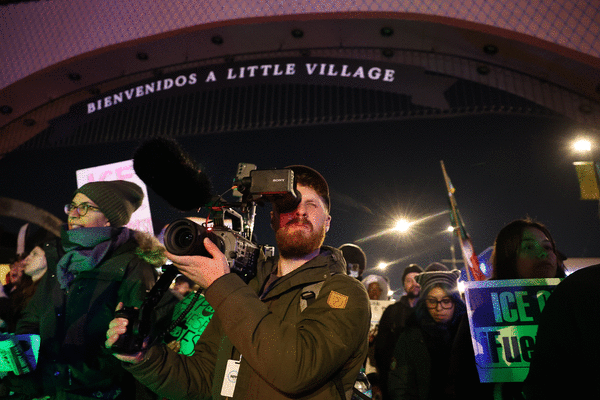
CHICAGO — Hours after a woman was shot and killed by a federal immigration agent in Minnesota, 400 miles away in Chicago’s Little Village, Andrew Freer moved through a crowd of community members huddled quietly around a mural of the Virgin Mary, a small video camera in hand.
Through the stillness, he weaved in and around the group. He didn’t ask questions, didn’t pause anywhere too long, just swept the scene, capturing footage for a story he’d help tell in due time.
Freer is part of a small band of filmmakers from across the Chicago area on a mission to protect constitutional rights through on-the-ground, documentary-style videos as President Donald Trump’s aggressive immigration crackdown pushes on — with its propensity, in experts’ estimation, for needless safety risks and often an approach of acting first and justifying later.
“We are trying to be truth-tellers,” Freer said.
The filmmakers, who call themselves Go Fourth Media, will be spending the better part of this week in Minneapolis, a trip they had already planned before Wednesday’s shooting.
With their footage, they hope to confront misinformation and give viewers a personal sense of enforcement activity’s impact, a goal only exacerbated by raids’ continued escalation.
Freer, speaking with the Chicago Tribune before leaving, said he doesn’t yet know what kind of stories they’ll find but that they’ll be capturing everything they can — as they’ve been doing since the immigration crackdown hit home — to ensure there’s a tangible record of the status quo changing around them.
“They’re just going to keep normalizing it, keep pushing until we just all accept that these rights are being taken from us,” Freer said. “Until we can barely recognize the Constitution anymore.”
A day after the Minneapolis shooting, federal immigration officers shot and wounded two people outside a hospital in Portland, Oregon. The violence, bringing echoes of the two federal agent shootings in Chicago during Operation Midway Blitz, has spurred vigils, protests and calls to keep resisting across the city and its suburbs.
As the Department of Homeland Security announced it was sending more than 2,000 federal agents and officers to Minnesota in what the agency has touted will be its “largest operation ever,” Chicago responded. Like Go Fourth Media, other advocates are traveling north to survey immigration agents, including a pair of West Chicago brothers turned seasoned patrollers and a small group of suburban volunteers who, after hearing of the newly launched operation’s intensity, flocked to provide reinforcements.
Spurred to act
Freer, a longtime Chicago-area resident, has been in filmmaking for nearly two decades since taking an interest in the field while studying international politics at west suburban Wheaton College. The 42-year-old has spent most of his career doing commercial projects but has also done sporadic documentary work.
When the raids started in early September, Freer was concerned, he recalled. But it wasn’t until his Oak Park neighbor Scott Sakiyama was detained at gunpoint outside of his child’s elementary school a month and a half into the blitz that Freer was driven to act. Sakiyama, who was arrested by federal immigration officers after allegedly cutting off and impeding an agent, told the Tribune at the time that two agents had drawn guns on him during the confrontation, a moment he could only describe as an out-of-body experience.
That night, Freer was so disturbed he couldn’t sleep as he lay awake wondering, “What can I do?” By 5 a.m. the next morning, he had a plan.
“I thought, with my background in filmmaking, it’d be a good idea to start documenting what is happening,” he said.
But he knew he couldn’t do it alone. Through connections built from years in the industry, Freer soon created a network of camera operators, editors, sound designers and even animators from across the Chicago area to bring the venture to fruition.
Since October, Freer and his team have fanned out to capture the consequences of the blitz. With the footage, they’ve been crafting documentary shorts, each focused on a different through line of the crackdown. So far, three videos have been released on YouTube, with more on the way in weeks to come. Of those posted online, one short focuses on Sakiyama’s arrest while another follows Freer as he tracked immigration officers on Halloween, a day that saw two U.S. citizens arrested and an agent repeatedly point a handgun at protesters.
While each video stands alone, the overarching aim is to draw attention to examples, the filmmakers reckon, of how the deportation campaign is violating constitutional rights. They’re especially interested in examining the Fourth Amendment, which protects against unreasonable search and seizure.
“People do not feel secure in their persons right now,” Freer said.
As for their audience, Go Fourth hopes to fill a space between traditional media and citizen journalists, and reach those who “aren’t traditionally our allies,” Freer said.
“I know we’re not going to change everybody’s mind,” Freer said. “But I do think there’s a segment of America who can be changed if they are educated as to what’s happening.”
Their strategy: connection. While capturing flashpoints in real time, they’re also seeking out and sitting down with those affected by operations firsthand.
For their interviews, they use a device called the Interrotron, a mirrored system that gives subjects the illusion of speaking directly to filmmakers while maintaining eye contact with the camera. The idea is to remove as many barriers between people telling their stories, and the audience listening, as possible.
“There’s something more meaningful ... and more immediate about it,” Go Fourth filmmaker Geno DiMaria said.
DiMaria recalled interviewing Eva Gurtovaia, a woman whose husband was detained by immigration agents a day before she became a U.S. citizen, at her Uptown home. He remembered the pictures of Gurtovaia and her husband on the fridge and the cats they owned together roving their apartment.
“It’s now just her,” he said.
When it’s direct, DiMaria says, it’s harder to dismiss.
That’s why Go Fourth is going to Minneapolis, to come face-to-face with activity there. Once they do, the footage isn’t something they’ll put out immediately, instead planning to take their time contextualizing firsthand accounts with B-roll of the new operation — and scenes from home.
In Little Village last Wednesday night, more than 100 people gathered to decry an ICE agent’s fatal shooting of 37-year-old Renee Good in Minneapolis. They carried signs that read “ICE kills” and “Observation is not a crime,” listening to speakers before marching more than a mile to the sound of whistles and chants.
Tracey Zupke walked at the back of the crowd. The 54-year-old Ukrainian Village resident said she needed to do something after a day spent feeling “absolutely sick” about the shooting. She wanted to connect with her community, she said, and hoped their solidarity sent a message to anyone watching.
“It’s important,” she said, “that people that all around the country and all around the world see the frustration that we’re suffering with here.”
To her left, DiMaria followed the crowd with his camera.
“Every part of it,” Freer said, “we’re trying to really craft in a thoughtful way.”
After news of the Minneapolis shooting broke, Freer said his daughter heard what had happened and that when he told her he’d soon be going to the city for work, she replied, “Don’t go, I’m scared for you.”
“But I told her, ‘We’re doing this to protect our community ... to protect our country. I’m doing this to protect you,’” he said.
Across state lines
West Chicago teenage brothers Ben and Sam Luhmann spent much of the fall and winter on the front lines of the blitz, chasing federal immigration officers. They left for Minneapolis on Thursday night to help bolster local rapid response.
“There’s so many agents going right now that I just can’t imagine it not being overrun,” Ben, 17, told the Tribune over the phone as he drove he and his 16-year-old brother the six hours to Minnesota.
They plan to patrol and pass on what they’ve learned about how to document legally and safely, Ben said. They also hope to keep matters de-escalated, especially after the killing of Good, which served as a reminder to the brothers that they’ve had their own confrontations with agents.
“If it would have gone the wrong way ... (that) very much so could have been us,” Ben said. “That kind of left me feeling empty.”
They were out patrolling for ICE activity in Minneapolis on Friday morning.
At home in West Chicago, Ben and Sam’s mom, Audrey Luhmann, said she was nervous, but knowing that patrollers were “stretched to absolute capacity” through the blitz — and that was with a fraction of the agents DHS plan to send to Minnesota — they had to help.
Still, she wishes she was there. By Friday afternoon, she’d heard from Ben and Sam a few times. Hours into their patrols, they already couldn’t believe the sheer number of agents they saw, Audrey said.
“And that’s coming from people who are pretty seasoned,” she said. “They’ve never seen anything like this.”
To her, it feels like “this administration is testing what we will withstand, what we will tolerate, what we will submit to and frankly, that’s terrifying.”
Maria Elena, a volunteer with Wheaton’s Casa DuPage Workers Center who is on the patrol team Resistencia Comunitaria, was close behind Ben and Sam. She and about five other patrollers planned to go to Minnesota starting Friday, she said.
“We’re not letting them intimidate us,” she said.
There’s an element of attrition to the operations, DiMaria says. That’s why it’s important, he continued, to keep their cameras trained on the raids, wherever they go.
Go Fourth hopes to eventually track and document immigration enforcement across the country, if the group can build up the infrastructure to keep the effort going. To date, Freer and his team have been running the venture for free but are now actively fundraising so they can continue and expand their reach.
In the long term, though, they want to put themselves out of business.
“(I hope) this turns into ICE going away,” Freer said, “and people’s minds being changed.”
After protesters’ moment of silence in Little Village on Wednesday came a brief, final rally before demonstrators dispersed for the night. Go Fourth lingered to catch any last footage. Above the crowd, posters still bobbed.
“From Chicago to Minneapolis,” one read in black and white. “Stop ICE terror.”
DiMaria shared a look with Freer, then aimed his lens at the sign.
_____
©2026 Chicago Tribune. Visit chicagotribune.com. Distributed by Tribune Content Agency, LLC.



Comments