Gov. Newsom claims California as Trump counterweight in final State of the State
Published in News & Features
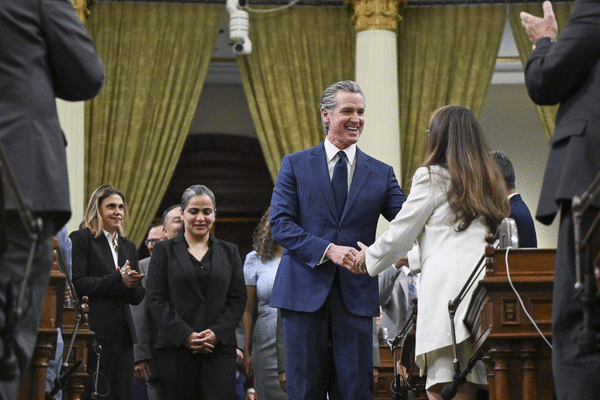
SACRAMENTO, Calif. — In his final State of the State address, Gov. Gavin Newsom touted California’s economic dominance and a modest reduction in the unsheltered homeless population, claiming victory on one of his most potent political liabilities.
During his address, which he gave to lawmakers in Assembly chambers, Newsom spotlighted the state’s position as the fourth-largest global economy while claiming that it had made strides to address its housing crisis, wildfire recovery, prescription price reductions and investment in renewable energy.
“In California, we are not silent. We are not hunkering down. We are not retreating. We are a beacon,” Newsom said. “This state is providing a different narrative. An operational model, a policy blueprint for others to follow.”
It was the first time Newsom, wearing his trademark navy suit and tie, has given an in-person state address from the Capitol in six years. He made informal remarks before launching into his speech, emphasizing how his tenure had been marked by disaster, from devastating wildfires to the pandemic.
“Last time I talked here was 2020, all of a sudden everything was virtual, and we came right out of that (with) social unrest, supply chains, inflation, all this staffing stress, and so I’ll try to reflect some of that in my comments today,“ the governor said. “I’ll say things that may be piercing some of you, but it’s not intended to demean, not intended to divide. But I’m speaking from my heart.”
The governor, whose term ends when the newly elected governor is inaugurated in early January 2027, positioned California as a liberal, stable counterweight to the “chaotic” and “lawless” White House, which he claimed had been “captured by wealth,” emphasizing President Donald Trump’s profiteering.
“Understanding the lessons of the past, in California, we proudly built one of the most progressive tax systems in the nation. One that asks the highest-income residents to pay a little bit more, without punishing people who are making a little bit less,” he said.
SEIU United Healthcare Workers West is pushing to levy a one-time 5% tax on billionaires, drawing ire from Silicon Valley giants who have threatened (or made steps) to leave the state over it.
Newsom, who counts Google and Salesforce executives as his friends and allies, opposes the tax. In his remarks, he pointed to California’s $25 hourly minimum wage as a contrast to other states like Texas, whose minimum wage is $7.25, and Florida.
“It comes down to a simple question: Who do you stand for? The rich and the powerful, the most well-connected?” Newsom said, to thunderous applause. “Or the bus driver, the janitor, the special education teacher, working overtime to support their families?”
He pointed out that in the year since the Legislature held a special session to shore up its legal defenses against the Trump administration, Attorney General Rob Bonta had filed 52 lawsuits against the federal administration, often prevailing in court.
“And as a consequence, California has preserved $168 billion in illegally frozen federal resources that belong to our schools, our hospitals, our elders; resources that belong to the people of this state,” Newsom said. “We won requests for emergency relief and affirmed the Constitution as the supreme law of the land.”
Newsom has so far demurred on the question of whether he will run for president in 2028, while also positioning himself as one of the Trump administration’s loudest critics, as well as an internal critic of his own Democratic Party.
He told The Atlantic earlier this week that he had conducted his own assessment of why the party lost in the 2024 election, and in recent months claimed victory as voters passed Proposition 50, to redraw the state’s congressional boundaries more favorably towards Democrats, and as the Legislature overhauled state laws to ease housing construction and address affordability in the nation’s most expensive state.
“Affordability. That’s not a word we just discovered. And it’s certainly not a hoax. Here’s the way we think about it. It’s not just one issue. It’s a stacking of many issues, one on top of another,” Newsom said Thursday.
He also claimed the unsheltered homeless population had dropped by 9% in the last year, a minor victory on an issue that has dogged him since his days as mayor of San Francisco.
“No more excuses — it’s time to bring people off the streets, out of encampments,” Newsom said, “into housing, into treatment.”
He also cited a historic drop in his hometown’s homicide rate, as San Francisco’s murder rate has ebbed to the lowest numbers not seen since 1954. “It’s time to update the talking points,” he quipped, referring to the outsized attention the liberal city receives in right-wing media.
Newsom said his administration would work with the Legislature in the next weeks to crack down on investors buying up single-family homes and driving up rent, calling it “an urgent area requiring our attention.”
“It’s shameful that we allow five private equity firms in Manhattan to become the biggest landlords here in our cities, in California,” he said.
The governor also teased aspects of his spending plan, which the Department of Finance will publish in full Friday. That includes a request to reauthorize the CalCompetes tax credit, a jobs training and workforce program, for another five years.
Budget numbers were not available Thursday, including whether he disagreed with the Legislative Analyst’s Office’s estimate of an $18 billion deficit. In his speech, Newsom said the state’s general fund was $248.3 billion, and said revenues had grown $42.3 billion compared to last year’s projections.
The $42.3 billion figure reflects revenue growth over fiscal years 2025 to 2027, according to Department of Finance spokesperson HD Palmer.
In addition to restructuring the Department of Education, Newsom said his budget proposal will call for an average investment of $27,418 per student.
“I’m proud to submit a budget with the most significant investments in public education in California’s history,” he said.
_____
©2026 The Sacramento Bee. Visit sacbee.com. Distributed by Tribune Content Agency, LLC.





Comments