Power begins to shift in Venezuela as rivals battle for control of armed forces
Published in News & Features

In the days after Maj. Gen. Javier Marcano Tábata vanished from Venezuela’s chain of command earlier this week, the official story never quite settled. Rumors of treason, incompetence and betrayal swirled.
But sources with direct knowledge of the regime’s internal dynamics say the explanations miss the point. Marcano Tábata did not fall because he was seen as disloyal. He fell because he controlled too much firepower — and lost the political cover that made that acceptable.
According to multiple sources familiar with the internal dynamics of the ruling socialist regime, Marcano Tábata’s removal was not driven by suspected treason or the failure of the forces under his command to prevent strongman Nicolas Maduro’s capture by U.S. troops in a predawn raid Saturday at his residence. Instead, the sources described the move as part of a deeper recalibration of armed power inside a regime increasingly defined by competition among rival security structures.
“This was not about loyalty,” one source told the Miami Herald. “It was about who controls the guns.”
In the internal logic of Venezuela’s ruling system, power functions less like that of a modern institutional state and more like a feudal hierarchy, where control of armed force determines political survival. Marcano Tábata commanded the largest single concentration of firepower in the country. What he lost, the sources said, was the political protection derived from Maduro that allowed him to hold that power without becoming a threat to others.
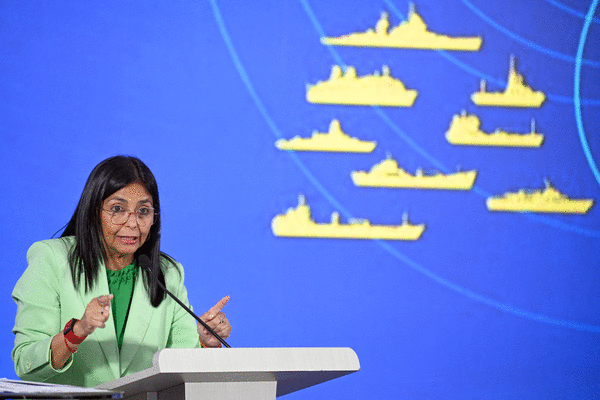
That dynamic carries implications beyond Marcano Tábata’s personal fate. As the Trump administration places its bet on recently sworn-in interim President Delcy Rodríguez to steer the historically U.S.-hostile Caracas regime toward a more Washington-friendly posture, her ability to do so — or more fundamentally, her ability to survive politically — will hinge on control of the nation’s military.
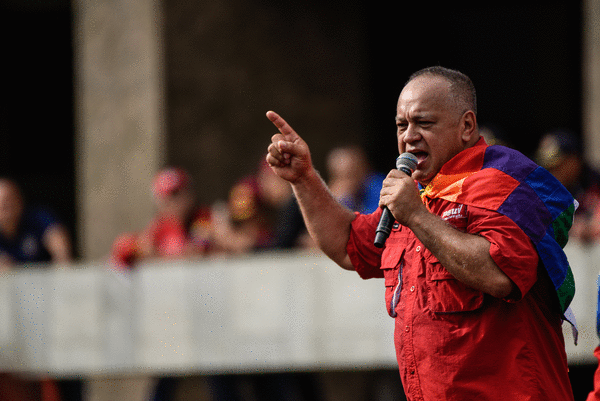
For now, that struggle appears to be tilting away from her and toward Interior Minister Diosdado Cabello, particularly following Marcano Tábata’s replacement.
A chain reaction
Marcano Tábata’s fall has triggered a rapid and opaque chain reaction within Venezuela’s military and intelligence services. At least 14 senior officers have abruptly disappeared from public view since his removal, according to sources, including figures regarded as central to the command structure of the Presidential Honor Guard.
A hard-line figure with a reputation for brutality, Maj. Gen. Gustavo González López, has taken Marcano Tábata’s place, decisively shifting the internal balance of power toward Cabello, one of the most feared and influential figures in the ruling elite, the sources said.
In the days following Marcano Tábata’s detention, Venezuela’s political crisis entered what officials and analysts describe as a darker, less visible phase. Publicly, the government projected continuity, issuing routine communiqués and staging carefully choreographed appearances by senior officials. Privately, however, sources described a violent struggle over control of the military— who commands it, who coordinates it — and who may soon deploy it against internal rivals.
According to the sources, Marcano Tábata was dismissed and detained shortly after the announcement of his replacement. While unconfirmed reports circulated that he may later have been released, those familiar with the situation said his removal from the chain of command was definitive.
Architecture of armed power
Power in Venezuela, the sources said, has long been defined not only by ideology or formal institutions, but by weapons, the men who operate them, the physical spaces from which they are commanded, and the systems that link them. Control over that constellation of assets has shaped political outcomes more reliably than elections, courts or party structures.
As head of the Presidential Honor Guard, Marcano Tábata presided over what had quietly become the most formidable armed force in the country.
In April, a presidential decree elevated the Honor Guard from a brigade to the equivalent of a division. What had traditionally been a ceremonial and protective unit expanded into a compact but heavily armed force, incorporating five additional special forces battalions, a drone battalion, trained militia units, and operational control over the military intelligence directorate known as DGCIM.
According to sources, the restructuring was designed not merely to protect the presidential palace but to give the Honor Guard the capacity to defeat — simultaneously, in the event of a coup attempt — the four brigades responsible for securing Venezuela’s central region: the 41st Brigade in Carabobo, the 42nd Brigade in Maracay, the 43rd Artillery Brigade in San Juan de los Morros, and the 31st Brigade based at Fuerte Tiuna in Caracas.
The 31st Brigade, long considered the backbone of capital security, was significantly weakened during Saturday’s U.S. raid, the sources said.
Hollowing out regional commands
The concentration of firepower within the Honor Guard was achieved by stripping resources from regional commands. Battalions were reassigned from Zulia, Barinas and Miranda states, weakening local military structures to reinforce the presidential core.
On paper, the resulting force was capable of overwhelming any internal challenger. In practice, its effectiveness depended on the assumption that threats would follow familiar and predictable patterns.
That assumption proved fatal.
Sources described Marcano Tábata’s failure not as a question of loyalty but as an inability to anticipate the scale and sophistication of the threat posed by the escalation of U.S. pressure. Venezuela’s defensive posture toward external challenges relied on protocols that created what one source described as “too many stable elements,” allowing adversaries to plan around them.
When the U.S. operation unfolded, those vulnerabilities were exposed.
Replacement known for repression
The replacement of Marcano Tábata by González López has sent shockwaves through Venezuela’s security services.
Known internally by the nickname “El Talibán,” González López is described by multiple sources as fiercely loyal to Cabello and prone to extreme violence.
“He was sidelined for years,” one source said. “Too extreme, too compromised, too heavily sanctioned. But when the goal is to purge power, moderation is not the priority.”
González López rose to prominence during the most repressive period of SEBIN, Venezuela’s intelligence service, when torture was openly practiced and centralized at the Helicoide detention center in Caracas. Although SEBIN’s influence has since diminished in comparison to the the network of clandestine detention facilities run by military intelligence, González López remains emblematic of an era when repression was overt and unapologetic.
His return to authority signals a shift away from controlled stability and toward consolidation through fear, the sources said.
Since González López assumed his new role, at least 14 senior figures associated with Marcano Tábata have disappeared, according to sources, including generals regarded as essential to the Honor Guard’s brigade-level command and operational continuity.
Their sudden absence has disrupted command structures and sent a clear message to remaining officers: survival now depends on avoiding visibility or leaving the country.
Rodríguez’s narrowing options
If González López and Cabello represent the consolidation of brute force, recently sworn-in interim President Rodríguez is meant to represent its political limits.
Now viewed by the Trump administration as one of the more “acceptable” figures within the regime, Rodríguez finds herself in what sources described as an untenable position. She did not select González López, could not block his appointment, and lacks the armed backing necessary to counterbalance him.
Her perceived usefulness to international actors — particularly Washington — may have increased her vulnerability at home, the sources warn. Cabello, fully aware of U.S. pressure on Rodríguez, may see her as a liability or a potential obstacle.
“She’s caught between forces she cannot control,” one source said. “And she doesn’t decide which one moves first.”
Cabello consolidates control
Cabello, a longtime power broker within the regime, has long been regarded as more attuned to the realities of power than many of his peers. Unlike Defense Minister Vladimir Padrino López — whom sources describe dismissively as an administrator rather than a commander — Cabello’s instincts are shaped by fear, violence and criminal logic.
According to the sources, Cabello now effectively controls the Presidential Honor Guard, both major intelligence agencies — DGCIM and SEBIN — and the armed civilian groups known as "colectivos," which have been accused of widespread intimidation and violence against civilians.
U.S. authorities have long viewed Cabello not only as a political enforcer but as a central figure in what they describe as the Cartel de los Soles, a drug trafficking network allegedly embedded within Venezuela’s military and political leadership. Washington has offered a $25 million reward for information leading to his capture.
Despite that history, U.S. officials now view Cabello — uneasily — as one of a small number of regime insiders capable of maintaining basic order in the immediate aftermath of Maduro’s downfall, according to the news agency Reuters. As Rodríguez attempts to govern amid institutional collapse, Cabello’s control of the armed force has made him, for now, unavoidable.
That reliance, however, is deeply conditional.
As González López consolidates authority, the armed forces are fracturing. Officers are going into hiding or preparing to flee. Padrino López, once the regime’s principal military pillar, is described as watching from the sidelines.
Sources said Padrino López, who received training in Russia and is viewed as possessing sensitive institutional knowledge, may be quietly extracted by Moscow. Unlike Cabello, he is not seen as a fighter.
Searching for an alternative
Behind the scenes, sources said efforts are underway from people assisting the U.S. with plans for a transition of power in Venezuela to identify an alternative military figure—an “alpha” within the Army capable of ordering troops back to their barracks while police and intelligence services manage remaining unrest.
Databases are reportedly being compiled to assess generals’ backgrounds, family ties, and legal exposure in an attempt to identify individuals relatively untainted and capable of commanding respect.
So far, the search has yielded no clear candidate.
Against this backdrop, the United States is pursuing a narrow and risky objective: preventing total collapse while making clear that certain figures cannot remain part of any future political arrangement.
According to Reuters, U.S. officials have warned Cabello through intermediaries that cooperation with Washington is now a condition for political survival as Venezuela navigates the post-Maduro transition. The message, sources familiar with the matter said, is explicit: defiance would place him on a trajectory toward removal.
Privately, U.S. officials fear that Cabello — long a rival of Rodríguez and a symbol of the regime’s coercive power — could deliberately undermine the transition if he believes he is being sidelined or targeted. That risk has prompted a strategy aimed at boxing him in: extracting short-term cooperation to reduce violence and prevent chaos, while quietly preparing options to remove him from the political landscape altogether.
Those options, according to people familiar with the deliberations cited by Reuters, could include exile or a negotiated surrender.
Cabello, the sources said, has no viable long-term future inside Venezuela and no safe path abroad. Indicted in the United States and exposed internationally, his choices are narrowing to cooperation, surrender or removal.
“Cooperation is not binary,” one source said. “It ranges from reducing violence to turning yourself in.”
Trump’s recent announcement regarding the U.S. moving to take over Venezuela’s oil production may reshape economic calculations at a policy level, but within the regime it has had little immediate impact.
“When survival is at stake,” one source said, “economic policy becomes secondary.”
_____
©2026 Miami Herald. Visit miamiherald.com. Distributed by Tribune Content Agency, LLC.


Comments