US allies offer muted response after Trump's Venezuela raid
Published in News & Features
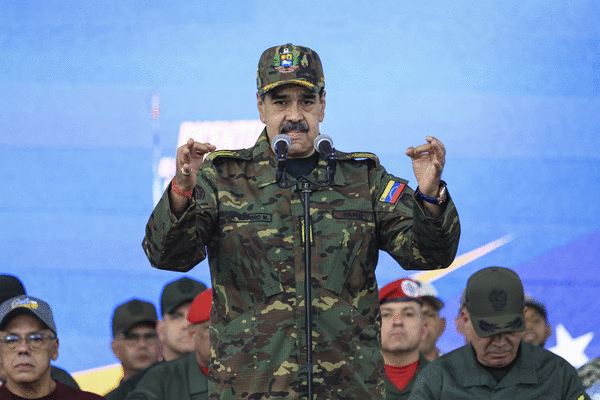
America’s allies offered a measured response after U.S. troops captured Venezuelan leader Nicolas Maduro in a raid, a move that sent shockwaves around the world and highlighted divisions among governments.
In Asia, Japan, South Korea, Australia and Thailand avoided condemning the move, instead emphasizing diplomacy, dialogue and stability. The Philippines went slightly further, pointing to Washington’s “underlying security considerations,” while also urging all parties to respect international law.
That restraint contrasted with more strident reactions elsewhere, exposing a divide between Washington’s partners and countries openly opposed to the move. China denounced the U.S. action, calling it a blatant use of force and urging Washington to “stop violating other countries’ sovereignty and security.”
In Southeast Asia, Singapore, Vietnam and Indonesia — which all have ties to Washington and Beijing — expressed deep concern but also avoided condemnation. The strongest criticism came from Malaysia’s Prime Minister Anwar Ibrahim, who had welcomed Trump in October for a peace agreement between Thailand and Cambodia. Anwar called for Maduro’s release and described the U.S. moves as “a clear violation of international law and amount to an unlawful use of force against a sovereign state.”
New Zealand, a member of the “Five Eyes” intelligence sharing partnership, said in a two-sentence statement that it “stands with the Venezuelan people in their pursuit of a fair, democratic and prosperous future” and avoided any mention of the U.S.
The U.S. allies made references to the rule of law and international legal frameworks, language that reflected broader regional anxieties, particularly the risk of any future conflict involving China and Taiwan, as well as concerns over North Korea. Those fears were reinforced when Pyongyang conducted a hypersonic missile test shortly after Maduro’s capture.
“The Japanese government will continue to stress the importance of restoring democracy in Venezuela as soon as possible,” Prime Minister Sanae Takaichi said on Monday. “Japan has consistently respected fundamental values and principles such as freedom, democracy and the rule of law.”
The caution also reflects more practical considerations. Last year, several U.S. allies in Asia, including Japan and South Korea, secured trade deals that reduced the threat of higher U.S. tariffs after months of negotiations.
At the same time, these countries rely heavily on the U.S. for security. Japan, in particular, is navigating heightened tensions with China after Takaichi’s remarks about the potential for military action in relation to Taiwan, making open criticism of Washington’s actions in South America even more difficult.
Europe
A similar pattern emerged in Europe, with many of Trump’s allies avoiding outright condemnation. U.K. Prime Minister Keir Starmer reaffirmed support for international law and said Britain would discuss the situation with U.S. counterparts, while French President Emmanuel Macron remarked that Venezuelans freed from Maduro’s dictatorship could “only rejoice.”
Italian Prime Minister Giorgia Meloni said the U.S. action was a “legitimate” response to what her office described as attacks against U.S. security through drug trafficking, though she added that military intervention was not “the way to go” to end totalitarian rule.
The reticence highlights a troubling shift, said Alicia Garcia Herrero, chief Asia Pacific economist at Natixis SA. “The West’s commitment to a rules-based order appears selective at best,” she said in a post on X.
She added that while China and Russia publicly object the U.S. move, they may welcome the erosion of international constraints, which could embolden their geopolitical pursuits as the U.S. is preoccupied.
“This upheaval signals not just the end of a regime but a broader erosion of global stability, where expediency overshadows established values, risking further disorder,” she said.
-------
(With assistance from Ramsey Al-Rikabi, Anisah Shukry, Swati Pandey, Claire Jiao, Ditas B Lopez, Thomas Kutty Abraham, Donato Paolo Mancini, Isobel Finkel, Francesca Stevens and Ainsley Thomson.)
©2026 Bloomberg L.P. Visit bloomberg.com. Distributed by Tribune Content Agency, LLC.






Comments