After blaming Trump for Jan. 6, they're still in the 'fight of our lives'
Published in News & Features
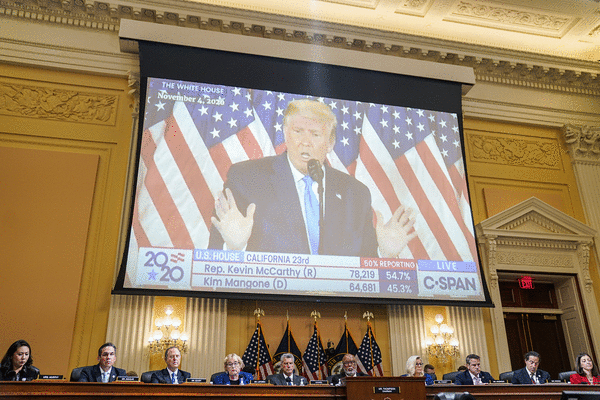
WASHINGTON — It’s been five years since the Jan. 6, 2021, attack on the Capitol, but Rep. Pete Aguilar still finds small reminders of that day all over — like when groups of people congregate in red hats, or even when the weather outside becomes “cold and crisp,” like it was last month as the anniversary approached.
“Those are things that I think will always be there,” Aguilar, D-Calif., said in an interview.
It can be an uneasy feeling for him and others who investigated the attack as part of a select committee in the House. Five of those nine members remain in Congress.
“Sometimes it feels like it was yesterday,” said Rep. Jamie Raskin, D-Md. “The initial horror and frightfulness and trauma of those events has just dissipated somewhat, but the basic contours of the political struggle we’re in are still sharply etched in our society.”
Rep. Bennie Thompson, D-Miss., who chaired the panel, said he notices tensions rise again around each anniversary, with more anonymous threats aimed at his office.
“The threatening phone calls still come,” he said.
The select committee wrapped up its probe in 2022, laying much of the blame at the feet of Donald Trump. It issued a final report of more than 800 pages, accusing the president of inciting his supporters to violently storm the Capitol as he tried to overturn his 2020 election loss.
In return, Trump has said members of the Democrat-led committee “should go to jail.” As soon as he reclaimed the White House last year, he granted sweeping pardons to Jan. 6 rioters.
On the fifth anniversary of the Capitol attack, lawmakers who sat on the select committee are still defending their work as many continue to question it, including House Republicans leading their own new investigation. Democrats are planning a “special hearing” to mark the day and say their concerns are disturbingly fresh — revenge and retribution, how power changes hands, and what fuels political violence.
By now, competing narratives about Jan. 6 seem set in partisan stone, but the story isn’t over yet, Raskin said.
“We are still very much in the fight of our lives,” he said.
‘Not going to be a unifying event’
For Raskin, the attack five years ago was part of “a succession of nightmarish events.”
His son died by suicide on Dec. 31, 2020, with Raskin deep in grief as he returned to the House floor a day after his funeral, only to hear a mob pounding on the chamber door as officers raced to barricade it.
For Adam Schiff, now a senator, worries of how the country could reconcile began even before the attack was over, as he raced to escape through underground tunnels.
“I had come to Congress just before 9/11, and I remembered what a unifying event that tragedy was, how we went to the steps of the Capitol and sang ‘God Bless America,’” said Schiff, D-Calif. “And I remember thinking on Jan. 6 that this event was not going to be a unifying event. This was going to be very different.”
Last year, federal prosecutors began looking into allegations of mortgage fraud against Schiff, according to news reports. Schiff has denied wrongdoing, saying the president is trying to silence his political foes.
“I was attacked on a pretty much daily, weekly, monthly basis by Trump in his first term, who called for my prosecution and accused me of treason. So this is sort of a continuation of that, but armed with new and dangerous tools, like a very pliable Justice Department,” he said.
Schiff had already served as lead manager of Trump’s first impeachment trial by the time then-Speaker Nancy Pelosi, D-Calif., tapped him for the Jan. 6 probe.
From the start, it fell short of what many had hoped. Almost three dozen House Republicans had joined Democrats in calling for an independent commission like the one formed after 9/11, but that bill didn’t make it through the Senate.
The “next best thing” was the House select committee, Thompson said, though any dreams of bipartisan harmony were squashed when then-Minority Leader Kevin McCarthy boycotted the effort after Pelosi rejected some of the members he picked.
“It would have been good if we could have had a committee with some more teeth,” Thompson said, while standing by its work, which ended with the panel referring Trump to the Justice Department for possible misdeeds like obstruction, conspiracy and inciting an insurrection.
“Some would say, ‘Well, you know, four years later, Donald Trump got elected president.’ You’re absolutely right,” he said. “In my mind, that says the work of the committee is far more realistic and accurate, because so much of what we said is being carried out in real time during the Trump administration.”
Just two Republicans, both chosen by Pelosi, ultimately served on the panel, and neither lasted much longer in Congress. Liz Cheney lost her Wyoming primary in 2022 after Trump endorsed now-Rep. Harriet Hageman instead, and Adam Kinzinger chose not to run again in Illinois, blaming a political climate driven by “extreme elements.”
On the Democratic side, Stephanie Murphy declined a reelection bid in Florida, citing “personal sacrifice” for her family. Meanwhile, Elaine Luria of Virginia was unseated by Republican Rep. Jen Kiggans but is now mounting a comeback campaign.
“I’m not scared. I’m coming back. I really believe in what I did and the work that the committee did,” Luria told NBC News in November.
As one of his last acts in office, President Joe Biden extended preemptive pardons to members and staff of the select committee, citing fears of “revenge” while adding it shouldn’t cast doubt on how they did their jobs.
“We wrote a report which is definitive and authoritative. No one has successfully contradicted a single sentence in that report,” Raskin said.
A new investigation
Rep. Barry Loudermilk sees it differently.
The Georgia Republican has long worked to pick holes in the select committee, arguing it pushed an anti-Trump narrative instead of seeking the facts of what happened that day, despite its 10 televised hearings and interviews with more than 1,000 witnesses.
Democrats say he is trying to revise the past and shift blame away from Trump, even if Loudermilk insists, “We’re not trying to rewrite history here. We’re just trying to uncover history.”
“We’re not any better off today, especially when it comes to the security of the Capitol, than we were before that,” he said. “How did this Capitol get breached in the way that it did? No one’s ever addressed that.”
Loudermilk’s own name turned up in the select committee’s final report, earning a brief mention for leading a tour group through House office buildings on Jan. 5, 2021. But Capitol Police concluded the tour was not suspicious.
After months of urging GOP leaders to give him freer rein, Loudermilk now leads a new House Judiciary select subcommittee tasked with investigating the “remaining questions surrounding Jan. 6, 2021.”
It has been slow to get off the ground, but Loudermilk said he hopes to hold a hearing soon on how the FBI handled its probe of pipe bombs placed near the offices of the Democratic and Republican national committees the night before the Capitol attack.
Asked about Loudermilk’s investigation, Raskin said, “Well, I’m glad to hear that he’s not trying to rewrite history, because of course, the internet is filled with right-wing conspiracy theories. From the start, people were saying that it was not a MAGA mob unleashed by Donald Trump, but it was really antifa fighters. Well, that’s just completely absurd. … Why did Donald Trump pardon 1,600 antifa fighters?”
Among the debunked conspiracy theories is one from conservative media outlet The Blaze, which incorrectly identified a law enforcement official as the Jan. 6 pipe bomber, relying on a computer analysis of the way the person walked. Within weeks, the FBI had arrested a different suspect.
The story has since been deleted by The Blaze, but not before Loudermilk shared it on social media, calling it “one of the scenarios we have suspected” while also promising to “follow the facts wherever they lead.”
Thompson said the “credibility and legitimacy” of the select committee has stood the test of time, rejecting accusations from Loudermilk that it did not properly preserve some of its records.
“Look, I will defend a person’s opposition to the work of the committee as his or her right,” Thompson said. “It’s just that in many instances … what they say or do is absolutely wrong.”
‘Bigger than me’
Thompson keeps a physical reminder of Jan. 6 both at home and in his D.C. office — a photo of him sitting upright in the House gallery as members were instructed to get on the floor.
“I didn’t get on the floor. I didn’t get behind a chair. Being a Mississippian, a lot of people had sacrificed for a person like me to get to hold elected office,” he said.
Asked how history will remember Jan. 6, Thompson predicted it won’t look kindly on anyone trying to violently overthrow an election. More than 150 police officers were injured that day, and five officers who responded to the attack died in the following days and months, four by suicide.
“I’ve been on the losing side of elections, but I’ve never thought about tearing up the voting precinct or the city hall or the county courthouse because my candidate lost,” said Thompson, who has spent much of his career advocating for voting rights for Black Americans. “That’s an enduring legacy for somebody like me, because my father was not able to vote in Mississippi, and ultimately died when I was in the 10th grade, never having cast a ballot.”
Rep. Zoe Lofgren, D-Calif., described serving on the select committee as “intense,” adding that “it was important to us that the information that we obtained be delivered in a way that was accessible to every American.”
“I don’t think I’ve ever worked harder on a committee,” said Lofgren, who was also chair of the House Administration panel at the time, leading separate oversight hearings on Capitol security failures.
But Jan. 6 is no longer an everyday topic of conversation on the Hill, she said. “Honestly, we don’t dwell on this. We’re not talking a lot about it. What we’re talking about is how to bring relief to the American people, their cost of living.”
The fifth anniversary poses a messaging challenge for both parties. Not every Republican is as eager as Loudermilk to keep the investigatory fire alive. And some Democrats are wary of a topic that may not resonate with voters outside the Beltway, especially after foregrounding threats to democracy did little to help them in the 2024 election.
Still, Minority Leader Hakeem Jeffries, D-N.Y., announced Thompson would be leading Democrats’ planned hearing to mark the day and “set the record straight,” reupping some of the select committee’s work while arguing for its continued relevance.
Aguilar, who currently serves as chair of the House Democratic Caucus, said Trump’s own focus on Jan. 6 has kept the wounds fresh. Election deniers now hold top government jobs, and the president’s sweeping pardons have only unleashed more violence, he argued, pointing to several rioters who have already been charged with unrelated crimes in their home states.
“This is bigger than me, bigger than the nine members of the committee,” he said. “It’s the entire country who is having to deal with the impacts.”
For Aguilar, it’s not the end yet.
“The completion of the report was one step, but how we keep our community safe, how we tell the truth, how we protect democracy, how we honor the brave men and women who defended the Capitol that day — all of those things seem a little unfinished to me,” he said.
_____
©2026 CQ-Roll Call, Inc., All Rights Reserved. Visit cqrollcall.com. Distributed by Tribune Content Agency, LLC.






Comments