Calls for restraint, condemnation: World leaders react to US action in Venezuela
Published in News & Features
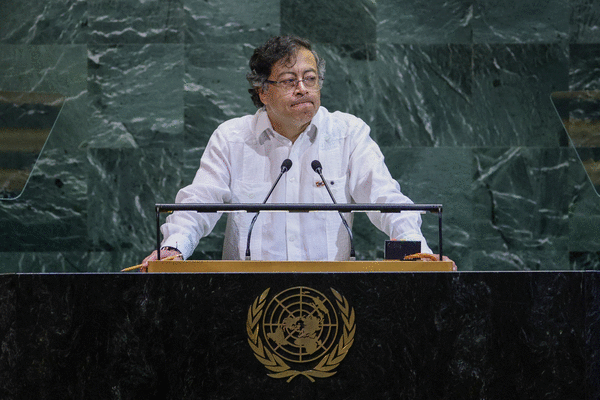
The overnight attacks in Venezuela and the subsequent capture of President Nicolás Maduro and his wife in a U.S. military operation on Saturday triggered sharp international reactions, ranging from European Union calls for de-escalation to condemnations from some of Latin America’s most outspoken leaders, who described the use of force as “unacceptable.”
“The Government of Mexico condemns and strongly rejects the military actions unilaterally carried out in recent hours by the armed forces of the United States of America against targets in the territory of the Bolivarian Republic of Venezuela,” a statement posted by Mexican President Claudia Sheinbaum said.
The statement called for “an end to any act of aggression against the Venezuelan government and people” and said the actions were in clear violation of Article 2 of the United Nations charter. The charter, among other things, calls for disputes among nations to be settled peacefully.
“Latin America and the Caribbean is a zone of peace, built on the foundation of mutual respect, the peaceful settlement of disputes, and the prohibition of the use and threat of force. Therefore, any military action seriously jeopardizes regional stability,” the Mexican government said, urging the U.N. “to act immediately to help de-escalate tensions.”
The spokesman for U.N. Secretary-General António Guterres said the U.N. chief is “deeply alarmed by the recent escalation in Venezuela,” which has potential worrisome implications for the region.
“Independently of the situation in Venezuela, these developments constitute a dangerous precedent,” spokesman Stéphane Dujarric said. “The Secretary-General continues to emphasize the importance of full respect—by all– of international law, including the U.N. Charter. He’s deeply concerned that the rules of international law have not been respected. The Secretary-General calls on all actors in Venezuela to engage in inclusive dialogue, in full respect of human rights and the rule of law.”
On Saturday, President Donald Trump said U.S. forces had entered Venezuela and removed Maduro, who is the subject of a U.S. indictment since 2020. Maduro was captured by U.S. forces and taken onboard the USS Iwo Jima.
While most U.S. allies remained mute, Argentina President Javier Milei celebrated the capture of Maduro “as a decisive advance against narcoterrorism in the region.”
In a nationwide address, Trump described the raid as “an extraordinary success overnight with breathtaking speed, power, precision and confidence.
“If you would have seen what I saw last night, you would have been very impressed,” he said describing the operation as the U.S. military acting to support the Justice Department. “It was an incredible thing to see. Not a single American service member was killed, and not a single piece of American equipment was lost, that many helicopters, many planes, many people involved in that fight.”
He also announced that following the extraction that involved more than 150 U.S. aircraft launched from 20 different bases across the Western Hemisphere, “we are going to run the country” and “stay until such time as the proper transition can take place.”
Caribbean leaders react
After the attacks, concerns engulfed Venezuela’s closest Caribbean neighbors, where Trump’s ramped-up campaign has been fueling tensions and public disagreements among regional leaders. In Guyana, which shares a land border with Venezula and has been in a decades-long dispute, President Irfaan Ali said his nation has activated its “security architecture.”
“The Guyana Defense Force and the security forces are monitoring the situation and Guyanese should be reassured that the government is working to ensure the safety and security of our citizens,” Ali said.
In Trinidad and Tobago, Prime Minister Kamla Persad-Bissessar moved quickly to distance her twin-island nation from the operation. She is one of Trump’s closest allies in the region, where ongoing U.S. boat strikes off the Venezuelan coast in the southern Caribbean had been sparking tensions for months.
Addressing citizens in an early morning post on X, Persad-Bissessar said: “Trinidad and Tobago is Not a participant in any of these ongoing military operations. Trinidad and Tobago continues to maintain peaceful relations with the people of Venezuela.”
The country’s People’s National Movement leader, Penny Beckles, said that “while some information remains unclear and unconfirmed, any such development in our immediate geographic space is a matter of serious concern” and “deeply troubling.” Beckles echoed the calls for de-escalation, which were also made by Spain’s prime minister and European Union leaders.
Condemnations
Some South American leaders offered some of the strongest and swiftest denunciations, alongside Iran and Russia.
The first regional leader to denounce the operation was Colombian President Gustavo Petro, who took to X as the night sky lit up and explosions could be heard over Caracas.
Colombia’s government, he said, was alarmed by “reports of explosions and unusual aerial activity” in Venezuela and reaffirmed its commitment to the principles of the U.N. Charter, including respect for sovereignty, the prohibition of the use of force and the peaceful resolution of disputes.
“The Colombian government rejects any unilateral military action that could aggravate the situation or put the civilian population at risk,” Petro said, urging all parties to de-escalate and prioritize diplomatic channels.
Ahead of Saturday’s extraction of Maduro, Trump warned that Petro should watch his back. On Saturday, he repeated the warning following comments by Petro that he was not concerned about anything happening to him in the aftermath of the Venezuela operation. The two leaders have been involved in public disputes on social media since Trump began his second term, and Petro has since had his U.S. visa revoked.
“He has cocaine bills, yes, factories where he makes cocaine,” Trump said about Petro. “I stick by my first statement. He’s making cocaine. They’re sending it into the United States. So he does have to watch his ass.“
As the region and the world woke up to the news, Brazilian President Luiz Inácio Lula da Silva also announced his displeasure.
“These acts represent a most serious affront to Venezuela’s sovereignty and yet another extremely dangerous precedent for the entire international community,” he said. “Attacking countries, in flagrant violation of international law, is the first step toward a world of violence, chaos, and instability, where the law of the strongest prevails over multilateralism.”
Lula said the Trump administration’s action “recalls the worst moments of interference in the politics of Latin America and the Caribbean and threatens the preservation of the region as a zone of peace.” He called on the international community, through the U.N., to respond forcefully and said Brazil stood ready to promote dialogue and cooperation.
Other world leaders
Iran called the U.S. military action a “blatant violation” of regional and international peace and security. Moscow, another ally of Maduro, said the U.S. action caused deep concern. Elsewhere in Europe, where Spain has welcomed tens of thousands of asylum-seeking Venezuelans, Prime Minister Pedro Sánchez called for restraint and for all parties to respect “international law and the principles of the U.N. Charter.”
He also offered up his nation’s “good offices to achieve a peaceful and negotiated solution to the current crisis.”
Sánchez noted that his government had not recognized the results of the July 28, 2024, elections, which the opposition said it had won, and “has always supported initiatives to achieve a democratic solution for Venezuela.”
Former French Prime Minister Dominique de Villepin said the U.S. military operation against Venezuela represents a major geopolitical shift. He accused the U.S. of “deliberately and indisputably placing itself outside international law by violating the charter and the spirit of the United Nations.”
“This is an act with heavy consequences for the international order established after World War II. This legitimizes regime changes by force. No matter how detestable the overthrown governments may be, precedents show that regime changes lead neither to democracy nor to peace, but to chaos, civil war and dictatorship. One need only refer to the situations in Iraq or Libya,” said Villepin, who served from 2005-07.
He also mentioned the ongoing U.S. pressure campaign involving 15,000 U.S. military personnel in the Caribbean who have been overseeing dozens of boat strikes against alleged drug traffickers. The strikes have a “barely veiled objective of gunboat diplomacy,” Villepin said. The Trump administration has said there have been 35 strikes in the Caribbean Sea and in the eastern Pacific Ocean, killing at least 115 people since early September.
“Once the United States frees itself from legality, what will we say to China if it overthrows a regime it dislikes in Korea, Vietnam, or even more so in Taiwan? What arguments will we have to counter Russia if it overthrows a government it dislikes in Moldova, or even in the Baltic States?” Villepin said. “France and Europe must clearly reaffirm, alongside the countries of the Global South, their commitment to the principles of international law — first and foremost the sovereignty of states and collective security — and defend the legal order of nation-states against the brutal collision of empires.”
©2026 Miami Herald. Visit miamiherald.com. Distributed by Tribune Content Agency, LLC.


Comments