Waymo is coming. How will robocars deal with wintry Minneapolis roads?
Published in News & Features
MINNEAPOLIS — News that robotaxi company Waymo is planning an expansion into Minneapolis was met with excitement in some corners, trepidation in others — and one big question:
How is that going to work in a Minnesota winter?
Minnesota drivers are accustomed to wintry roads. Less clear is how well driverless cars can handle ice and snow of various forms, from fluffy to slushy to slick.
So far, Waymo is operating its driverless taxi service in temperate cities like San Francisco, Phoenix and Los Angeles. In November, it announced a future expansion into more cities, including intemperate Minneapolis.
Waymo’s cars are already on the roads here, collecting data. The company’s entry into the Twin Cities market builds on other efforts, including a pilot in Eden Prairie, to use autonomous vehicles in a wintry climate.
For now, there are drivers behind the wheel of Waymos, though the company has said it’s not just here for test drives and plans to launch its driverless ride service in the future.
Waymo isn’t the first robocar company to come to Minnesota. May Mobility has been operating vehicles semiautonomously in Eden Prairie since last year and in Grand Rapids, Minn., since 2022.
As of mid-December, the Eden Prairie pilot, a partnership with SouthWest Transit, was close to providing free rides to 20,000 people, bringing people to and from 127 preset stops within the city.
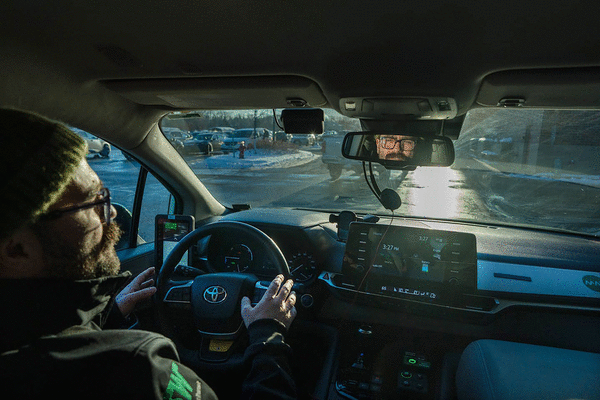
On a recent ride, Mark Schmelzle, a May Mobility site autonomy engineer working with SouthWest Transit, took control of the company’s autonomous van when he wasn’t sure the vehicle could safely operate autonomously. Most often when that happens, it’s an issue of the vehicle determining exactly where it is, he said.
“We like to compare it a little bit to a horse and a carriage,” he said. “You can let the horse take the lead, but if things get tight … you always have the leads in your hands to interact and to manually control the situation.”
Snow presents its own challenges because it’s a temporary obstacle: The edges of a building don’t change with the seasons, but the edges of a snowbank in Minnesota do, Schmelzle said.
Eventually, the plan is to operate 100% autonomously. Now, the vehicles operate autonomously about 60% of the time, said SouthWest Transit CEO Erik Hansen.
“It’s a process,” he said. “You start with smaller numbers, you work your way up.”
The vehicles are learning to negotiate snow and ice, but for now, human drivers do play a bigger role on snowy or extremely cold days. May Mobility vans were out during the snowstorm Dec. 9 but were fully human-operated, Schmelzle said. Likewise, it’s up to humans to drive on very cold days because the sensors aren’t rated for use below zero degrees Fahrenheit.
Robocars use a suite of sensors — including LIDAR (light detection and ranging), radar and cameras — that are often better at “seeing” obstacles than humans.
Using light and sound waves, LIDAR and radar are good at detecting and measuring the size of a car up ahead, and how far away it is, even through fog. Because it relies on heat, infrared is good at detecting deer, or a person out shoveling, even if the visibility is bad.
Unlike the lane assist some drivers have on their cars, which tends to rely on white and yellow paint lines to tell when drivers are off-track, robocars use more precise geofencing, which works even when road surfaces are snow-covered.
Put together, these technologies mean robocars have a more sophisticated read on the roads than humans.
“They can see more than humans. They can see more detail farther away. They can see through fog,” Nathir Rawashdeh, an assistant professor of applied computing at Michigan Technological University, which is located in Michigan’s famously snowy Upper Peninsula, where many robocars get tested in winter driving conditions.
Autonomous vehicles tend to be good at dealing with expected obstacles, and less good at handling unexpected ones, said Rawashdeh’s colleague, Jeremy Bos, an associate professor in the Electrical and Computer Engineering Department at Michigan Tech.
“They’re much better and safer drivers than we are in a lot of circumstances,” Bos said. “The one thing they don’t do is adapt to new situations.”
For example, Rawashdeh offered, a human would hopefully see a wet concrete sign and not drive onto a just-poured road — but an autonomous vehicle might not read the sign. Recently, Waymo recalled software after reports of cars failing to stop for school bus stop signs.
In December, Waymo cars blocked traffic during a power outage in San Francisco as they struggled to negotiate intersections where traffic lights weren’t working. The company suspended service temporarily.
Ultimately, Bos said companies operating autonomous vehicles need to consider the conditions they can — and can’t — safely operate in, whether that’s dry roads or snow and even black ice.
Waymo, a division of Google parent company Alphabet, hasn’t provided timelines on when it plans to advance its rollout of robotaxi services in Minneapolis.
Minnesota Department of Transportation spokesperson Anne Meyer said MnDOT doesn’t have a formal relationship with Waymo, but the company has met with the agency to discuss its product.
In Minnesota, autonomous vehicles are in a legal gray area, though Meyer said MnDOT expects to see action regulating autonomous vehicles in the upcoming legislative session.
In a statement, Waymo weather product lead Robert Chen said the company has collected data in diverse weather conditions.
“The same Waymo Driver navigating foggy San Francisco will navigate snowy Minneapolis,” he said. “We look forward to validating our system further this winter and serving Minnesotans year-round in the future.”
Waymo acknowledged there are some weather conditions that any driver should stay off the roads in and said it would follow local guidance.
©2026 The Minnesota Star Tribune. Visit at startribune.com. Distributed by Tribune Content Agency, LLC.






Comments