Judge points to Trump's authority in challenge to H-1B visa hike
Published in News & Features
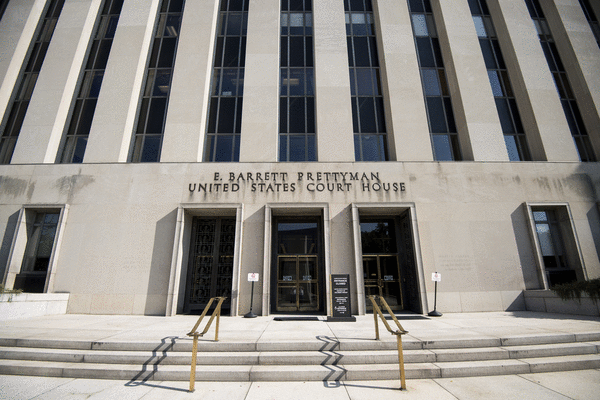
WASHINGTON — A federal judge had tough questions during a hearing Friday for attorneys representing the U.S. Chamber of Commerce in a legal challenge to President Donald Trump’s new $100,000 fee hike on companies seeking to hire foreign workers on H-1B visas.
Judge Beryl Howell of the U.S. District Court of the District of Columbia, an Obama appointee, sounded skeptical of the business organization’s request to either block enforcement of the presidential proclamation against its members or strike it down completely.
Trump signaled upon signing the proclamation the new policy was an attempt to encourage the hiring of American graduates from U.S. universities for high-skilled jobs and address national security concerns of hiring foreign workers for industries that engage in sensitive technologies.
Howell raised issues of a president’s broad authority under immigration law and cited an example of a company that had opted to hire an American worker instead of a foreign national with the new fee structure in place.
Howell said Congress gave presidents authority “with a red ribbon on it” to block entry on foreign nationals, including the capacity to “impose on the entry of aliens any restrictions to be appropriate.”
Howell said it’s “pretty hard to see limiting principles” in provisions in the law and questioned whether the chamber should redirect its efforts from litigation to lobbying Congress.
“The Chamber is one of the bigger lobbying outfits, possibly if not in the world, then in this country,” Howell said. “They know how to go to Congress and get Congress to modify statues.”
Zachary Schauf, an attorney at Jenner & Block law firm who represented plaintiffs during the hearing, said the president’s authority under the law has never been used to “impose a fee, much less one that effectively regulate domestic conduct, which is employment in the U.S.”
The proclamation imposes a new $100,000 fee on companies for every new H-1B visa application, asserting the increased rate is necessary to reverse “systemic abuse of the program has undermined both our economic and national security.”
Howell listed several statistics from Trump’s proclamation demonstrating companies have sought to hire foreign workers on H-1B visas. When Schauf didn’t challenge those numbers, Howell said she thinks Americans would be “alarmed” by those statistics.
Howell brought up an example of an entity that opted to hire an American worker as opposed to going through the process to hire a foreign national on an H-1B after Trump hiked the fees.
That example, Howell said, is what defenders say is the purpose of the proclamation, “to take entry-level people in this country who are Americans and train them up to get a good, high paying job.”
“So from the defendant’s perspective, the proclamation has only been in existence for a couple months and is already working,” Howell said.
Howell also had questions on whether the chamber had the right to file the lawsuit in the first place, and said nonprofits with no cap on H-1Bs have “more clear standing.” The chamber lawsuit is one of several challenging the fee.
Tiberius Davis, an attorney for the Justice Department, said exemptions on the fee for certain foreign nationals seeking an H-1B visa, such as those who are already in the United States, demonstrates “the fact that this doesn’t override the H-1B program.”
“It’s adding a restriction on entry because people who are seeking H-1Bs within the country can do so without this restriction being applied,” Davis said.
_____
©2025 CQ-Roll Call, Inc., All Rights Reserved. Visit cqrollcall.com. Distributed by Tribune Content Agency, LLC.


Comments