Chicago remains alert, even as Border Patrol Cmdr. Gregory Bovino and his agents sweep in and out of town
Published in News & Features
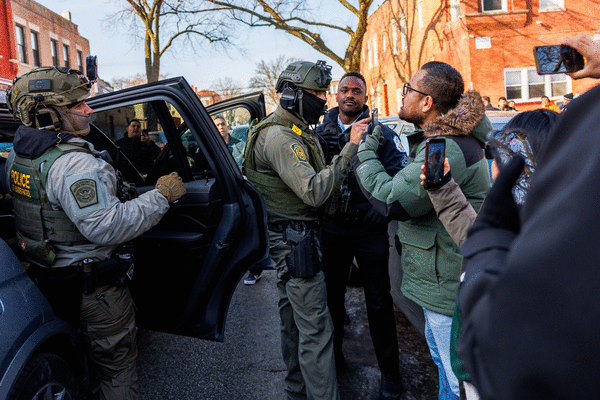
CHICAGO — It was almost as if they never left.
When Border Patrol Cmdr. Gregory Bovino and a throng of masked federal agents returned to Chicago in a flash on Tuesday, residents across the city — armed with whistles, smartphone cameras and chat networks on encrypted texting channels — were just as quick to greet them.
“For our team, we never stopped preparing, being ready,” said Torrence Gardner, a cofounder of the community group Protect Rogers Park.
Sources told the Tribune that Bovino had once again left the city on Thursday. It’s unclear whether his agents would remain behind or how many. Indeed, his apparent departure was followed by a noticeable decrease in immigration enforcement activity Thursday.
But this week’s immigration enforcement surge showed Bovino can “pop in with intensity at any point in time,” Gardner said, illustrating why the activists remained focused even after his first departure.
“Just because he left doesn’t mean the feeling of being victimized, of your neighborhood being targeted, that feeling does not leave you,” Gardner said. “That feeling sits with everyone.”
During the two-month Operation Midway Blitz this fall, Bovino and his agents terrorized Chicago neighborhoods and suburbs in their often discriminatory hunt for immigrants without legal documentation. But after the first snowfall of the season, Bovino and many of his agents left for operations in other states. Though immigration enforcement has never stopped, the daily onslaught against the region’s immigrant communities slowed down, allowing struggling businesses and tired residents to regain their balance.
But they didn’t let their guard down.
“We keep doing what we’ve been doing,” Gardner said. “We’ve got people watching at our schools. We’ve got verifiers. We’ve got people helping other neighborhoods.”
The ability of rapid responders and community activists to answer the call quickly after Bovino’s return this week is rooted in practice and a greater visibility of immigration issues brought by the Trump administration, said Brandon Lee, communications director for the Illinois Coalition for Immigrant and Refugee Rights.
Some rapid response teams formed nearly a decade ago, while others are newer. But the Trump administration’s “escalation throughout this year brought the issue to everyday people across the state of Illinois to join rapid response teams and form their own teams.”
“They know to record. They know to share ‘know-your-rights’ information. They know to share the hotline,” Lee said. “It’s almost like it’s a muscle some folks have developed over time.”
Though the Border Patrol’s activities this week appeared to have detained fewer immigrants than previous rounds, the operation still left behind significant controversy and pain.
On Wednesday, agents once again swept up ride-share drivers near O’Hare International Airport, arresting 15 people, according to the U.S. Department of Homeland Security. Bovino bragged about the arrests in a post on X Wednesday, and another post that evening vowed agents would return to O’Hare “soon.”
About 90 people have been detained in O’Hare parking lot raids since Oct. 10.
Ride-share drivers at the airport wait for ride assignments in designated staging lots. Throughout October, Border Patrol agents repeatedly descended on those parking lots to arrest drivers, despite unsuccessful efforts by the city to stop them.
Although the broader activist community remained focused on the possibility of new large-scale raids, the Border Patrol’s return surprised some ride-share drivers.
“I don’t think people were expecting them to come back,” said Lori Simmons, an organizer with the Chicago Gig Alliance, an advocacy group for ride-share drivers.
Most drivers, Simmons said, are “horrified and scared.” A smaller minority think the arrests could be good for them by driving up fares, she said.
The ride-share lots are owned by the city of Chicago, but efforts by the city to prevent immigration raids there have proved futile, despite an executive order by Mayor Brandon Johnson that bars the use of city property for federal immigration enforcement.
A spokesperson for the city’s Department of Aviation did not respond to a question Thursday about whether the department was taking any steps in response to Bovino’s vow to return to O’Hare soon.
The Tribune previously reported that the department had been warned that the ride-share lots could be targeted for immigration raids in September — weeks before federal agents first conducted raids there. The city appeared to ignore that warning until the first raid took place. Afterward, the city posted signage and security in the lots in an attempt to dissuade federal agents from making arrests there.
Uber and Lyft have remained silent on the targeting of ride-share drivers in Chicago and did not return messages on Thursday seeking comment.
Meanwhile, leaders in the City Council’s Latino Caucus said federal agents need to see more consequences following the latest flurry of immigration enforcement in Chicago.
The footage of Chicago police officers pulling over a driver who was filming immigration activity Wednesday before releasing him and tailing vehicles that appeared to be occupied by federal agents on the North Side deeply concerned Ald. Andre Vásquez, he said.
At the same time, Vásquez, 40th, acknowledged “it’s uncharted territory” given there have been at least three instances now of Chicago police catching flak after DHS made emergency calls for help.
“I would argue confidently, there has never been a situation that’s occurred where they actively needed backup,” Vásquez, co-chair of the Latino Caucus, said. “They’re their own law enforcement. If I’m being cynical, I can see the federal agents using it to create that kind of spectacle. Like, Bovino then puts out a tweet that says, ‘Thank you to the officers.’ For all you know, they’re intentionally trying to cause that division.”
Vásquez stopped short of saying the sanctuary city ordinance needs to be revised to account for these situations, due to concerns that more conservative aldermen might take the opening to water it down.
Asked about the video of Chicago police cars apparently following federal agents along Sheridan Road and Hollywood Avenue on Wednesday, a department spokesperson said “we did not provide them an escort.” Rather, officers “pulled over the vehicle” occupied by a federal agent who, in a 911 call, said another driver was trying to ram them. But the agent said he didn’t want to “pursue enforcement.”
On Thursday, the mayor gave credence to Vásquez’s theory that federal agents were using 911 calls to bait Chicago Police Department officers in order to score political points. He said the city will “absolutely” have to look at “creative ways” to mitigate such requests for CPD backup under dubious grounds.
“It is possible that Donald Trump is using Greg Bovino to lure in local law enforcement to carry out his terror,” Johnson said. “As our Police Department assesses situations, as they did that one, they realized that ‘Here we go again. Another fabricated, exaggerated claim that is ultimately putting people’s lives in danger.’ We’ve already seen that over and over again.”
Ald. Jessie Fuentes, who introduced an ordinance that would require the Civilian Office of Police Accountability to investigate Chicago police for violating the Welcoming City ordinance, said, “We have not heard exactly why CPD was sort of clearing traffic in the way that they did. I look forward to the response, because the public deserves one.”
She added that federal agents who make what she described as unfounded calls for help should be prosecuted for wasting local police resources.
“We would charge anyone or fine anyone who makes a false 911 report, and I think that shouldn’t fall on the wayside because these are federal agents,” Fuentes, 26th, said. “They should not be exempt from responsibility.”
Fuentes was one of several progressive aldermen caught in a violent protest outside a U.S. Immigration and Customs Enforcement office in the South Loop on June 4 and questioned whether Chicago police officers were aiding federal agents that day. The department denied that.
Chicago police Superintendent Larry Snelling has sought to walk a fine line throughout this year, saying the department must remain politically neutral and “we don’t make the laws, we uphold them.”
Meanwhile, with the ongoing raids at O’Hare’s ride-share lot, Ald. Mike Rodríguez called on the city to go after the federal government in the courts for continuing to violate Johnson’s executive order banning immigration agents from city property.
“Absolutely, I’m in favor of suing the hell out of these guys,” Rodríguez, chair of the Workforce Development Committee, said. “What they’re doing is wrong, and we’ve got to leverage every opportunity we have to go after them.”
_____
Chicago Tribune’s Jason Meisner and Laura Rodriguez Presa contributed.
_____
©2025 Chicago Tribune. Visit chicagotribune.com. Distributed by Tribune Content Agency, LLC.



Comments