Trump bucked tradition with partisan end-of-year address
Published in News & Features
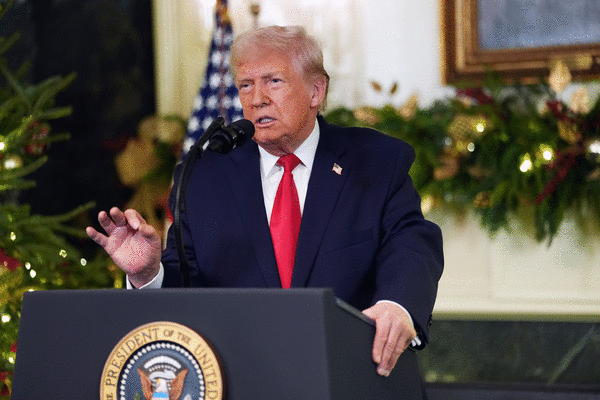
WASHINGTON — Donald Trump broke with past presidents with Wednesday night’s end-of-year address to the nation in which he raised his voice repeatedly and cast wide blame for a stubborn economy that has frustrated many Americans.
Former officials and analysts called the speech an unprecedented attempt to upend the State of the Union tradition. Trump spoke directly to the American people and pleaded for patience, arguing the economy would improve in the new year as his policies fully kick in.
According to Trump, the state of the union this holiday season is: Stay tuned. But multiple polls suggest voters are tiring of his message.
Unlike a traditional State of the Union speech, Trump’s prime-time monologue was devoid of the jeers and insults from opposition lawmakers that have peppered recent presidential addresses in the House chamber. Instead, the president spoke for just over 18 minutes standing between two large lit Christmas trees, with a puffy garland on a mantle behind him.
“Already, I’ve secured a record-breaking $18 trillion of investment into the United States, which means jobs, wage increases, growth, factory openings and far greater national security. Much of this success has been accomplished by tariffs,” Trump said after leading the speech by blaming his predecessor, Joe Biden, for the current state of the economy. “We’re doing what nobody thought was even possible, not even remotely possible. There has never, frankly, been anything like it. One year ago, our country was dead.
“Now, we’re the hottest country anywhere in the world and that’s said by every single leader that I’ve spoken to over the last five months,” he added.
Martha Kumar, a professor emerita at Towson University who studies presidential communications, said the address was “characterized by its dissonance.”
“His words and sharp — often partisan — tone contrasted with the cheerful holiday decorations behind him. Additionally, he sought to convince people their economic situation is thriving when their bank accounts tell them otherwise,” she said.
At times Wednesday, Trump appeared to be rushing through his remarks, in a cadence noticeably faster than normal. According to journalists who were in the room, he took a swig of Diet Coke after wrapping up his speech and said White House Chief of Staff Susie Wiles had pushed him to deliver the address.
Wiles credited him for keeping the remarks under 20 minutes, the journalists reported, as aides push him to espouse more concise and domestic-focused messaging heading into the midterms.
Overhauling norms
The enchanted Christmas forest-like scene in the White House’s Diplomatic Reception Room was a far cry from the stately House chamber that hosts the president’s annual report on the health of the country to a joint session of Congress.
“The president and team seem to want to preempt the State of the Union,” Edward Lengel, a former chief historian for the White House Historical Association, said in a Wednesday phone interview. “This very much appears to be the Trump team again trying to take his message directly to the American people, just like his posts on Truth Social.”
Addresses to joint sessions of Congress typically occur early in a new year. But Lengel said he senses the Trump 2.0 team may want to overhaul that tradition, the latest in a long list of American political mores it has bulldozed through this term.
“With the State of the Union, there’s an implicit element that is a president being deferential to Congress. From former President George Washington’s first State of the Union in 1790, it was deeply implicit that — and this has continued for centuries — that the president is humbly submitting his job performance report to Congress,” Lengel added. “He’s showing that deference, going hat-in-hand to the Capitol, saying, ‘Let’s talk about how to work things out.’ Donald Trump has shown again and again that he doesn’t want to show that deference, that he wants to get outside that kind of setting and take his message directly to the American people.”
Kumar expressed doubts about any possible interest in upending the annual address to Congress, though.
“Audience-wise, you will never replace the State of the Union,” she said in a Thursday phone interview. “The State of the Union is an event. … People tune in with expectations. They want to hear the president look back at the previous year, and explain where he’s going, with statistics and explanations of his policies and what he wants to do next.”
Previous presidents used written or brief radio or video holiday messages to put out messages that were both “upbeat” and “unifying,” Kumar said. Trump chose otherwise, declaring at one point Wednesday: “We have broken the grip of sinister woke radicals in our schools, and control over those schools is back now in the hands of our great and loving states, where education belongs.”
‘Attempt to distract’
Richard Nixon, the Republican president to whom Trump often is compared, did not deliver an end-of-year address in December over his five-plus years in office, according to the University of Virginia’s Miller Center. The closest he came was an election night speech to the country in November 1972 and an address on the Vietnam War in November 1969.
More recently, former President Bill Clinton delivered one December national address. That came on Dec. 8, 1993, to mark the signing of the North American Free Trade Agreement. His successor, Republican George W. Bush, delivered a national address on his way out office on Dec. 19, 2008, about an automobile industry bailout amid the Great Recession. He also spoke on Dec. 19, 2005, about the Iraq War and on Dec. 8, 2003, about signing a Medicare bill into law.
Former President Barack Obama spoke to the country in December 2013 about the economy and in December 2012 about the mass shooting at Sandy Hook Elementary School. There were a combined total of zero December national addresses during Trump’s first term and Biden’s tenure, according to the center.
Several former officials said Trump, amid slumping numbers over his job performance and economic stewardship, opted to put politics over the State of the Union tradition.
“It’s my sense from my exchanges that this is an attempt to distract from the horrid headlines the White House has been enduring this week, including: the bad polling, failure to work out a solution to the expiring health care tax credits, and of course, his chief of staff’s comments,” G. William Hoagland, a onetime aide to former Senate Majority Leader Bill Frist, R-Tenn., said in a Wednesday email.
(He was referring to a recent Vanity Fair series in which Wiles spoke candidly about her boss, his policies and several senior administration officials.)
“It is not common for presidents to have year-end-news conferences or end of year messages,” Hoagland added. “End-of-year speeches from the White House aren’t a thing because in December, past presidents’ staffs were swamped with rhetorical prep for the [coming] State of the Union address, which always served as a look-forward more than a look-backward.”
Asked if the unprecedented address appeared an attempt by Trump to jump the route on an appearance in the House chamber, William Galston, a former Clinton White House aide, said in a Wednesday email: “This speech is a sign of serious concern on the part of senior White House officials.”
©2025 CQ-Roll Call, Inc., All Rights Reserved. Visit cqrollcall.com. Distributed by Tribune Content Agency, LLC.




Comments