US indicts alleged Tren de Aragua boss on murder, drug- and sex-trafficking charges
Published in News & Features
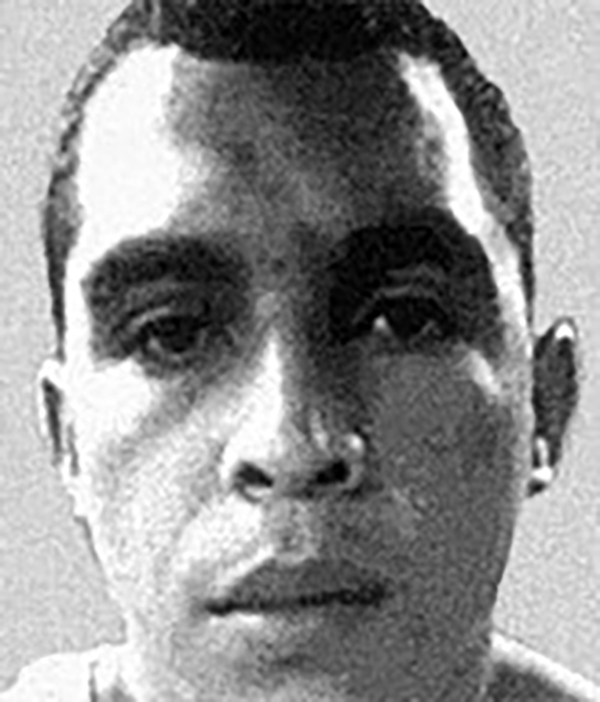
U.S. prosecutors have charged Héctor Rusthenford Guerrero Flores, the alleged leader of the Venezuelan gang Tren de Aragua, accusing him of masterminding a violent criminal enterprise responsible for murders, kidnappings, sex trafficking and the movement of massive cocaine shipments into the United States, according to a federal indictment unsealed this week.
Guerrero Flores — also known as “Niño Guerrero,” “El Cejón” and “El Innombrable” (the Unnameable) — is charged under U.S. racketeering laws with leading a transnational organization that prosecutors say operated across South America, Central America, the United States and Europe through a sustained campaign of violence, intimidation and organized crime.
According to the indictment in the Southern District of New York, Tren de Aragua members and associates expanded into new countries by illegally crossing borders and establishing control over vulnerable neighborhoods, where they used kidnappings, extortion, robberies and murders to dominate civilian populations and generate income.
Prosecutors say the gang engaged in a wide range of criminal activity, including drug trafficking, prostitution, sex trafficking, weapons trafficking and money laundering, with many of those crimes ordered or directed by Guerrero Flores from South America. He is accused of acting as the group’s leader or co-leader and serving as the central coordinator of its expansion across the Western Hemisphere.
The indictment describes the gang as an enterprise whose violent tactics allowed it to seize control of entire neighborhoods and apartment buildings in the United States. It alleges the group laundered criminal proceeds — including through cryptocurrency — and sent a portion of those funds to senior leaders, including Guerrero Flores.
U.S. authorities say Tren de Aragua established a presence in countries including Colombia, Peru, Chile, Brazil, Mexico and Spain, while also expanding into the United States, where members allegedly operate in states including New York, Colorado, New Mexico, Texas, Nebraska, Illinois and Florida.
As a result, prosecutors argue, the gang functioned as a national and international criminal organization whose activities regularly crossed borders and affected interstate and foreign commerce, placing it squarely within the reach of U.S. federal law.
The indictment says the gang has worked in concert with some of the world’s largest cocaine trafficking organizations, including Venezuela’s Cartel de los Soles. U.S. prosecutors have long accused the cartel of being headed by strongman Nicolás Maduro alongside other senior Venezuelan officials who corrupted state institutions to facilitate the flow of cocaine into the United States.
According to the indictment, traffickers linked to the Cartel of the Suns sought to “flood” the United States with cocaine and relied on corruption and violence — including kidnappings and murder — to protect shipments moving along maritime and air routes from Venezuela through Central America and Mexico.
Earlier this year, the Trump administration designated Tren de Aragua as a transnational criminal organization, citing the gang as a major threat to U.S. national security because of its violent activities, international reach and growing presence in the United States.
The whereabouts of Guerrero Flores are currently unknown.
Tren de Aragua emerged from a Venezuelan prison gang and expanded across Latin America and into the United States by exploiting migration flows. According to U.S. government sources, the group engages in drug trafficking, human smuggling and trafficking, extortion, kidnapping, money laundering, sexual exploitation and other violent crimes that directly impact American communities.
Under the Trump administration, the State Department designated the gang as a Foreign Terrorist Organization and a Specially Designated Global Terrorist entity, reflecting a view that its operations resemble those of insurgent or terrorist networks rather than a conventional street gang. Key leaders have been sanctioned and, in some cases, placed on the FBI’s Ten Most Wanted list, with multimillion-dollar rewards offered for information leading to their capture.
Administration officials argue that the gang’s tactics — including embedding within migrant populations, using migration routes to facilitate illegal entry and trafficking, and operating as a sophisticated criminal enterprise — pose a threat to U.S. border security, public safety and the rule of law. Domestic threat assessments cite concerns about gang members being apprehended nationwide and committing violent and organized crimes once inside the country.
The Trump White House has gone further in some proclamations, framing the group’s activities as an “invasion” and alleging ties to Venezuela’s narco-terror networks. Critics note that independent U.S. intelligence has questioned the extent of direct state control, but the administration has maintained the designation to justify aggressive enforcement and counter-trafficking measures.
Prosecutors allege Guerrero Flores worked directly with major cocaine traffickers to transport tons of cocaine produced in Colombia and Venezuela for eventual distribution in the United States. At times, he is accused of personally accompanying large shipments guarded by heavily armed teams carrying automatic weapons and grenades.
The indictment says Guerrero Flores was paid per kilogram transported or received ownership stakes in portions of shipments that involved thousands of kilograms at a time and occurred multiple times per month, resulting in hundreds of tons of cocaine entering the United States.
In addition to drug trafficking, Guerrero Flores is accused of selling firearms — including AK-47s, MP5s and AR-15–style rifles — to large-scale traffickers, who allegedly used the weapons to protect drug shipments.
Prosecutors say the gang’s U.S. operations were organized into regional cells, each with local leaders responsible for managing criminal activity, collecting money, ordering acts of violence and distributing proceeds to higher-ranking leaders across the Americas. Those leaders allegedly reported to senior gang figures and followed directives issued from abroad.
The indictment also details allegations of human smuggling and sex trafficking, including the trafficking of young women referred to by Tren de Aragua members as “multadas,” Spanish for “fined” or “fines paying.” Prosecutors say the women were smuggled from Venezuela into countries including Colombia, Peru and the United States and forced into commercial sex work to repay debts, with compliance enforced through threats, assault, kidnapping and murder.
Guerrero Flores is accused of directing and supporting acts of violence and terrorism across borders, including murders, kidnappings, extortion and maiming, against victims inside and outside the United States. For much of the past decade, prosecutors claim, he operated from Venezuela’s Tocorón prison, where authorities allowed him to control the facility’s day-to-day operations.
The charges include a racketeering conspiracy spanning at least from 2005 through 2025, with acts including murder, kidnapping, extortion, robbery, drug trafficking and conspiracy to commit violent crimes abroad.
_____
©2025 Miami Herald. Visit miamiherald.com. Distributed by Tribune Content Agency, LLC.






Comments