Is the death penalty legal in California? Capital punishment's complex history
Published in News & Features
The deaths of director Rob Reiner and his wife have drawn attention to California’s long and tangled history with the death penalty.
Reiner and Michele Singer Reiner were found dead of stab wounds Sunday at their Brentwood home.
Their son, Nick Reiner, 32, faces charges of two counts of murder. He could face life in prison or the death penalty if convicted, the Los Angeles Times said. No decision has been made on whether to seek the death penalty in the case, prosecutors said.
Reiner did not enter a plea at a court hearing Wednesday.
Here’s what to know about the death penalty in California:
Is the death penalty legal in California?
In 1977, the California Legislature reinstated the death penalty in the state for first-degree murder charges under a narrow set of circumstances, the Department of Corrections and Rehabilitation said. In November 1978, voters approved Proposition 7, which expanded those circumstances, according to a 1978 voting guide from the California Secretary of State.
The 1978 version of the law is what California currently operates under.
The death penalty can be imposed in convictions for first-degree murder with special circumstances, including torture or the conviction of first- or second-degree murder of more than one victim; military sabotage; trainwreck causing death; treason; perjury resulting in execution of an innocent person; and fatal assault by a prisoner serving a life sentence, the Death Penalty Information Center said.
In November 2012, voters rejected Proposition 34, which would have repealed the death penalty. California voters once again affirmed the death penalty in November 2016 by passing Proposition 66 and rejecting Proposition 62, which would have banned it.
How many people are on death row in California?
The state has 580 condemned prisoners, according to the Department of Corrections and Rehabilitation — 562 are men and 18 are women.
The inmates currently on death row the longest were added in 1979, the department said. There are four. Four more were added in 2025.
Are executions being carried out in California?
Gov. Gavin Newsom signed an executive order in March 2019 placing a moratorium on executions in California, the state Department of Corrections and Rehabilitation said.
The state’s death penalty laws still stand and defendants can still be sentenced to death, but no executions are being carried out, according to the Office of the State Public Defender.
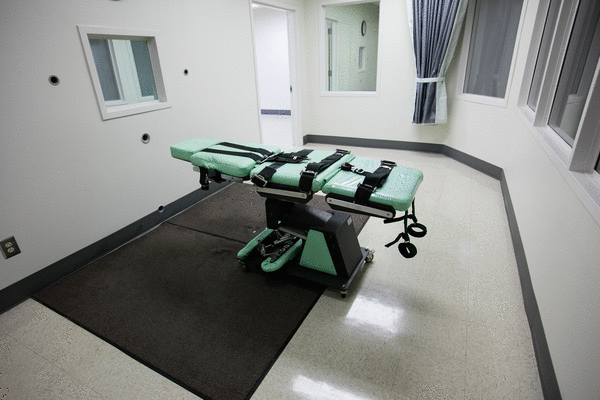
The order also withdrew the state’s lethal injection protocols and closed down the death chamber at San Quentin State Prison, the governor’s office said.
“The intentional killing of another person is wrong and as governor, I will not oversee the execution of any individual,” Newsom said at the time.
He said the penalty is unfairly applied, has resulted in the deaths of innocent people and has no public benefit.
When was the last execution in California?
The last person executed in California as of December 2025 was Clarence Ray Allen, 76, who was killed by lethal injection at San Quentin State Prison on Jan. 17, 2006, the Department of Corrections and Rehabilitation said.
Allen was convicted of three counts of first-degree murder after a robbery in Fresno.
What’s the history of the death penalty in California?
Legal executions were authorized in California in 1851 and added to the penal code in 1872, the state Department of Corrections and Rehabilitation said.
The first legal execution in California took place in 1893 at San Quentin State Prison.
In 1937, the state replaced hanging with lethal gas as the method of capital punishment.
In 1972, the California Supreme Court ruled the death penalty constituted cruel and unusual punishment, resentencing 107 condemned inmates to life without parole, the agency said.
The U.S. Supreme Court ruled in 1973 that the death penalty was being improperly applied in some states.
An amendment to the state constitution and legislation in 1972 and 1973 responded by making the death penalty mandatory in certain cases, but in 1976 the state Supreme Court ruled that such mandatory sentences were unconstitutional.
In 1977, the state legislature reinstated the death penalty.
The state began offering condemned prisoners a choice of lethal gas or lethal injection in 1993, and in 1994 the courts barred California from executing prisoners with cyanide gas.
Further court cases have challenged the state’s lethal injection protocols.
_____
©2025 The Sacramento Bee. Visit sacbee.com. Distributed by Tribune Content Agency, LLC.






Comments