Canada's fentanyl czar seeks Chinese help to stop precursors
Published in News & Features
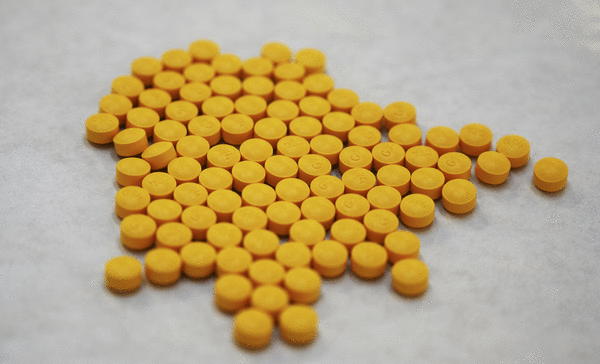
Canada wants to work more closely with China to stop the chemicals used to create the deadly synthetic opioid fentanyl from reaching North America, said Prime Minister Mark Carney’s point person for fighting the opioid crisis.
“We’re looking to collaborate with China, because it’s not an indictment against the Chinese government, per se,” Kevin Brosseau, the Canadian government’s fentanyl czar, said in an interview. “It’s companies, chemical companies in China, that are engaged in this kind of conduct — and the Chinese government has taken a lot of action in terms of regulating and prohibiting various precursors.”
U.S. President Donald Trump has used fentanyl trafficking to justify tariffs against Canada and Mexico, though that move is currently being challenged at the Supreme Court. Figures from U.S. Customs and Border Protection suggest that only small amounts of the deadly drug flow into the U.S. from Canada, but Brosseau was named by the government in February to lead a plan for stamping it out.
Carney is preparing to visit Chinese President Xi Jinping next year, part of his broader effort to mend ties with the world’s second-biggest economy. Both countries have imposed high tariffs on certain products from the other in a protracted trade fight.
“China has consistently and earnestly fulfilled its international obligations regarding drug control, carrying out extensive efforts to crack down on fentanyl-related crimes and strictly regulate precursor chemicals for fentanyl production,” the Chinese Foreign Ministry said in response to a request for comment on Tuesday.
“China will continue to comprehensively promote global governance of drug issues and is willing to engage in practical cooperation with all parties based on equality and mutual respect,” it added.
Brosseau said Canadian officials revived conversations about working with China to curb fentanyl around the time of his appointment. The government also launched a $944 million border plan that included new helicopters, drones, and surveillance towers.
That didn’t deter Trump from levying 25% emergency tariffs on Canada and Mexico with the accusation that “massive” amounts of fentanyl were coming over both U.S. land borders. The White House subsequently upped the base tariff on Canada to 35%, though most goods are exempt if they comply with the U.S.-Mexico-Canada Agreement.
Fentanyl seizures at or near the U.S. border with Canada averaged 3.5 pounds per month over the three-year period ended Oct. 31. Seizures of the same drug at or near the border with Mexico averaged a little more than 1,600 pounds a month.
That said, seizures of the drug in CBP’s northern border region spiked in April and May with a couple of unusually large interceptions. A so-called sprint by law enforcement agencies this year led to 386 kilograms (851 pounds) of fentanyl and 270 kilograms of precursors being seized within Canada — more than 10 times the amount that’s been caught by American agents at or near the U.S.-Canada border so far this year.
U.S. intelligence agencies have described China as “the primary source country for illicit fentanyl precursor chemicals” and pill-pressing equipment, followed by India. Brosseau said fentanyl precursors come from Asian countries but the drug itself is produced “largely” within North America.
Fentanyl for the U.S. is made domestically and in Mexico, and fentanyl for Canada is produced in Canada, he said. “There’s very little north-south movement of produced fentanyl across the borders,” he said. Supporting that theory is the fact that opioid overdose rates for Canada and the U.S. have fallen by similar percentages recently, he said.
Asked if he was aware of a target or threshold that would end the fentanyl emergency from the White House’s perspective, Brosseau said: “I’m not.”
Even if “there’s 0.01 of a pound or percent going across, my uber-focus — while I suppose to a degree aspirational — has been to lower that to zero, and to eliminate fentanyl the best as I can from a supply perspective, but also reduce demand in this country,” he said.
U.S. officials have expressed “strong acknowledgment of the efforts being made and encouragement to continue on this path” tackling fentanyl, if not necessarily “satisfaction,” Brosseau said.
U.S. officials want cooperation against joint targets, Brosseau said. He cited the recent example of the pursuit of Canadian former Olympic snowboarder Ryan Wedding, now accused by both countries of running one of the world’s biggest cocaine-trafficking operations. U.S. Attorney General Pam Bondi, Federal Bureau of Investigation Director Kash Patel and Royal Mounted Canadian Police Commissioner Michael Duheme appeared together at a November press conference increasing the reward for his capture.
Pressure for Canada to do more to fight drug trafficking isn’t only coming from the U.S. Brosseau met Group of Seven interior ministers in Ottawa recently, and European officials raised the concern that Canada “is either a transshipment point, or Canadian cannabis for instance, and/or meth is showing up in countries afar,” he said.
That echoes comments from Vancouver Fraser Port Authority CEO Peter Xotta, who said officials are discussing better inspections of outbound containers.
There are “methamphetamines and other things that have been caught, going particularly to Australia,” he said in an interview with Bloomberg News in November.
Carney has proposed two bills to expand border and security powers. The legislation would increase law enforcement access to data and to mail being transported by state-owned carrier Canada Post Corp. It would increase information sharing inside and between governments, ban precursor chemicals more quickly, as traffickers constantly tweak their recipes, boost money-laundering supervision and increase penalties, and restrict large cash payments for business.
Canada has also announced a new financial crime agency will be established in 2026. It’s intended to pull together the expertise to investigate money laundering, online fraud and other crimes.
On Monday, Trump signed an executive order to classify fentanyl as a “weapon of mass destruction,” after he used drug deaths and trafficking to justify attacks against boats in international waters that the Pentagon says were being used to smuggle drugs.
“We’ve got it down to a much lower number,” he said of the amount of fentanyl. “Not satisfactory, but it will be satisfactory soon.”
During the press conference, Trump mentioned Mexico, cartels, and China — which “is working with us very closely” to bring down fentanyl numbers. Canada was not mentioned.
____
(With assistance from Colum Murphy.)
©2025 Bloomberg L.P. Visit bloomberg.com. Distributed by Tribune Content Agency, LLC.





Comments