Reagan National airport safety looms as appropriations issue
Published in News & Features
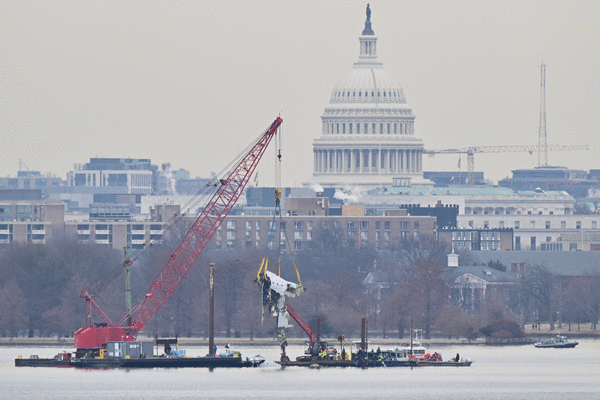
WASHINGTON — Senate Commerce Committee leaders vowed Monday to secure enactment of legislation to improve flight safety at Ronald Reagan Washington National Airport, and they said an appropriations measure next month could be a vehicle.
Chairman Ted Cruz, R-Texas, and ranking member Maria Cantwell, D-Wash., want Congress to delete a provision in the fiscal 2026 National Defense Authorization Act that they say would undermine safety at Reagan National airport, known as DCA.
They also want Congress to clear a bipartisan aviation safety bill, known as the ROTOR Act, which would require all aircraft near civilian airports to signal in real time their location to one another and to air traffic controllers.
It seems unlikely that they will achieve either of those goals on the NDAA itself, which the Senate plans to clear this week. But they appear poised to move to the next potential legislative vehicle: appropriations.
Most of the federal government is operating through Jan. 30 on a stopgap spending measure. To avoid another partial government shutdown, Congress must clear either another continuing resolution or new full-year funding bills.
Policy language is generally not allowed on spending bills, but lawmakers allow it if there is sufficient support.
“I’m seeking a vote on the ROTOR Act as part of any appropriations measure before the current continuing resolution expires at the end of next month,” Cruz told reporters Monday.
Cantwell said changing flight safety laws as part of the fiscal 2026 Transportation-HUD appropriations bill is another of several legislative options.
Cantwell suggested she is seeking not only enactment of the ROTOR Act but also elimination of the NDAA provision.
Standing next to Cruz and Cantwell were three family members of some of the 67 people killed near DCA in January when an Army helicopter and a descending jetliner collided in midair.
“No parent should have to go through this,” said a tearful Christina Stovall, mother of Michael Bret Stovall, one of the jet passengers who died.
15,000 near misses
Cruz said he spoke last week with White House officials about legislation affecting safety at Reagan National airport. And Cruz said Defense Secretary Pete Hegseth has said the Pentagon will not oppose the ROTOR Act.
But within the Defense Department, Cruz said, “there are career bureaucrats who are just reluctant to change anything.”
The immediate issue is whether military flights operating in airspace near civilian airports should be required to use the Automatic Dependent Surveillance-Broadcast system, a technology that transmits location data quickly between aircraft and air traffic control towers.
Between October 2021 and December 2024, there were 15,000 close calls between commercial aircraft and helicopters near DCA, the National Transportation Safety Board has said.
In 2019, the first Trump administration allowed a waiver from a requirement for military aircraft to use ADS-B Out, which transmits an aircraft’s location. The waiver permitted the military to turn off the system only in limited circumstances and for sensitive government flights.
However, Cantwell said, the Army has acknowledged that it has been exercising that waiver not only in limited circumstances but for “100 percent” of its helicopter flights around DCA.
Then came this past January’s deadly collision.
After that, the Trump administration implemented restrictions on nonessential government helicopter flights and barred military and civilian flights from occurring at the same time and space as commercial takeoffs and landings.
What’s more, the Pentagon and Federal Aviation Administration agreed after the January crash to require all military flights to use the ADS-B Out system when flying near DCA.
Armed Services input
The NDAA provision in question would require military training aircraft at DCA — but not other military flights, such as VIP transports — to use a safety system called the traffic alert and collision avoidance system, or TCAS. There is no requirement in the NDAA for ADS-B Out to be used by military aircraft at DCA.
But the TCAS system is not used at low altitudes below 900 feet — meaning altitudes used during take-off and landing — such as the 278 feet of altitude at which the January collision at DCA occurred, said Jennifer Homendy, the chair of the National Transportation Safety Board, in a letter to Armed Services leaders earlier this month.
“Simply stated, a requirement limited to TCAS-compatible warning systems would not ensure adequate safety for any aircraft in the DC airspace,” Homendy wrote.
The NDAA provision allows a waiver for use of TCAS, if a service secretary, in coordination with the Transportation Department secretary, determines that the waiver is in the U.S. national security interest and that a particular kind of risk assessment has been conducted.
But Homendy, in her letter, called the NDAA provision “a major step backwards from where we are today and an unacceptable risk to the flying public”
The ROTOR Act, by comparison, would require all aircraft in certain airspaces to use ADS-B In, which allows pilots to receive data on what is nearby. And it would narrow exceptions for military aircraft to fly without ADS-B Out, allowing it only for “sensitive government missions.”
The leaders of the Senate Armed Services Committee, in a Dec. 10 statement, expressed their commitment to aviation safety and said the NDAA would preserve it.
“In particular, we want to ensure military aircraft properly coordinate with civil aviation authorities in order to avoid another tragic accident like the one that took place on January 29th, 2025,” they wrote.
_____
©2025 CQ-Roll Call, Inc., All Rights Reserved. Visit cqrollcall.com. Distributed by Tribune Content Agency, LLC.




Comments