Henry Payne: King Porsche 911 Turbo S goes hybrid to keep its crown
Published in Business News
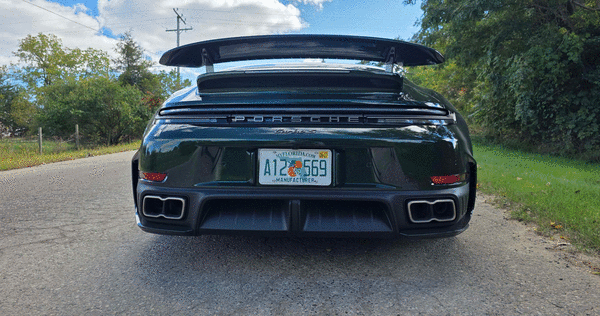
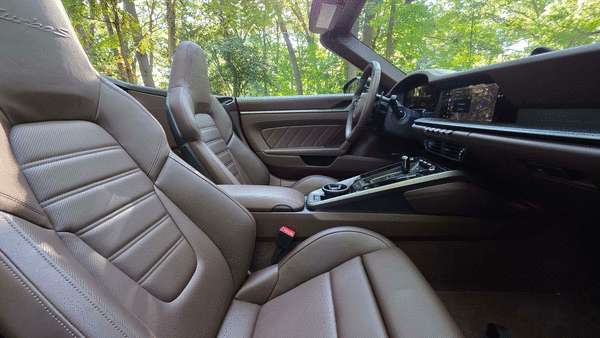
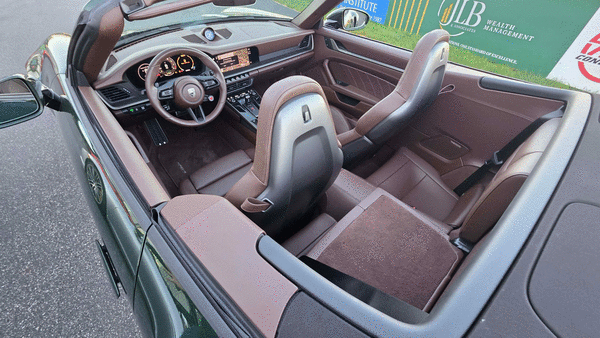
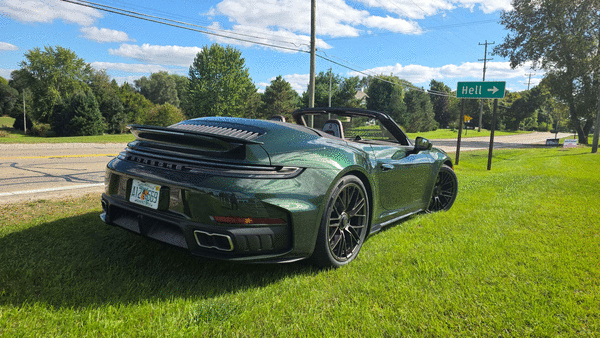
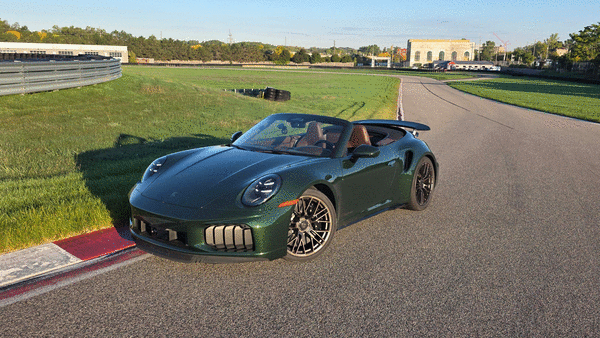
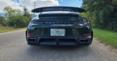
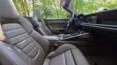
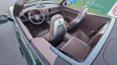
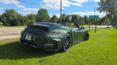
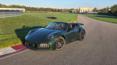
HELL, Michigan — Destroying Hell’s twisted roads then cruising topless through Ann Arbor to pick up lunch. Blitzing the back straight at M1 Concourse at 130 mph. Schlepping to the airport on adaptive cruise control in bumper-to-bumper traffic. Just a typical 24 hours in the King of Supercars, the 2026 Porsche 911 Turbo S.
But it’s not easy being king.
Setting the engineering standard for decades, the 911 model lineup is now under siege from competitors and governments alike. Half-the-price Motown missiles like the mid-engine Corvette C8 and Ford Mustang Dark Horse — armored with lightning-quick transmissions and eyeball-flattening launch control that the 911 made famous — are now playing in the six-figure supercar space along with international makes McLaren 750S, Aston Martin Vantage and Mercedes GT.
On the left flank is the European Union mandating electric vehicles by 2035 with a steady tightening of electrified regulations. The wailing, gas-drinking, flat-6-cylinder 911 engine can’t hide (even as it prays to the Archangel of Synthetic Fuels for rescue).
To beat back this horde of invaders, King Porsche has called on Stuttgart palace engineers to conjure the latest in electronic sorcery.
From its hybrid, 701-horsepower, twin-turbo, 3.6-liter powerplant (T-Hybrid in Porsche speak) to active aerodynamics to wireless Android Auto/Apple CarPlay, the 911 Turbo S is the state of the art. Sitting atop the ($137k-plus) 911 model lineup with a base price of $272,650, Turbo S is king of kings. But all that modernization comes at a cost of — not just megabucks — but of complexity and weight as my Turbo S Cabriolet tester tips the scales at over two tons.
This is one complicated fullback.
On an empty stretch of road in Hell, I dialed in SPORT mode on the steering wheel, matted the brake and accelerator pedals, then pressed the SPORT RESPONSE button optimizing the engine/turbo/gearbox team. Let go of the brake. Hold on tight.
GRRRR-WHOOOM! Sixty mph blew by in a retina-flattening 2.2 seconds, with 100 mph following just three seconds later (the Turbo S coupe model is even quicker at 2.0 seconds). In Pontiac, I hit 130 mph at the end of M1’s back straight, only the second car to achieve that in my experience along with the McLaren GT.
Our friends at Car and Driver clocked the 911 as the second-fastest (along with the 986-horsepower Ferrari SF90 Stradale hybrid) internal-combustion-engine car they have tested after the 1,250-horse Corvette ZR1X. That’s electric Tesla Model S Plaid and Lucid Air territory.
Credit a lithium-ion battery pack powering a transaxle-housed 80-horsepower electric motor for low-end torque and electric assist keeping the turbos spooled up inside the 3.6-liter flat-six. Sound complex? I’m just getting started.
M1’s back straight is punctuated by a long, difficult, 135-degree Turn 7. I stomped on the brakes and the Porsche threw out its boat anchor: massive 16.5-inch front/16.1-inch rear rotors paired with 10-inch front/13-inch rear Pirelli P-Zero summer tires. Again, I reference Car and Driver test stopping data: “(among) the best we've ever recorded.”
Outfit the Porsche with stickier Michelin Pilot Cup R ties and the braking force would bounce my eyeballs off the front window.
I rotated right into the corner apex with the help of rear-axle steering, electro-hydraulic active anti-roll-bars (officially, Porsche Dynamic Chassis Control or PDCC) and electro-assisted shock absorbers (Porsche Active Suspension Management or PASM) to react in milliseconds to body roll to keep the beast planted so I could access those 701 ponies as early as possible with my lead foot.
Back to power up blind Turn 8 headed to the moon. PDCC + PASM + HP = OMG.
It is an intoxicating combination of g-loads and stupid power, but it can’t erase the fundamental physics of weight: 4,008 pounds. Especially when you take the Turbo S on Hell’s narrow, bumpy roads. The Porsche is working hard — harder than the 3,206-pound, carbon-fiber-tub McLaren 750S I tested last summer.
Payne, you’re driving a convertible grand tourer, for goodness sake.
Well, yes and no. Porsche has made a droptop grand tourer — without sacrificing Porsche track capability and European emissions compliance. That requires a lot of engineering.
Pay $304,000 for my Turbo S tester (the droptop version starts at $286,650) and expect high service bills to follow. The electronics revolution Porsche is leading requires a lot of software, motors and modules. At a Metro Detroit exotics service center I visited, mechanics were replacing a Porsche motor for the front aerodynamic shutters that close at high speeds. The active front spoiler is controlled by pneumatic control module in the front trunk. The center-nut, 20-inch front/21-inch rear wheels? You’ll need the dealer to remove them with a torque wrench.
At Thermal Club race track in California three years ago, I tested the track-focused, normally-aspirated, 3,268-pound 911 GT3 RS. Club members prized the RS for its simplicity.
“The Porsches are fast, easy to maintain, bulletproof,” said one owner who estimated 60% of club member owned GT3s.
In satisfying performance, comfort and government nannies alike, the 911 Turbo S T-Hybrid is a different animal.
After setting Hell’s asphalt on fire, I navigated to Ann Arbor to pick up my favorite Reuben sandwich at Zingerman’s Deli. VROOM! The Porsche fired instantly using the electric motor to start rather than a conventional starter motor. Cool.
While my phone charged wirelessly inside the 911’s center console, the Porsche infotainment screen projected Google Maps using the Android Auto app. “Navigate to Zingerman’s Deli in Ann Arbor,” I barked. The directions appeared in the Porsche’s instrument display. Slick.
I set adaptive cruise control (a feature neither Corvette nor Dark Horse SC offer) to 75 mph using the left steering wheel stalk. Awesome.
While cool fall air tumbled through the cabin, I reached inside the lower steering wheel spoke and squeezed the heated steering wheel tab. Dude.
Ergonomics have come a long way since the days when Porsche harumphed at cupholders (the 911 now has four).
Rolling down Division Street in Ann Arbor under 30 mph, I toggled the roof switch and the soft top covered the cabin in just 12 seconds. I pulled into a Zingerman’s parking space.
Careful not to graze the front spoiler, I actuated the electro-hydraulic front-axle lift system to raise the front end over the curbed, bumpy brick street. I would need that spoiler for maximum downforce when I accompanied the king to M1 Concourse the next morning.
2026 Porsche 911 Turbo S Cabriolet
Vehicle type: Rear-engine, all-wheel-drive, two-passenger convertible supercar
Price: $286,650, including $2,350 destination fee ($304,000 as tested)
Powerplant: Twin-turbocharged, 3.6-liter flat-6 cylinder mated to electric motor and 1.9 kWh battery
Power: 701 horsepower, 590 pound-feet of torque
Transmission: 8-speed, dual-clutch automatic
Performance: 0-60 mph, 2.2 seconds (Car and Driver); top speed, 200 mph
Weight: 4,008 pounds
Fuel economy: EPA, 15 mpg city/22 highway/18 combined
Report card
Highs: Launch control from the gods; all-around supercar
Lows: Complicated systems; porky
Overall: 4 stars
____
©2026 www.detroitnews.com. Visit at detroitnews.com. Distributed by Tribune Content Agency, LLC.









Comments