Econometer: Does California need new cities?
Published in Business News
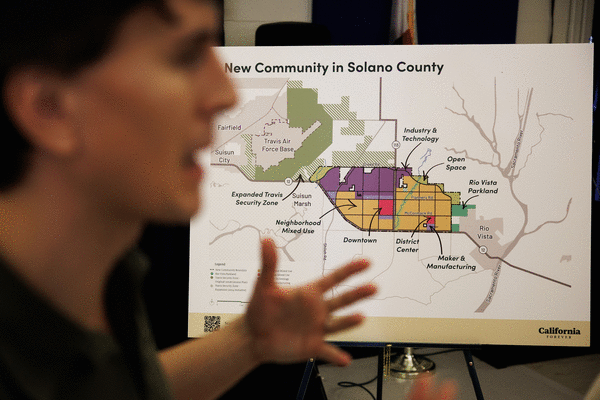
There are several proposals to build cities from scratch in California to address housing undersupply and also create new urban centers without being hampered by city holdups.
Silicon Valley moguls are attempting to build a city of 400,000 an hour north of San Francisco, and there is another proposal for a new urban center in Sonoma County on what was previously land zoned for a golf course and large single-family homes.
Several nations are in the process of building new cities, like Egypt and Saudi Arabia, but they often face criticism for wasting money or ignoring people still living in overpopulated capitals. Some criticisms of new city plans in California have been that they are too utopian and unrealistic.
Another factor at play is California’s population, which has largely plateaued and might experience declines because of stricter immigration policies and slowing birth rates.
Question: Does California need new cities?
Economists
Caroline Freund, UC San Diego School of Global Policy and Strategy
NO: If you build it, they probably won’t come. New cities are enormously costly to locate, design and build. They don’t succeed without jobs, housing, roads, electricity, schools, and tight public-private coordination. California already struggles to deliver major infrastructure projects on time and on budget. Instead of trying to pick winners, the state should focus on improving the investment climate to spur business formation and residential development.
David Ely, San Diego State University
YES: New cities can promote economic growth by expanding the state’s capacity to sustain new businesses and provide housing for a growing workforce. But for a new planned city to succeed, it must be feasible and affordable to build water, power and transportation infrastructure, and businesses must be willing to locate there. Given these challenges and risks, establishing a new city will be an infrequent event and not an easy solution to housing undersupply.
Ray Major, economist
NO: Forecasts clearly show that California’s population will decrease for a variety of factors in the coming decades. Investment into new cities at this time would be a bigger boondoggle than the high-speed rail project. Housing undersupply can be solved by reducing government regulations especially in suburban and rural areas. This would would allow existing cities throughout the state to grow and accommodate whatever housing shortage they may currently have.
Alan Gin, University of San Diego
YES: The biggest problem the state faces is the lack of affordable housing, particularly along the coast. There are structural problems with existing cities in trying to deal with this problem. One is that existing cities developed in the automobile era, which led to low-density, sprawling development with a lack of public transportation. The other problem is NIMBYism, where existing homeowners work against increased housing and housing density. New cities can be built around public transit with higher density, and NIMBYism wouldn’t be a problem.
James Hamilton, UC San Diego
YES: The leaders of San Francisco and Los Angeles have led these once-great cities on a path of inexorable decline. It’s hard to resist the optimism behind the vision of starting fresh from scratch. And I certainly welcome new approaches to build more affordable housing in California. I do not know if a new city will succeed, but I am not going to be the one to shoot someone down for trying.
Kelly Cunningham, San Diego Institute for Economic Research
NO: California already has hundreds of cities with infrastructure to support thousands of additional housing units, but apparently, it’s too politically difficult to allow it to happen. The state population plateauing and declining is a partial result of municipal governance preventing affordable housing being built. Building entirely new cities in less desirable geographic locations under the same dysfunctional conditions of overregulation, compounding costs, inefficient allocation of resources and land will likely have the same outcome. Utopian dreams are usually thwarted by reality.
Norm Miller, University of San Diego
YES: Given the extreme difficulty of adding density and inserting better transit systems into our existing urban districts, we are probably better off simply adding some holistically planned new cities like Irvine or Columbia, Md., for that matter. However, it is very difficult to finance and complete such a new city given the time required and the challenges of attracting industry and balancing land uses in a state with high taxes and overregulation of business.
Executives
Chris Van Gorder, Scripps Health
YES: This is an interesting question. If there are reasonable and safe areas to create and build new cities with industry, businesses, communities, schools and housing, why not? The decision to create new cities depends on being able to support them with utilities, water, energy, etc. But I’d rather see initiatives to grow than shrink if it is safe to do so.
Jamie Moraga, Franklin Revere
NO: California needs to focus on and strengthen the cities it already has. “California Forever” style projects ignore why people are leaving: Extreme housing costs, high taxes and an unfriendly business climate. With declining birth rates, strained water supplies and continued wildfire risk, converting needed agricultural land into utopian, high-density enclaves is shortsighted. Don’t build cookie cutter cities by tech billionaires. Instead, focus on making existing communities more affordable and better governed, with fewer stifling regulations.
Phil Blair, Manpower
NO: As nice as it would be, the obstacles seem insurmountable. Even if enough land could be purchased and combined for development, the core aspect of companies agreeing to move their headquarters and/or production to the new area in an isolated part of the state would be a huge challenge. The concept does not work without thousands of jobs being relocated in the same area as thousands of new houses, and all the auxiliary support services of retail and more being built in California in our litigious state seems a dream.
Gary London, London Moeder Advisors
YES: In our quest to add housing, the policy bias is to encourage infill housing within neighborhoods. But that’s insufficient. While building entire “new cities” is too much of a leap, an achievable approach is to develop master planned communities on the edges of metropolitan areas like San Diego. We cannot hope to supply to the demand without tapping into the green fields, controlled by unincorporated county government. Whatever the nomenclature, that must be the emphasis.
Bob Rauch, R.A. Rauch & Associates
NO: California doesn’t need new cities, but it needs its existing cities to act like new ones. We need to build housing at scale, streamline permitting, embrace density near jobs, and modernize infrastructure rather than defend outdated, small‑town zoning. The state’s real constraint isn’t land; it’s political incompetence and local veto power. Fix that, and California unlocks the equivalent of multiple new cities without pouring a single new foundation.
Austin Neudecker, Weave Growth
YES: California could use new urban centers to expand into, but only if they are pragmatic, not utopian. Chronic housing undersupply is primarily due to self-imposed constraints: zoning, process, and local veto points. A new city could bypass those frictions and experiment with denser, transit-oriented models at scale. That said, with population growth flattening, such cities must prove economic viability, integrate with regional labor markets, and deliver housing quickly or risk becoming expensive planning fantasies rather than solutions.
©2026 The San Diego Union-Tribune. Visit sandiegouniontribune.com. Distributed by Tribune Content Agency, LLC.










Comments