Alaska Airlines still 'proudly Boeing,' now with Airbus in its fleet
Published in Business News
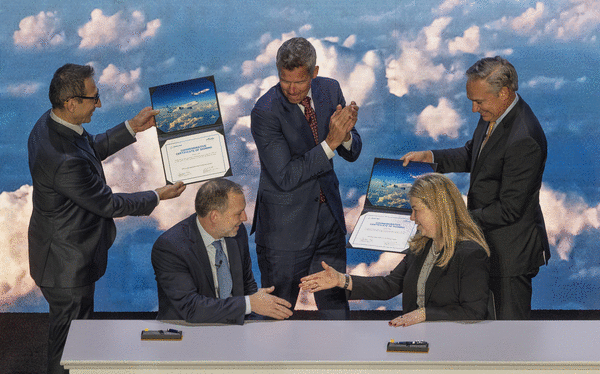

Alaska Airlines ordered more than 100 Boeing planes Wednesday, the largest order in the airline’s history and a commitment to the Seattle-based manufacturer even as Alaska moves away from being “proudly all Boeing.”
Alaska had for years operated an entirely Boeing fleet, until last year when it acquired Hawaiian Airlines and, with it, a fleet of planes from Boeing’s European rival Airbus. Alaska executives have said the carrier will likely keep the Airbus planes, particularly the widebody aircraft that can travel farther than Alaska’s 737 Max fleet.
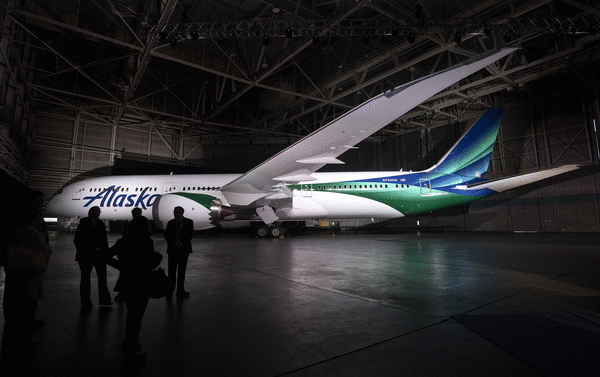
At an event Wednesday to celebrate the large order and introduce the first 787 painted with a new livery, Alaska displayed a new logo to replace its now out-of-date tagline: “Proudly Boeing.”
Kelly Ortberg, the aircraft manufacturer’s CEO, said Wednesday the announcement was “more than an order.
This is a doubling down on (Alaska’s) commitment to Boeing,” Ortberg said.
In turn, Ortberg continued, Boeing knows it must “deliver high-quality airplanes.” He thanked Boeing employees and said their “focus on safety and quality, particularly in the last 18 months, has been critical.”
That sentiment is particularly meaningful for Alaska, which was thrust into a turbulent year in 2024 when a panel flew off one of its 737 Max planes midair. Accident investigators determined Boeing delivered the plane to Alaska without four bolts properly installed to hold the panel in place. Boeing mechanics in Renton had installed the piece incorrectly after removing it for maintenance.
“We have an opportunity here to perform,” Ortberg said Wednesday. “This is going to be a big year for all of us.”
Alaska CEO Ben Minicucci said Wednesday’s order was a “historic day” for the carrier and that Alaska was ready to compete with the nation’s other large airlines.
Alaska is currently the fifth largest airline in the U.S., behind Delta, American, Southwest and United. Alaska partners with American through the oneWorld alliance.
At Wednesday’s event, Minicucci said, “with this order, with this gorgeous airplane behind me, we are going to compete against the big three and we’re going to win.”
Alaska’s order includes 105 narrowbody 737 Max 10s and five widebody 787-10s. It also includes the option for an additional 35 737s down the line.
The narrowbody planes will act as Alaska’s “backbone” for its domestic network, flying transcontinental routes and to Hawaiʻi and Alaska, Minicucci said. The widebody aircraft will help Alaska achieve its intercontinental ambitions.
On Wednesday, Alaska also introduced the first 787 painted in Alaska’s new global livery. The design is inspired by the aurora borealis, with a palette of midnight blues and emerald greens and flowing aura lines, Alaska said. It expects to feature the new design on its entire 787 fleet by the spring.
While updating the 787 design, the livery on Alaska’s other planes will remain the same, including the Alaska Native on the airline’s narrowbody planes and Pualani on Hawaiian Airlines’ aircraft.
Capitalizing on its acquisition of Hawaiian Airlines and new fleet of widebody aircraft, Alaska set out last year to turn its Seattle hub into a “global gateway,” with plans to offer 12 new long-haul international routes from Seattle by 2030. So far, it has announced five of those routes, launching nonstop flights to Seoul, South Korea, and Tokyo-Narita in 2025 and London, Rome and Reykjavik, Iceland, in 2026.
The new order will bring Alaska’s 787 widebody fleet to 17, with five already in operation. Following the Hawaiian acquisition, the airline also has 24 Airbus A330s.
Alaska currently operates 248 737 narrowbody planes and, with the announcement Wednesday, now has 174 Max planes on order. Some of the new Max planes will replace Alaska’s existing fleet, while others will grow the carrier’s total aircraft count.
Alaska Air Group, which includes Alaska Airlines, Hawaiian Airlines, regional carrier Horizon Air and ground support company McGee Air Services, currently has a fleet of 413 aircraft. The new order will bring its fleet to 475 planes by 2030 and 550 by 2035.
The 737 Max 10s Alaska ordered have not yet been certified to carry passengers by the Federal Aviation Administration. The new Max variant, which will be larger than the Max planes flying today, has been delayed for years as Boeing worked to address an issue with the engine anti-ice system and navigates a strict regulatory process.
Boeing expects the Max 10 and another variant, the Max 7, will be certified this year.
Alaska’s order allows the airline to switch to a different Max model “if necessary,” the carrier said in a news release.
But Alaska executives said Wednesday they were confident Boeing would get the plane certified this year. The company expects the first delivery of its new 737 Max 10s in 2027 and 787-10s in 2028.
U.S. Transportation Secretary Sean Duffy, who attended Wednesday’s event, said the deal signaled strong leadership at both Boeing and Alaska.
He pointed specifically to Ortberg, telling attendees that not too long ago, some in the aerospace industry were asking what would come next for Boeing after a tumultuous few years that included two fatal Max crashes and a nearly catastrophic panel blowout. Ortberg answered that question, Duffy said.
Of Alaska, Duffy said, “you don’t have these kinds of deals done unless you have really well-run airlines.”
©2026 The Seattle Times. Visit seattletimes.com. Distributed by Tribune Content Agency, LLC.










Comments