Pa. hemp industry buffeted by lack of framework and controversial new rules
Published in Business News
HARRISBURG, Pennsylvania — When the federal government gave hemp-growing the green light in 2018, Josh Bobbert almost literally bet the farm on the crop, figuring the versatile plant was going to be a moneymaker for himself, his wife, and nine children.
Since then, though, devoting a lot of his 61-acre family farm in Lawrence County, Pennsylvania, to hemp hasn't generated the revenue he anticipated. Government, Mr. Bobbert and others say, never created the sort of regulations needed for a stable industry built around a hardy plant that is — in genetic terms — a first cousin to marijuana.
"They never followed up to provide a legal framework and dosages and things like that," Mr. Bobbert said. "Nobody has set safety limits and standards."
Next month, the feeling-out process for possibly creating a framework will play out for a few hours in Harrisburg when the Center for Rural Pennsylvania holds a hearing about the hemp industry. One topic sure to get attention is a recent action that government actually did take — language was put into a federal appropriations bill that that some fear could decimate the industry.
There is "frustration in the business community about how this all unfolded, without giving farmers and the business community time to respond," according to the executive director of the center, Zachary Adams.
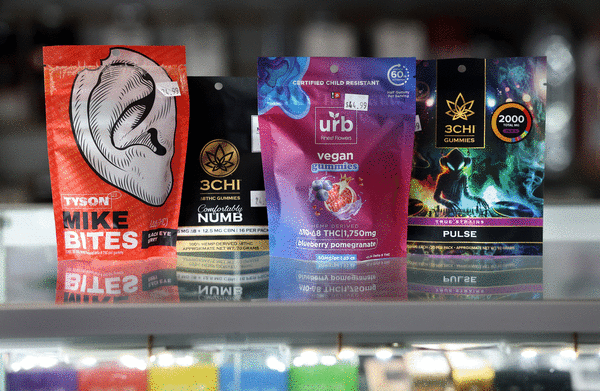
After hemp growing became legal in 2018, a vast array of new THC-containing products began to appear with no testing and no regulatory framework. In the words of Republican Sen. Gene Yaw of Lycoming County, what happened in the years after 2018 was that "people found a way to tinker with the plant and raise the THC."
The result, Mr. Yaw said, was that a federal bill intended to help farmers instead boosted hemp from a $5 billion-a-year industry to a $30 billion industry, with much of the surge coming from new and untested products with significant THC levels. It became a "wild West" with no product regulations, said Mr. Yaw, who is chairman of the Center for Rural Pennsylvania board.
The just-passed federal law was intended to quash that part of the business, but instead it may quash the whole industry, according to Beaver County hemp grower Kevin Lusky.
"They only needed a scalpel to fix one or two things, but they took a machete and cut everything off," Mr. Lusky said.
Hemp has been used by humans for centuries, and the diversity of those uses is vast. They include paper products, molded plastics, construction materials, body care products, and what are known as CBD extracts.
Its legal growing in the U.S. ended for many decades after World War II when both hemp and marijuana became regulated. In 2018, though, the U.S. farm bill removed hemp from the definition of marijuana in the Controlled Substances Act.
Growing hemp was legal, but government registration was required. For 2025, the state Department of Agriculture has issued 165 hemp growing permits and 34 hemp processing permits.
Seven years after the start of the new growing era, advocates believe it still has the potential to be a huge agricultural winner. Republican Rep. Russ Diamond of Lebanon County, who has introduced multiple hemp bills, said it has big upside potential if lawmakers are willing to work hard to create the appropriate framework.
Another Republican, Rep. Dan Moul of Adams County, minority chairman of the House Agriculture & Rural Affairs Committee, said "a lot of oversight" could convert Pennsylvania into a major hub.
"Hemp could be a savior for a lot of small farms," Mr. Moul said.
The hearing on the industry is scheduled for Jan. 15 in Harrisburg during the Pennsylvania Farm Show. Testimony is anticipated from the state departments of Agriculture and Health, hemp farmers, and business interests.
Among them will be Jake Sitler, a hemp business owner and founder of the Pennsylvania Hemp and Cannabis Guild. What government needs to do, he said, is perform a balancing act.
"There need to be directions and guard rails so we can operate cleanly and safely," Mr. Sitler said. "But we don't want to be over-regulated, at the same time."
For years, Mr. Sitler worked to get hemp industry regulations approved in Harrisburg. The lack of action by lawmakers, he said, has convinced him to take a new approach: lobby for hemp industry regulations in tandem with advocacy for approval of recreational marijuana.
Mr. Lusky and his father, Randy, grow hemp in two small fields that cover about one-eighth of an acre each. They till with a tractor but a lot of the work is done by hand, and their products include hemp animal bedding — hemp has strong anti-microbial qualities — and animal feed that is high in protein and fat.
The recent twists and turns, Mr. Lusky said, have left him uncertain "if it is worth it for me to grow next year."
Mr. Bobbert lost 250 hemp plants this season to flooding that had nothing to do with government actions. Nonetheless, he said, government needs to act.
He said, "There is no support for the farmer or producer."
©2025 PG Publishing Co. Visit at post-gazette.com. Distributed by Tribune Content Agency, LLC.








Comments