Ford to redeploy EV unit plants for gas, hybrid and energy storage products
Published in Business News
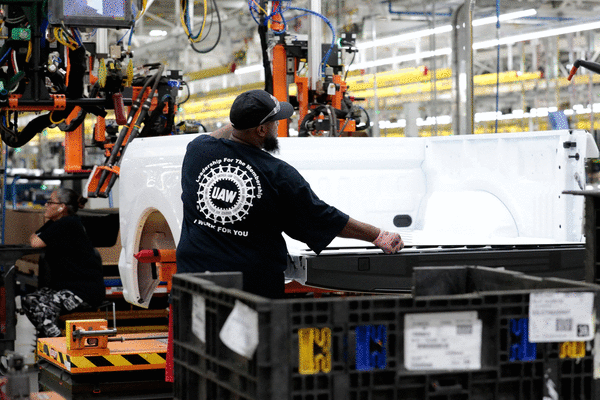
In a major move away from electric vehicles, Ford Motor Co. will take a majority of $19.5 billion in special charges in the fourth quarter of 2025 as it restructures its Model e division to be profitable by 2029 and reutilizes EV plants for other applications.
The Dearborn, Michigan, automaker will focus on higher-return products and businesses. It has ended production of the all-electric F-150 Lightning pickup and will launch in Dearborn a fully battery-powered version with a gasoline engine generator onboard as a next-generation model. It's also adding U.S.-built gas-powered and hybrid trucks and vans to its lineup, starting a battery energy storage business, and nixing plans for a full-size electric truck and commercial van because of poor demand, high costs and regulatory changes.
"Ford is following the customer," said Andrew Frick, president of Model e and the Ford Blue gas and hybrid division, during a conference call Monday on the announcement. "We are looking at the market as it is today, not just as everyone predicted it to be five years ago. The American consumer is speaking clearly, and they want the benefits of electrification, like instant torque and mobile power, but they also demand affordability, range confidence, vehicles that match their duty cycle and the freedom to choose the powertrain that fits their life and their work."
Ford also confirmed an agreement to dissolve its joint venture with South Korean battery partner SK On and have a wholly owned Ford subsidiary take over two battery plants in Kentucky. That will result in layoff notices to the 1,600 workers at the Kentucky 1 plant, though they will have the opportunity to apply for the 2,100 jobs there that Ford will have after transitioning the plant to build energy storage systems with licensed technology from China's Contemporary Amperex Technology Co. Ltd.
In the first nine months of the year, Ford's Model e EV division lost almost $3.6 billion in operating earnings. The company forecasts annual improvements starting in 2026. The special item charges will extend into next year and 2027. Ford expects approximately $5.5 billion in cash effects, with the majority paid in 2026 and the remainder in 2027.
Ford shares were trading up less than 1% to $13.78 in after-market trading following the restructuring announcement.
Despite the charges, Ford raised its 2025 adjusted operating earnings guidance to about $7 billion, citing continued underlying business strength and cost improvements. That was up from $6 billion to $6.5 billion it stated in November after a fire at an aluminum supplier plant affected truck production. Ford added that its free cash flow is trending to the high end of its previously stated $2 billion to $3 billion projection.
Under its plans, Ford expects approximately 50% of its global volume will be hybrids, extended-range EVs and fully electric vehicles by 2030, up from 17% in 2025. Nearly every vehicle will have a hybrid or multi-energy powertrain choice by the end of the decade. Ford will launch five new affordable vehicles by then, four of which will be U.S.-assembled.
The 50% goal is "easy," said Sam Abuelsamid, vice president of market research for automotive communications firm the Telemetry Agency. "Where the trend with hybrids and EREVs are going globally, 50% is natural."
Ford has scrapped an all-electric commercial van slated for Ohio and a full-size electric truck in Tennessee. Instead, Ohio Assembly Plant in Avon Lake will build a new affordable commercial van with gas and hybrid models alongside Super Duty chassis cabs starting in 2029, a year after the electric van was supposed to launch. Ohio Assembly employs 1,700 people, and Ford didn't have an updated hiring number.
The Tennessee Electric Vehicle Center in Stanton, outside Memphis, will be renamed the Tennessee Truck Plant. The facility will produce an all-new, gas-powered, affordable truck with production starting in 2029, also a year after the electric truck was slated to launch. The plant was a part of a $5.6 billion investment for BlueOval City that also included a battery plant that SK On will retain after the end of the joint venture. Ford is expecting 2,300 jobs there initially, though it plans eventually to fully utilize the facility.
BlueOval Battery Park in Glendale, Kentucky, was a $5.8 billion investment by the BlueOval SK joint venture. Under Ford's full ownership and without SK On as a partner, it will invest $2 billion in the next two years to produce lithium-iron-phosphate prismatic battery cells in Kentucky 1, all for energy storage purposes for data centers, utilities and other commercial customers. It'll also make more than 5 megawatt-hour energy storage systems, including their modules, and 20-foot DC container systems.
Production is expected to begin within 18 months. Ford expects to deploy at least 20 gigawatt-hours annually by late 2027.
"The technology of choice for most of these customers was an LFP prismatic type of container system," said Lisa Drake, vice president of technology platform programs and EV systems, on the call. "And given the fact that we already had a license to build that technology in the U.S., you couple that with our over-a-century of high-scale manufacturing, it just made a lot of sense as a natural adjacency for us."
Especially with the discontinuation of the Lightning, Abuelsamid said, Ford doesn't have much use for nickel-manganese-cobalt batteries that it was making with SK On in Tennessee.
The BlueOval Battery Park in south-central Michigan's Marshall will produce smaller Amp-hour cells for use in residential energy storage solutions. But it also remains on track to produce LFP prismatic battery cells in 2026 to power Ford’s $30,000 midsize electric truck arriving in 2027, the first model on its new Universal EV Platform that will underpin its EV launch strategy focused on affordable models. The company declined to provide a capacity breakdown for energy storage and automotive production in Marshall.
"We really think that we have a good understanding of how we should position our large trucks and SUVs, matching the demands for their capability towing in range," Frick said. "But the Universal Electric Vehicle Platform, that's where a lot of our scaling and our growth will come from. It's competing in the heart of the affordable segment."
Ford ended production this month of the Lightning at the Rouge Electric Vehicle Center, transferring hourly employees to Dearborn Truck to prioritize gas-powered and hybrid F-150s following multiple fires this fall at a Novelis Inc. aluminum plant in New York. It'll hire a new third crew of 1,200 employees at Dearborn Truck in 2026 to make up for lost production.
Ford said details on the next-generation F-150 Lightning EREV, or extended-range electric vehicle, and when it will launch at the Rouge EV center, will be shared later. The truck, however, will have a sub-5-second acceleration, be able to tow, and add an estimated more than 700 miles of range, with a typical customer able to drive nine days on electricity alone, Frick said.
Model e asset impairment and program write-downs will total $8.5 billion in 2025. The joint venture disposition will be $3 billion this year and $3 billion in 2026 and 2027. Additional program-related expenses total $1 billion in 2025 and $4 billion in the following two years.
"What's really important about our timing right now ... is this gives us the ability to redeploy future cash against these new products that we're very excited (for)," Chief Financial Officer Sherry House said on the call. "They're higher growth, higher profitability, and it's moving into areas of our business — trucks and vans — where Ford excels."
Ford also reconfirmed its commitment to be carbon neutral by 2050. The automaker last year also canceled an electric three-row SUV program slated for Canada, writing off as much as $1.9 billion.
Ford last week announced a partnership with French rival Renault SA for EVs in Europe and said it would explore commercial vehicle collaboration. The company said Monday it no longer intends to produce a previously planned new electric commercial van for Europe.
Ford's EV sales were down year-over-year by almost 25% in October and more than 60% in November after an up-to $7,500 federal plug-in credit expired. That was part of President Donald Trump's agenda to repeal what he described as an "EV mandate" on the U.S. consumer.
His administration has also made efforts to rescind a legal finding that allows the Environmental Protection Agency to regulate greenhouse gas tailpipe emissions, revoke California's waiver to set stricter emissions standards that close to a dozen states had adopted, and roll back fleet fuel economy requirements. That paves the way for the sale of more gas- and diesel-powered vehicle sales, prompting companies like General Motors Co. and Chrysler parent Stellantis NV to continue to invest in engine production.
General Motors Co. also divested from its battery plant with LG Energy Solution in Lansing to prioritize profitability and capital efficiency. It has said it plans to launch plug-in hybrids in North America in 2027. Additionally, it's discontinued electric commercial vans built in Canada and cut shifts at its EV plant in Detroit and Hamtramck. Meanwhile, Stellantis NV has nixed plans for the electric Ram 1500 REV pickup, though it expects to launch an EREV model next year.
©2025 www.detroitnews.com. Visit at detroitnews.com. Distributed by Tribune Content Agency, LLC.










Comments